
How Dr. Blake C. Scott turned a pandemic evacuation into Charleston's first urban ecological corridor
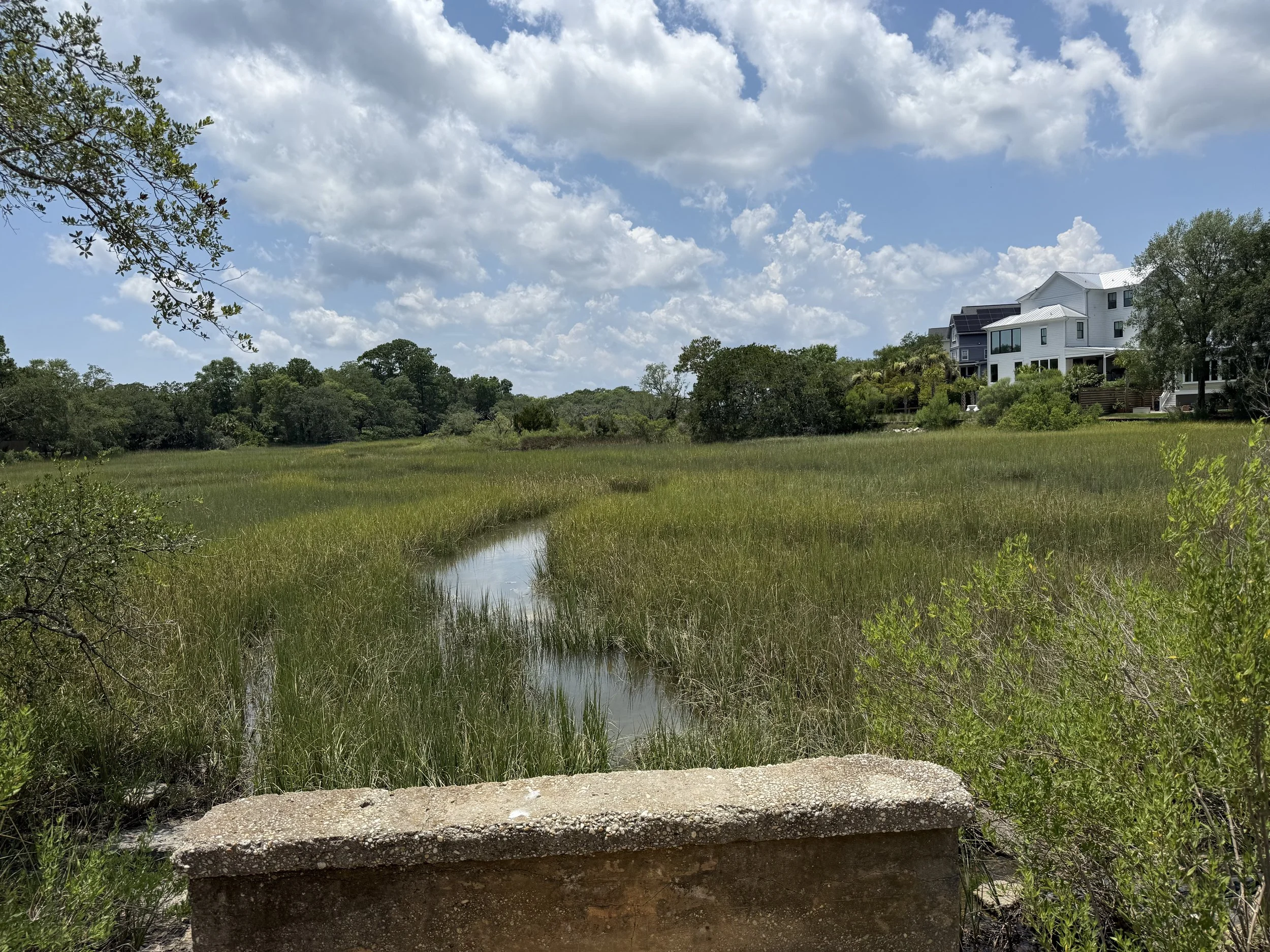
Halsey Creek Marsh Photo: Denny Frazier
Based in part on an interview with Dr. Blake C. Scott, July 7, 2026
In early 2020, Dr. Blake C. Scott was in Havana, Cuba, doing what he does best: teaching students to see a landscape through the lens of human experience of inter-American relations over time – from the age of revolutions in the late eighteenth century through the Cold War and rebellions of the 20th century to modern ecotourism.
His study-abroad course, "U.S.-Latin American Relations," run through the Centro de Estudios Martianos, was built on the principles of environmental pedagogy — the idea that the most powerful education happens not in a classroom but in a place where history, ecology, and human experience are woven together in the ground beneath your feet. In Havana, that meant walking students through a country transformed by a century of U.S. intervention, medical campaigns, tourism infrastructure, and political tension, and asking them to feel how all of that history lived in the landscape around them.
Then COVID-19 arrived.
The College of Charleston made the call quickly: evacuate. Students were at risk. The program was suspended. Scott and his class flew home to Charleston — abruptly, mid-semester, mid-thought — carrying the unfinished work of a course designed around the irreplaceable experience of being somewhere specific.
"When we were evacuated, I started looking for a local project that could apply the same principles I had been teaching in Cuba." — Dr. Blake C. Scott, July 2026
He didn't have to look far. The answer was, quite literally, in his backyard.
The Neighborhood Creek
Scott had grown up in Florida, where the marsh was simply part of the air — something you didn't think about because it was always there. That early sensory education never left him. When he and his family settled in Charleston's Wagener Terrace neighborhood, the tidal creek running along its edge felt like home.
But Halsey Creek, he soon realized, was a creek in trouble. Development had choked its banks. Trash accumulated in its mud. The ecological work the marsh had always done quietly — filtering water, absorbing storm surge, sheltering juvenile fish and nesting birds — was degrading, almost invisibly, the way things degrade when no one is watching.
What the creek needed, Scott believed, was for people to know it. Not know it abstractly, as a feature on a map or a line item in a stormwater report — but know it the way you know a neighbor: its history, its struggles, what it has survived.
He went to the archives.
What the Creek Had Witnessed
Working with the Preservation Society of Charleston and Special Collections at College of Charleston's Addlestone Library — and drawing on what he now calls the research approach he had practiced abroad — Scott spent months reconstructing the story of Gibbs Landing and Halsey Creek. What emerged was not just local history. It was a chronicle of everything a single stretch of tidal water had witnessed across four centuries.
The land that is now Wagener Terrace was originally home to the Kiawah people of the Cusabo Nation. When English colonists founded Charles Towne Landing in 1670 just across the Ashley River, the Kiawah were among the first to feel the consequences. Within 40 years, they had been forcibly removed. By 1769, the land had become the Gibbes family's Grove Plantation — 232 acres along the east bank of the Ashley, worked by enslaved people whose labor built the wealth that built the neighborhood.
During the American Revolution, British forces used the site as a staging ground during the Siege of Charleston. After the war, Denmark Vesey — who would later organize one of the largest planned slave revolts in American history — may have lived on the property before purchasing his own freedom in 1800. The Washington Race Course was later built on the land. The Confederacy turned it into a prison camp for Union soldiers during the Civil War. When the war ended, Black Charlestonians gathered there and conducted one of the first Memorial Day ceremonies in American history, reburying Union dead with dignity.
In the early twentieth century, the land hosted a major exposition attended by Mark Twain and President Theodore Roosevelt before becoming one of Charleston's first suburbs — home first to Jewish, Greek, and Italian immigrants, and later to middle- and upper-class African American families following the Civil Rights Movement.
Through all of it, Halsey Creek kept running. The same water that bordered a Kiawah village bordered a plantation, a racetrack, a prison camp, a ceremony of remembrance, and a suburb. It has been there the entire time.
"If you want people to care for and love and restore the marshes, you've got to tell their story." — Dr. Blake C. Scott
Canvassing the Neighborhood
With the historical research in hand, Scott did something that was, in its way, a direct extension of what he had been doing in Cuba: he took his students out of the building and into the community.
He and his class began canvassing Wagener Terrace, knocking on doors, asking neighbors a simple question — Did you know the history of this creek?
Almost no one did.
That discovery was, paradoxically, the project's first success. Because what happened when neighbors heard the story was immediate and visible: they felt something shift. The creek they had walked past without thinking became a creek they had a relationship with — one that ran through history they hadn't known was theirs. The connection deepened not despite the lack of prior awareness, but because of the surprise of discovery. Learning something true and remarkable about your own backyard changes how your backyard looks to you.
This is the mechanism at the heart of environmental pedagogy. The North American Association for Environmental Education (NAAEE) defines the goal not as transmitting information but as cultivating genuine connection to place — the kind of connection that produces stewardship, advocacy, and the willingness to show up and do the hard work of restoration. Scott had used this approach to teach students about the Caribbean from within the Caribbean. Now he was applying it one block at a time in his own neighborhood.
The Flyer That Started a Movement
By 2022, the canvassing had done its work. Wagener Terrace knew its creek. It knew what had happened there, and it had at least begun to understand what was happening to it now.
Blake Suárez — Scott's neighbor, a graphic designer, and one of the project's eventual co-founders — designed a flyer. It announced a cleanup event at Halsey Creek. It was simple. It was community-scaled. And it was deliberately designed to be accessible in the particular way that mattered most in the spring of 2022: it was socially distanced.
Fifty people showed up.
In the context of a world still learning to gather again after two years of COVID, that number was remarkable. These were not environmental professionals or trained conservationists. They were neighbors — people from the next block, from the apartment building on the corner, from the house with the kids who always played in the yard. They came because someone had told them the story of the place where they lived, and the story had mattered enough to bring them outside.
That day became the foundation of the M.A.R.S.H. Project. What Scott and his co-founders — Caldwell, an environmental journalist and photographer, and Suárez — had done was prove a thesis: that a community which knows its landscape will act to protect it, and that joy and connection are legitimate, essential conservation tools.
The acronym they chose was not accidental. The Marsh Appreciation and Restoration Society for Happiness. The happiness was the point.
From Cleanup to Corridor
By April 2023, the M.A.R.S.H. Project had become a formal program of the Carolina Ocean Alliance, a Charleston-based 501(c)3. The programming expanded: debris cleanups in collaboration with Charleston Waterkeeper, Keep Charleston Beautiful, and the Sustainability Institute; native plant restoration using Spartina grass, Muhly grass, seaside goldenrod, and a dozen other tidal species; citizen science water quality monitoring; guided marsh walks; oral history projects; art programs; book clubs; and College of Charleston student internships that returned the whole project to its academic roots.
In June 2024, the community gathered at Halsey Creek to dedicate cast-aluminum interpretive plaques — formalizing, in permanent form, the story Scott had spent years telling door to door.
But the vision had grown beyond Halsey Creek. Through a formal partnership with the American Geophysical Union's Thriving Earth Exchange, the M.A.R.S.H. Project is now pursuing the "Just" Eco-Corridor: a connected network of restored tidal creeks, native plant buffers, rain gardens, and ecological green spaces threading across Charleston's entire peninsula — Gadsden Creek to Halsey Creek to Newmarket Creek. If realized, it will be the first urban ecological corridor of its kind in the American Southeast.
The "just" in the corridor's name is deliberate. The project is explicitly designed to ensure that the ecological benefits — cleaner water, flood protection, wildlife habitat, pedestrian access, green space — reach all of Charleston's neighborhoods, including those historically denied them.
At Newmarket Creek, that vision is already becoming infrastructure. The city is pursuing a $1 million National Fish and Wildlife Foundation grant, matched with $500,000 in local funds, for the Newmarket Creek Headwaters Project — a combined flood prevention and public park initiative that would restore salt marsh habitat for 27 local fish species, recover native vegetation, and create a new pedestrian corridor along the peninsula's east side. The Newmarket basin already has $50 million in planned drainage improvements on the city's capital docket. Bids for restoration work were published in May 2026.
The Unfinished Semester
There is something worth understanding about the origin of all this.
In early 2020, a professor and his students were evacuated from a foreign country mid-course — their classroom, literally, taken from them. The lesson they had been building, about how landscapes absorb and express the forces of history, about how people and places shape each other across generations, was left unfinished in Havana.
Scott came home and found a marsh at the end of his street.
He went to the archives, learned its story, knocked on doors, got his neighbors to listen, watched a graphic designer print a flyer, and then stood at the edge of Halsey Creek on a spring morning in 2022 while fifty people — strangers to each other, neighbors to the water — passed oyster shell bags toward the mud.
The semester, it turns out, was never interrupted. It just moved.
What began at one creek in one neighborhood in Charleston is, at its core, a replicable model — and that replication is exactly what coastal communities across America need right now. Every city with a tidal creek, a degraded wetland, or a fragmented shoreline faces the same converging pressures: aging stormwater infrastructure that can't keep pace with heavier rainfall, seas that rise a little further each year, and storm surges that reach streets that never flooded before. Hard infrastructure alone — pipes, seawalls, concrete channels — cannot absorb what is coming. Living infrastructure can.
The lesson from Charleston is not that every community needs a professor who spent time in Havana. It is that every community already has the raw materials: a place with a story, neighbors who don't yet know it, and the capacity to feel something change when they do. Start there. Research the history of your local creek, your neighborhood wetland, your degraded shoreline. Tell that story door to door, at block parties, in schools, through art, walking tours, and book clubs. Build the constituency before you ask for the cleanup. Then clean up — and plant, and monitor, and invite more people in.
When enough neighborhoods do this, something larger becomes possible. Connected restored wetlands across a city create an ecological corridor that absorbs stormwater, buffers storm surge, filters runoff before it reaches the harbor, and provides the kind of green space that makes coastal living worth protecting. These corridors don't require billion-dollar bond measures to begin — they require people who know their watershed well enough to fight for it. Federal grant programs, city stormwater funds, and county greenbelt initiatives are all available to communities that show up with a plan and a constituency behind it, just as Charleston is now demonstrating at Newmarket Creek.
The creek has always known what to do. It just needs the community to meet it halfway.
Sources
• Interview with Dr. Blake C. Scott, July 7, 2026
• Thriving Earth Exchange — Reimagining Halsey Creek
• College of Charleston Faculty Profile — Blake C. Scott
• Post and Courier: Eco-corridor aims to connect Charleston's remaining creeks
• Post and Courier: New public park could reduce flooding and improve wildlife habitat
• NAAEE: About Environmental Education
• Project Learning Tree: Teaching and Learning Ecologically
• CofC Newsroom: Community Integral in Peninsula Marsh Restoration
