
Mud, Wire, and Oyster Shells: The Volunteers Rebuilding South Carolina's Living Shoreline
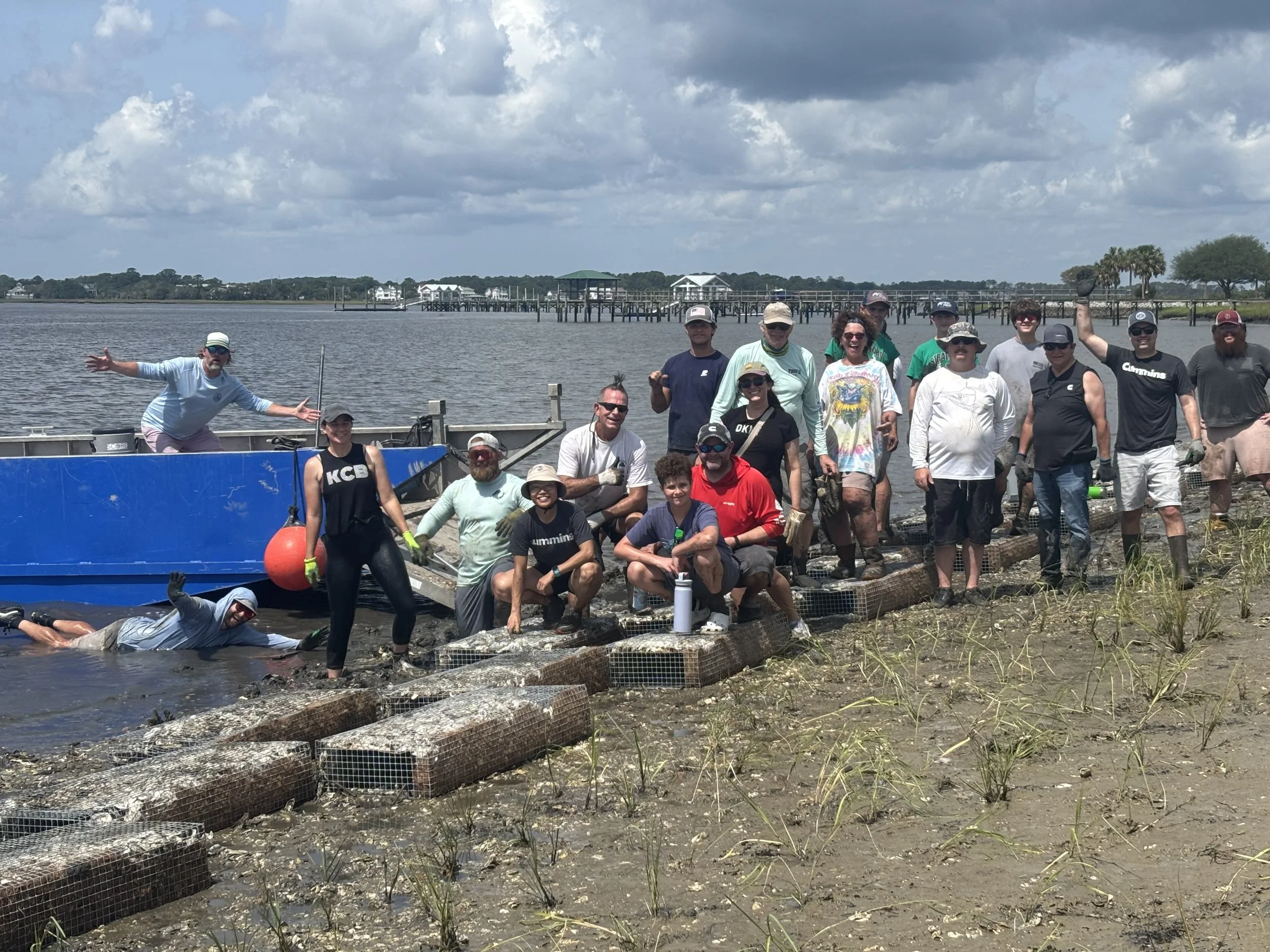
Volunteers from Cummins Inc and Charleston Waterkeepers are installing Manufacturer Wire Reefs on the Stono River. Photo Credit: Cheryl Carmack-Smith
The oyster shell in your hands was, not long ago, someone's dinner.
It came from a restaurant. Maybe a backyard oyster roast. Someone shucked it, ate what was inside, and tossed the shell — and instead of a landfill, it ended up in a quarantine pile baking in the South Carolina sun for a year. Now it's in a wire cage on the bank of the Stono River, waiting to become a reef.
That's the quiet revolution happening in the salt marshes of the Lowcountry, and volunteers are at the center of it.
The Problem No One Can See Until It's Gone
South Carolina's tidal marshes are some of the most productive ecosystems on Earth. Spartina grass filters runoff. Fiddler crabs aerate the mud. Shrimp, redfish, and blue crab breed in the shallow creeks. And oyster reefs — the foundation of it all — armor the shoreline against the relentless energy of boat wake and storm surge.
But those reefs are disappearing. Dredging, development, and decades of harvest without adequate restoration have stripped the hard substrate that oyster larvae need to survive. A larval oyster — microscopic, swimming blind on tiny hair-like cilia — has roughly three weeks to find a suitable hard surface before it dies. In many stretches of South Carolina's coast, that surface is gone. The larvae drift past, settle in mud, and perish.
Without oyster reefs to absorb wave energy, the marsh erodes. Spartina grass loses its footing. The fisheries that depend on it — shrimp, crab, redfish — lose their nursery. And the coastlines that communities depend on become more vulnerable with every passing storm season.
"Without oyster reefs, all the picturesque salt marsh that you see would be eroded away by boat energy and by storm energy. The oyster is a keystone species for those fisheries." — Adrian, SC DNR SCORE Program
Enter the Manufactured Wire Reef
The Manufactured Wire Reef — MWR — is a deceptively simple structure: a wire mesh cage, roughly four feet long by one foot wide by three feet tall, stuffed with recycled oyster shells and lined on one side with coconut husk fiber. It weighs enough to hold position in tidal currents. It's stable enough to last years in salt water. And it does something no bag of loose shell or sprayed substrate can reliably do: it raises a hard, calcium-rich surface above the pluff mud and keeps it exposed long enough for oyster larvae to find it.
"MWRs solve the Lowcountry's issue better than other restoration methods through raising hard substrate from the mud and ensuring its exposure for elongated periods of time," explains Austin King of Toadfish, a South Carolina
-based conservation brand that has partnered with SCORE on multiple deployments. "This gives larval oysters more opportunity to attach themselves to recycled oyster shell and, later, to newly developed oyster reefs."
The coconut husk — called coir — is biodegradable, salt-resistant, and does double duty: it prevents synthetic materials from entering the waterway while promoting sediment accumulation on the shore-facing side of the structure, which helps Spartina grass take root. Every material in an MWR was chosen because it belongs in a marsh ecosystem.
Each completed structure exposes nearly 15 square feet of viable settlement substrate. The shells inside came from restaurants, oyster roasts, and community recycling bins — cleaned, quarantined for a full year to eliminate pathogens, and hand-picked to remove any plastic or debris before entering the water.
How It Gets Built: A Day at the Station
Building MWRs is not glamorous work. It is, however, deeply satisfying.
Volunteers work in rotating stations. At one, someone cuts wire panels to precise lengths — safety glasses required. At another, a small team bends and shapes the wire frame, then fires a pneumatic ring gun to fasten the sides together before packing in the coir and shoveling in oyster shells by the bucketful. Younger volunteers often take to the shell-shoveling with enthusiasm; there is something viscerally pleasing about the weight of a full bucket and the sound of shells hitting wire.
The SCORE program — South Carolina Oyster Recycling and Enhancement — operates 33 shell recycling locations across the state, collecting shells from restaurants and public bins, quarantining them, processing them, and transporting them to build sites. It is a supply chain built entirely around ecological restoration, running on a combination of state resources, community partnerships, and volunteer hours.
Today's build is happening in partnership with Charleston Waterkeeper and with support from a Cummins Foundation grant — the kind of public-private-community collaboration that makes this scale of restoration possible. At the end of a build event, the team tallies how many structures were made and calculates the water filtration potential. The numbers are startling.
A single adult oyster filters 2.5 gallons of water per hour. A well-populated MWR can recruit hundreds of oysters. A few hours of volunteer labor translates into millions of gallons of cleaner water — every hour, indefinitely.
Into the Stono River
Volunteers who build the structures today will have the chance to deploy them on the banks of the Stono River — one of the tidal rivers that winds through Charleston's coastal lowlands into the Atlantic.
Deployment is physical and memorable. MWRs are loaded onto a boat, driven to the site, and carried through knee-deep marsh mud to the shoreline edge — the precise zone where wave energy meets exposed bank. Placing a structure is collaborative, muddy, and occasionally hilarious. It is also permanent.
Those benefits compound over time. MWRs planted along South Carolina's coast several years ago are already showing significant oyster recruitment and reef development. The structures that go into the Stono River this week will begin recruiting larval oysters within the first spawning season. Within a few years, if conditions are right, a functioning oyster reef will stand where there was only an eroding bank.
Over 120 species use oyster reefs for shelter, feeding, and reproduction — from juvenile shrimp and blue crabs to redfish, sheepshead, and the egrets and herons that hunt them. When you place an MWR in the marsh, you are not just preventing erosion. You are building a neighborhood.
The Bigger Picture: Shell by Shell
What makes the SCORE program remarkable is its closed loop. The shell that came from a restaurant table goes into a recycling bin, into quarantine, into a wire cage, into the river, and eventually into a reef that filters the water that oysters need to survive. The system feeds itself — if communities participate.
That participation is the variable. SCORE's 33 collection sites are only as effective as the restaurants, event organizers, and homeowners who use them. Every oyster roast that sends its shells to a landfill is a missed opportunity. Everyone who sends them to SCORE contributes to a reef that hasn't been built yet. You can find a drop-off location along the South Carolina coast by visiting the SC DNR Oyster Recycling Drop-off Location.
The Toadfish team joined a SCORE build event during their "Marsh Madness" campaign and later helped deploy MWRs at Kiawah Island's Mingo Point — a stretch of shoreline suffering from intense erosion and absent oyster beds. Charleston Waterkeeper has been a consistent partner in this work, connecting volunteers to build events and deployments throughout the Lowcountry. Their Creek Watchers program, nurdle-monitoring network, and marsh-restoration partnerships form an interlocking system of community science and direct action — proof that protecting coastal ecosystems doesn't require a government budget or a biology degree. It requires showing up.
What You Can Do
You don't have to wade into the Stono River mud tomorrow — though you can. There are entry points at every level of commitment.
If you eat oysters in South Carolina — at a restaurant, a roast, anywhere — ask if they recycle their shells. If they don't, tell them about SCORE. If you host an oyster roast, bring your shells to one of the 33 collection sites. If you want to go further, volunteer for a build event or deployment through Charleston Waterkeeper.
The oyster doesn't ask much. It needs a hard surface to land on, clean water to filter, and enough time to grow. Volunteers are providing all three — one wire cage, one bucket of shells, one muddy afternoon at a time.
The marsh is worth it.
Get Involved
Volunteer with Charleston Waterkeeper → charlestonwaterkeeper.org/volunteer
Find a SCORE shell recycling site → SCDNR Oyster Recycling Drop-off Locations
Learn more about MWRs → toadfish.com/blogs/put-em-back-post
Learn more about Cummins Inc.’s commitment → Charleston waterkeeper Linkin page
SOURCES
SC DNR SCORE Program volunteer briefing, June 2025
Austin King, "MWRs: The Future of Oyster Habitat Restoration," Toadfish Put 'Em Back Blog, August 2024
Charleston Waterkeeper volunteer program materials
