
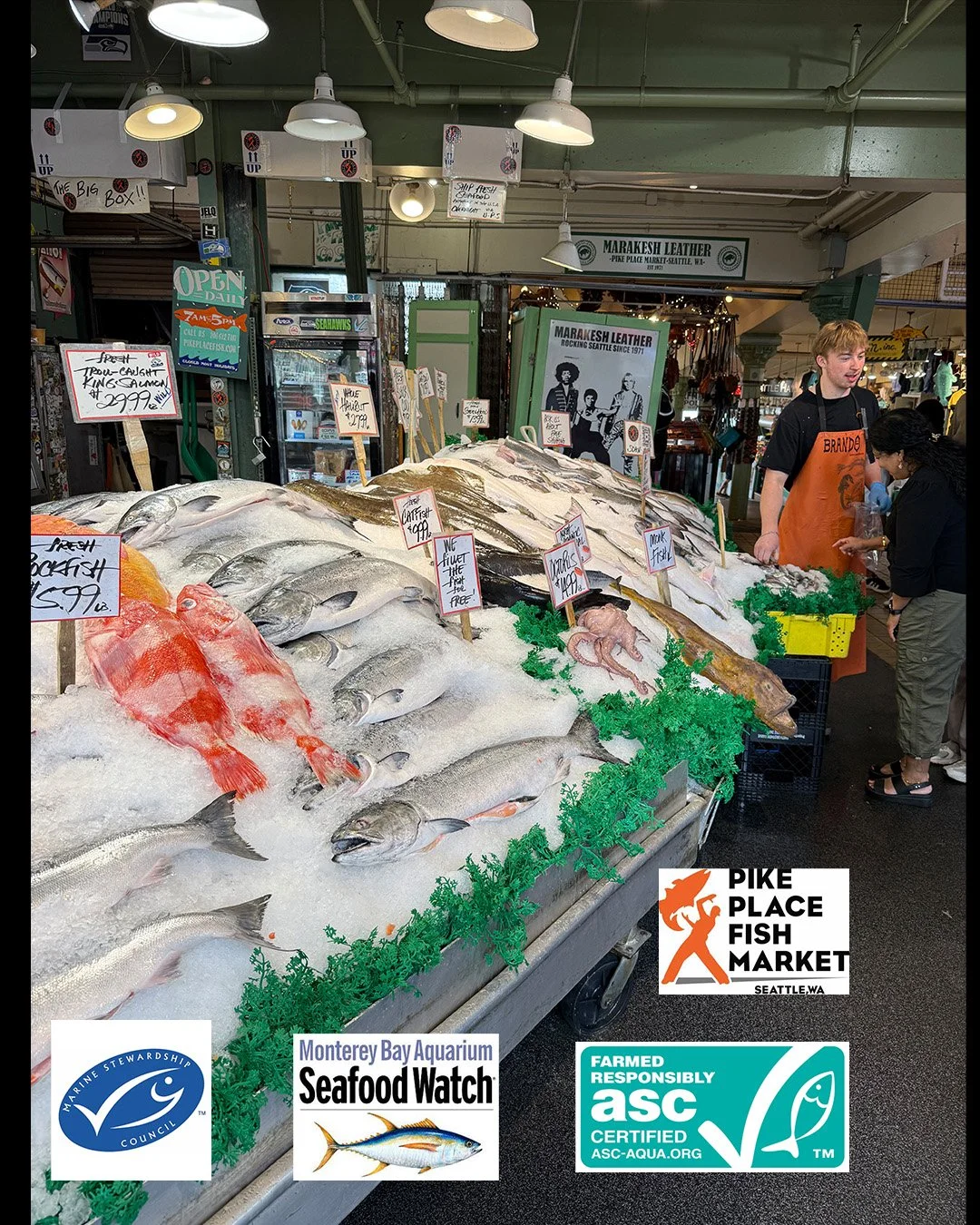
Pike Place Fish Company Photo Credit: Denny Frazier
Every time you buy seafood, you cast a vote for the kind of ocean you want to live next to. That choice — made at a fish counter, a grocery store, or a restaurant — ripples outward in ways most of us never see: the health of a coral reef, the survival of a fish population, the livelihood of a fisherman working responsibly off the coast of Alaska or Oregon.
Sustainable seafood isn't a trend. It's one of the most direct, actionable ways consumers can protect ocean ecosystems. And it's more achievable than you might think — especially when trusted vendors, smart tools, and a little knowledge are all on your side.
Why It Matters Before Anything Else
Global fish populations are under enormous pressure. Overfishing, destructive harvesting methods like bottom trawling, and the collapse of once-thriving fisheries have reshaped ocean ecosystems in ways that take decades — sometimes centuries — to recover. When high-demand species like tuna, shrimp, and Atlantic salmon are pulled from the water faster than they can reproduce, the entire food web suffers. Predator populations crash. Ecosystems are losing the species that keep them balanced. Coastal communities lose the fisheries they depend on.
The good news: consumer demand is a powerful lever. Fisheries and fish farms respond to market pressure. When buyers consistently choose sustainably sourced seafood and ask hard questions at the counter, vendors listen — and the supply chain shifts.
That shift starts with understanding why it matters, long before it starts with reading a label.
A Fish Market That Got It Right: The Story of Pike Place Fish Market
Few places in America capture the soul of a working fish market like Pike Place Fish Market in Seattle. Founded in 1930 at the iconic Pike Place Market, it has served generations of Pacific Northwest seafood lovers with wild, fresh fish delivered daily. In 1965, a young employee named John Yokoyama purchased the business — and nearly lost it two decades later.
By 1986, the market was on the verge of bankruptcy. What saved it wasn't a new product or a price cut — it was a cultural transformation. Fishmongers began throwing fish to each other across the counter, turning transactions into performances that drew crowds and national media attention. Pike Place Fish Market became famous worldwide.
But the more meaningful transformation was quieter. Working alongside the Seattle Aquarium and a local sustainable sushi restaurant, the market began scrutinizing every species on its shelves — analyzing catch methods, population health, and sourcing practices. Species that didn't meet the standard were cut. Farm-raised tilapia from Asia? Gone. Wild-caught steelhead trout and monkfish? Removed. The market is committed to 100% sustainably sourced seafood, arriving daily from trusted fishermen and fisherwomen.
In 2018, four veteran fishmongers — Jaison Scott, Ryan Reese, Sam Samson, and Anders Miller — purchased the market from Yokoyama, carrying that commitment forward into a new era.
From the Counter: A Fishmonger's Perspective
Brian has been working at the fish market for thirty years. He's seen trends come and go, watched certifications evolve, and witnessed the supply chain shift in real time.
"The biggest changes I've seen," Yogi says, "are around where the fish actually comes from." At Pike Place Fish Market specifically, he points to two major recent developments: the market no longer sells farm-raised salmon, and it now sources exclusively through reputable wholesalers from Alaska, Canada, Oregon, and California.
Those two decisions reflect something deeper than business strategy. Farm-raised salmon — particularly from open-net pen operations — has faced criticism for sea lice outbreaks, antibiotic use, and the escape of non-native fish into wild ecosystems. By stepping away from it entirely and locking in regional, traceable supply chains along the Pacific coast, the market has made a clear statement: where your fish comes from is not a marketing point. It's a responsibility.
Yogi's advice to shoppers is simple: ask questions. "If the person behind the counter can't tell you where it came from or how it was caught, that's your answer right there."
How to Shop Sustainably
Once you understand the stakes, the tools for smarter buying are straightforward.
Look for Trusted Eco-Labels. Certifications signal that a fishery or farm has met rigorous environmental standards. The Marine Stewardship Council (MSC) label applies to wild-caught seafood; the Aquaculture Stewardship Council (ASC) applies to responsibly farmed fish. Neither is perfect, but both represent a meaningful baseline.
Use Pocket Guides and Apps. The Monterey Bay Aquarium's Seafood Watch is the gold standard — a regularly updated guide that rates species as "Best Choice," "Good Alternative," or "Avoid" based on current fishing and farming practices. It's free, searchable, and fits in your pocket.
Embrace Local and Boat-to-Table.
Community-Supported Fisheries (CSFs) let you buy directly from independent fishermen, often at lower environmental cost. Small-boat fishermen typically use methods like troll poles or pots rather than industrial bottom trawling — meaning less bycatch, less habitat damage, and a more direct relationship between catch and consumer.
Species Selection and Traceability
Diversify your diet. Shifting demand toward underutilized, smaller forage fish — sardines, herring, anchovies, mackerel — relieves pressure on heavily targeted species like tuna, shrimp, and salmon. These smaller fish are often more abundant, lower on the food chain, and richer in omega-3s.
Ask at the counter. Three questions worth asking every time: Where was this caught? How was it harvested? Is it wild-caught or farmed? A vendor committed to sustainability should be able to answer all three without hesitation.
Understand the trade-offs. Wild-caught fish generally carry a lower carbon footprint than airfreighted imports — but "wild-caught" alone doesn't mean sustainable. Check the Seafood Watch Recommendations for species-specific population health data. A wild-caught fish from a depleted stock is still a problem, regardless of the label.
The Bigger Picture
Sustainable seafood is about more than individual choices — though those matter. It's about building a market culture where accountability is expected, transparency is the norm, and the health of ocean ecosystems is treated as non-negotiable.
Markets like Pike Place Fish Market — and the fishmongers like Brian who've spent careers learning the difference between responsible and reckless sourcing — show that it's possible. The supply chain can shift. Consumer choices drive it.
The ocean is not an infinite resource. But it is a resilient one, when given the chance. Every sustainable purchase is part of giving it that chance. Want to go deeper? Start with Monterey Bay Aquarium Seafood Watch, explore NRDC's Smart Seafood Buying Guide, and look into CSFs in your region at LocalCatch.org.
Sources:
· Seafood Watch Recommendations
· NRDC Smart Seafood Buying Guide
· Serious Eats: How to Shop for Sustainable Seafood
· SeaChoice: Choosing Sustainable Seafood
· About Pike Place Fish Market
· Pike Place Fish Market – Wikipedia
