
Ocean Law · Good News · June 2026
The Ocean Finally Has a Law
For two-thirds of the world’s ocean, there were no rules. No protection. No enforcement. Then, on a January morning in 2026, that changed. Here’s the story of the most important environmental treaty you’ve probably never heard of.
Think about everything that happens in the ocean beyond the horizon. Fishing fleets dragging nets across seamounts that took millions of years to form. Deep-sea mining operations targeting minerals on the ocean floor. Cargo ships crossing invisible lines where one country’s rules end and nobody else’s begin. For most of human history, this was just how it worked. The open ocean — the high seas, stretching across roughly two-thirds of the world’s water — was essentially a free-for-all. Big, vast, and legally unprotected.
On January 17, 2026, that era ended.
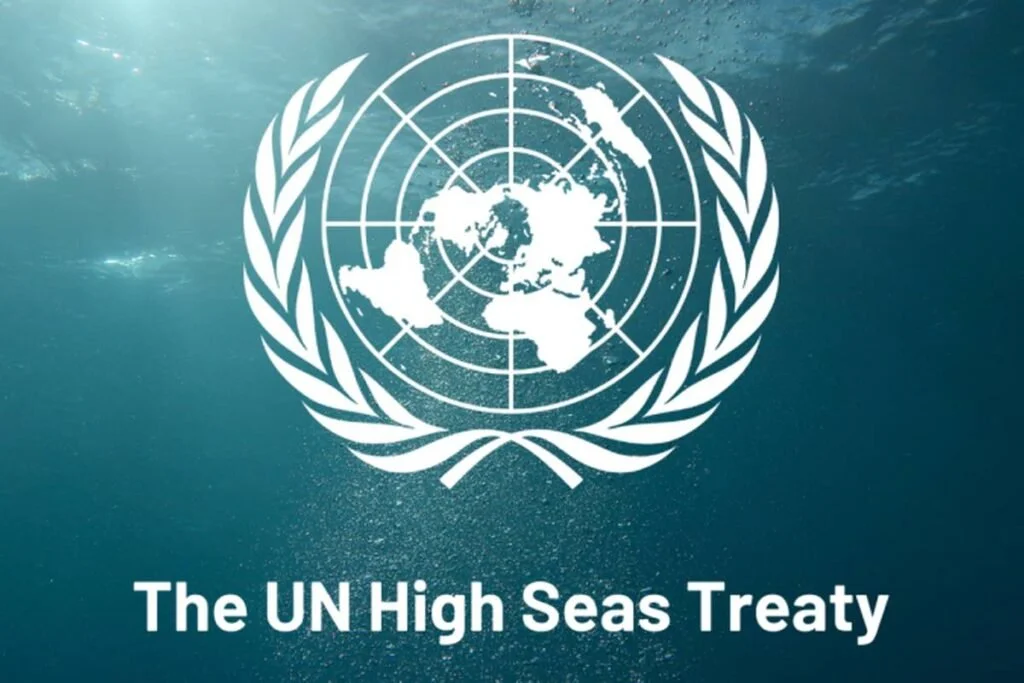
On that date, the High Seas Treaty — the first legally binding international agreement dedicated to protecting marine life in international waters — entered into force. It’s a moment that took twenty years to arrive, required the agreement of 60 nations to trigger, and is already reshaping what ocean conservation can actually look like. And yet most people have never heard of it. That seems worth fixing.
20
years of negotiations
Related Articles
60
ratifications needed to trigger the treaty
89
nations now on board
145
countries that signed
Twenty Years in the Making
The story of how this treaty came to exist is, at its heart, a story about patience. Exhausting, maddening, occasionally inspiring patience.
The problem had been obvious for decades. The United Nations Convention on the Law of the Sea — UNCLOS, often called the constitution of the oceans — was adopted back in 1982. It drew the lines: territorial waters, exclusive economic zones, the high seas beyond. What it didn’t do was create any real framework to protect the biodiversity in those international waters. That gap sat there, quietly widening, as industrial fishing spread further into remote oceans, as deep-sea mining technology improved, as climate change pushed species into waters they’d never occupied before.
Formal negotiations on a new treaty began in 2018. They were interrupted by COVID-19, entangled in disagreements between wealthy and developing nations over who gets to benefit from ocean resources, and repeatedly pushed to the brink of collapse. Then, on March 4, 2023, after a final marathon session in New York, delegates emerged with a deal. Greenpeace called it the biggest conservation victory ever. That’s not a small claim. But it wasn’t wrong.
“The ocean’s health is humanity’s health.”
— UN Secretary-General António Guterres, September 2025
What the Treaty Actually Does
The treaty’s formal name — the Agreement on the Conservation and Sustainable Use of Marine Biological Diversity of Areas Beyond National Jurisdiction, or BBNJ Agreement — is a mouthful. What it actually does is more straightforward.
For the first time, countries can now propose and establish marine protected areas in the open ocean. Before this treaty, that was legally impossible in international waters. There was no mechanism. No process. You could want to protect a stretch of the high seas, but there was no body with the authority to make it happen. Now there is.
The treaty also requires environmental impact assessments for activities in international waters — things like deep-sea mining, large-scale fishing operations, and scientific research. If you want to do something that might harm the ocean beyond national borders, you now have to show you’ve thought about the consequences. Again, that sounds obvious. It wasn’t law until now.
And it addresses something less discussed but enormously important: marine genetic resources. The deep ocean is full of organisms with genes that pharmaceutical companies, food producers, and cosmetics manufacturers have already begun to exploit. Under the old regime, whoever had the technology to get there first got to keep what they found. The treaty changes that, requiring benefits to be shared with developing nations who lack the ships and science to access these resources themselves.
The Race to 60
A treaty isn’t law until enough countries ratify it. For the High Seas Treaty, that number was 60. Simple on paper. A lot harder in practice.
The first country to ratify was Palau — a small Pacific island nation whose entire identity is woven into the sea. It ratified in January 2024, just weeks after the treaty opened for signatures. That felt right. Palau has been one of the most outspoken advocates for ocean protection for years, a country that has more ocean than land and knows exactly what’s at stake when it’s left unprotected.
From there, ratifications came in steadily. The European Union joined as a bloc. Small island states from the Pacific, Caribbean, and Indian Ocean moved quickly — these are the nations living closest to the consequences of ocean degradation, and they knew it. African nations stepped up in the final stretch. It was Sierra Leone and Morocco, ratifying within hours of each other on September 19, 2025, that pushed the count to 60 and 61, triggering the 120-day countdown clock. By the time the treaty entered into force on January 17, 2026, 82 countries had already ratified. Today that number stands at 89, with 145 having signed.
“We are proud to have been the first nation to ratify the BBNJ Treaty, and today we celebrate alongside sixty other countries. With sixty ratifications, the treaty will now enter into force — ushering in a new era of stewardship for the High Seas.”
— President Surangel Whipps Jr., Palau
What Comes Next — and What’s Still Missing
Here’s the honest part: having a treaty in force is not the same as having a protected ocean. The High Seas Treaty is a framework — a legal structure inside which protection can now happen. The actual work of designating marine protected areas, running environmental assessments, and sharing genetic resource benefits is still ahead. The treaty’s first Conference of the Parties, BBNJ COP1, must take place by January 2027. That’s when the real decisions get made.
There’s also a notable absentee. The United States signed the treaty in September 2023 and President Biden sent it to the Senate for ratification in December 2024. Since then, it’s been sitting. The world’s largest naval power — with more coastline, more ocean territory, and more distant-water fishing interests than almost any other nation — is currently watching from the sidelines. That matters, both practically and symbolically.
And then there’s the sheer scale of what needs protecting. Less than 2% of the high seas is currently under any form of formal protection. The 30×30 goal — protecting 30% of the world’s ocean by 2030 — was legally unreachable without this treaty. Now it’s legally possible. Those are very different things from being done.
Why It Still Matters
It’s easy to be skeptical about international agreements. The history of environmental diplomacy is littered with pledges that sounded transformative and delivered less than promised. The High Seas Treaty could follow that path. Implementation could stall. COP1 could get mired in procedural disputes. Funding could fail to materialize.
But here’s what’s different this time. The legal gap that allowed the high seas to be exploited without consequence or oversight has been closed. That can’t be undone. For the first time in history, the open ocean is protected by international law. The fishing fleets, mining companies, and cargo ships crossing those invisible lines now operate in a world where the rules have fundamentally changed.
That’s not nothing. In fact, it might be everything. The question now is whether the 89 nations that have signed up — and the ones still waiting — are willing to do the harder work of making it real.
The ocean covered two-thirds of the planet for billions of years before we got here. It’ll be here long after us. The treaty doesn’t save it — but it gives us the tools to try. What happens next is up to us.
see-the-sea.com · Independent ocean conservation journalism
Sources: High Seas Alliance, IUCN, World Resources Institute, UN News, SDG Knowledge Hub, European Commission