
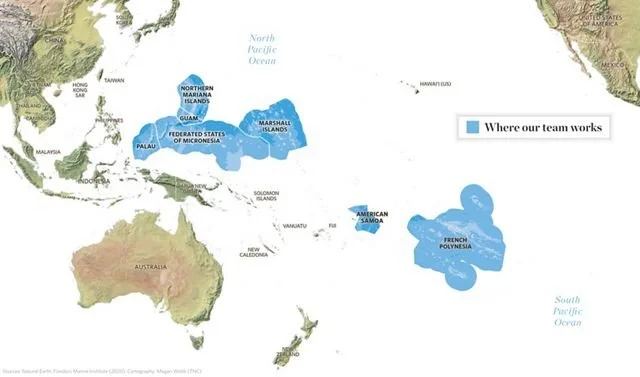
Source: The Natural Conservacy
OCEAN CONSERVATION · WORLD OCEANS DAY 2026
The Pacific Stands Up for the Ocean
A nation of 280,000 people just made the largest ocean protection commitment in history. French Polynesia has designated 515,000 square kilometers of fully protected marine area across the Austral and Marquesas Islands — rooted in Indigenous tradition, backed by 90% of its citizens, and announced on World Oceans Day 2026.
see-the-sea.com · June 8, 2026
There is a place in the South Pacific where sharks still dominate the food web as nature intended. Where humpback whales migrate through waters so clear they seem made of glass. Where coral reefs shelter endemic species found nowhere else on Earth, and where communities have practiced rāhui — the traditional Polynesian art of resting the ocean to let it recover — for generations before the word “conservation” existed in any language but their own.
That place is French Polynesia. And on June 8, 2026 — World Oceans Day — its government made history.
515,000 km²
Nearly 200,000 mi²
New fully protected ocean
5 million km²
2 million mi²
Total EEZ protected
#1
Largest single 30×30 contribution

Polynesian President Brotherson Source: Guardian
President Moetai Brotherson announced the designation of 515,000 square kilometers of new, fully protected marine areas across the Austral and Marquesas Islands — two of the most remote and ecologically extraordinary archipelagos on Earth. The announcement fulfilled a commitment made at the UN Ocean Conference in June 2025 and went further, exceeding the original target.
According to Conservation International, it represents the single largest contribution to the global 30×30 goal — the international commitment to protect 30% of the world’s land and ocean by 2030 — ever made by a single nation in a single act.
A Promise Made, and Kept
The story begins a year earlier. At the third United Nations Ocean Conference in Nice, France, President Brotherson stood before world leaders and announced the creation of the world’s largest Marine Protected Area — encompassing French Polynesia’s entire Exclusive Economic Zone of nearly five million square kilometers. The broader area, known as Tainui Atea, had long been recognized by local communities as a place of profound cultural and ecological significance. Its name, in Māʻohi, means “the vast ocean of life.”
That announcement pledged that at least 500,000 square kilometers of additional highly protected areas would be designated around the Austral and Marquesas Islands by World Ocean Day 2026. The government met that deadline — and exceeded it by 15,000 square kilometers.
“In French Polynesia, the ocean is much more than a territory — it is a source of life, culture, and identity. By strengthening the protection of Tainui Atea, we are asserting our ecological sovereignty while creating biodiversity sanctuaries for our people and future generations. This ambitious choice also carries a universal message to the international community: that of an Oceanian people who protect their vital space not only for themselves, but for all of humanity.”
— President Moetai Brotherson of French Polynesia
What Has Been Protected — and Why It Matters
The two newly protected archipelagos are not simply large — they are among the most biodiverse marine environments on the planet. The Nature Conservancy TNC has been working alongside Micronesian communities and governments for over 30 years to support them in their efforts to protect, restore and sustainably manage their valuable resources and biodiversity. More recently, our team has expanded projects in French Polynesia and American Samoa to build local community capacity to effectively manage coastal fisheries, coral reefs, and marine protected areas.
Work in this Region Supports
By the Numbers
THE MARQUESAS ISLANDS
• Designated a UNESCO World Heritage Site in 2023
• Home to some of the highest concentrations of endemic marine species in the entire Indo-Pacific
• Critical habitat for endangered sharks, whales, dolphins, and sea turtles
• Key spawning grounds that help replenish tuna stocks across the broader Pacific Ocean
• Hosts the kūpūtea and Marquesan domino damselfish — species found nowhere else on Earth
THE AUSTRAL ISLANDS
• Bridge tropical and temperate marine zones, creating rare biodiversity overlap
• Host ecosystems found nowhere else in French Polynesia
• Waters around Rapa remain one of the very few places on Earth where large marine predators still dominate the food web as nature intended
• Unique coral species adapted to cooler, deeper water conditions
Across French Polynesia’s full EEZ, the waters support 21 shark species, 176 coral species, and over 1,000 species of fish. The broader Tainui Atea — now the world’s largest MPA — bans deep-sea mining, bottom trawling, and the use of fish aggregating devices by commercial fleets. Only traditional artisanal fishing is permitted in designated zones close to shore.
Rooted in the Community, Not Imposed From Outside
What makes French Polynesia’s conservation story distinctive is its origin. These protections were not handed down from international bodies or foreign NGOs. Island councils across both the Austral and Marquesas archipelagos have championed these designations for more than a decade.
Polling conducted ahead of the announcement found that more than 90% of French Polynesians supported the creation of new highly protected areas. Respondents emphasized the need to safeguard ocean resources for current and future generations, with specific calls to respect cultural values and to draw upon traditional stewardship practices like rāhui — the ancient Polynesian practice of temporarily closing areas of ocean to allow marine life to recover.
Rāhui is not a modern conservation technique borrowed from elsewhere. It is an Indigenous Pacific knowledge system that has sustained these reefs for centuries. What happened on June 8th was its global recognition.
Laure Katz, Executive Director of the Blue Nature Alliance, noted that the protections are “deeply rooted in the will and wisdom of local communities,” and that for a decade, island councils championed these designations “not as an outside conservation agenda, but as an expression of their own traditions of ocean stewardship.”
A $15 million international funding commitment — channeled through French Polynesia’s own financial mechanisms — has been secured to support implementation, monitoring, and enforcement. The government has committed to integrating rāhui formally into national ocean governance.
What This Means for the 30×30 Goal
The global context makes this announcement even more significant. As of April 2026, just 10.01% of the world’s ocean was officially protected — a milestone, but still a long way from the 30% target agreed under the Kunming-Montreal framework in 2022. To meet that goal, an area the size of the Indian Ocean must be protected in the next four years.
French Polynesia’s June 8 announcement does not close that gap alone. But it demonstrates, at scale, that the gap is closeable. It shows that meaningful, enforceable, community-rooted ocean protection is possible — and that small island nations can lead where larger ones have hesitated.
“These designations deliver above and beyond the landmark commitment President Brotherson made last year. Beyond their ecological value, these new MPAs are a forward-looking investment. Keeping those ocean ecosystems as intact as possible in this part of the Pacific will make these waters increasingly valuable in helping ecosystems elsewhere recover.”
— Laure Katz, Executive Director, Blue Nature Alliance
The announcement also lands just months after the UN High Seas Treaty entered into force in January 2026 — the first legal framework protecting the open ocean beyond national borders. Together, these developments are reshaping what ocean governance can look like in the twenty-first century.
A Model for Pacific Leadership
French Polynesia is not alone in its ambitions. Samoa has established nine MPAs covering 30% of its national ocean territory. The Cook Islands, Palau, and Fiji have each made significant marine protection commitments in recent years. A pattern is emerging: Pacific Island states, the nations most existentially threatened by climate change and ocean degradation, are also becoming its most ambitious protectors.
There is something quietly powerful in that inversion. The communities with the smallest carbon footprints and the deepest ancestral connections to the ocean are stepping forward while larger economies argue over timelines and targets. President Brotherson put it plainly at Nice last year: “We have been managing this EEZ wisely for centuries, using the techniques that were passed on from the generations before us and our ancestors.”
The world could do worse than follow their lead.
What Comes Next
French Polynesia’s commitments do not end with the June 8 announcement. The government has pledged to continue expanding artisanal fishing zones, strengthen monitoring and enforcement capacity, and formally integrate rāhui into national conservation strategy. Implementation — the unglamorous work of turning designated areas into genuinely protected ones — is where the effort now turns.
The Blue Nature Alliance, Conservation International, and Pew Bertarelli Ocean Legacy are all committed partners in that process. The $15 million funding package is structured to support long-term stewardship rather than a one-time designation.
For the ocean itself, the measure of success will come in the decades ahead: in recovering shark populations, in healthy coral, in tuna spawning grounds left undisturbed, in communities that can still fish because the fish are still there. French Polynesia has given those futures a chance.
On a planet where ocean news is too often a story of decline, World Oceans Day 2026 offered something different. A government that did what it said it would. A people whose relationship with the sea is measured in generations, not quarterly reports. And 515,000 square kilometers of the Pacific that will now, with luck and care, remain wild.
SOURCES
Conservation International press release, June 10, 2026 · Pew Bertarelli Ocean Legacy, January 2026 · IUCN press release, June 9, 2025 · UNEP-WCMC, August 2025 · Positive News, April 2026 · Oceanographic Magazine, June 2025

Related Articles