
Adapt & Protect · Living Shorelines · April 2026
Building a Reef by Hand
On a cool, overcast morning on the banks of Old Town Creek in South Carolina, 35 volunteers laid plywood across the pluff mud and built something that will last a hundred years. This is what climate anxiety looks like when it turns into action.
see-the-sea.com · April 2026
A lot of people who care about the ocean reach a point where the caring starts to hurt. They read the reports, watch the reefs bleach and the plastic pile up, and somewhere in there the concern tips into something heavier. Climate scientists have a name for it: eco-anxiety. The feeling that the scale of what’s being lost is simply too large for any individual response to matter.
I know that feeling. What I didn’t fully appreciate, until a Monday morning in April on the banks of Old Town Creek, is how quickly it can shift when you put something in your hands and get to work.
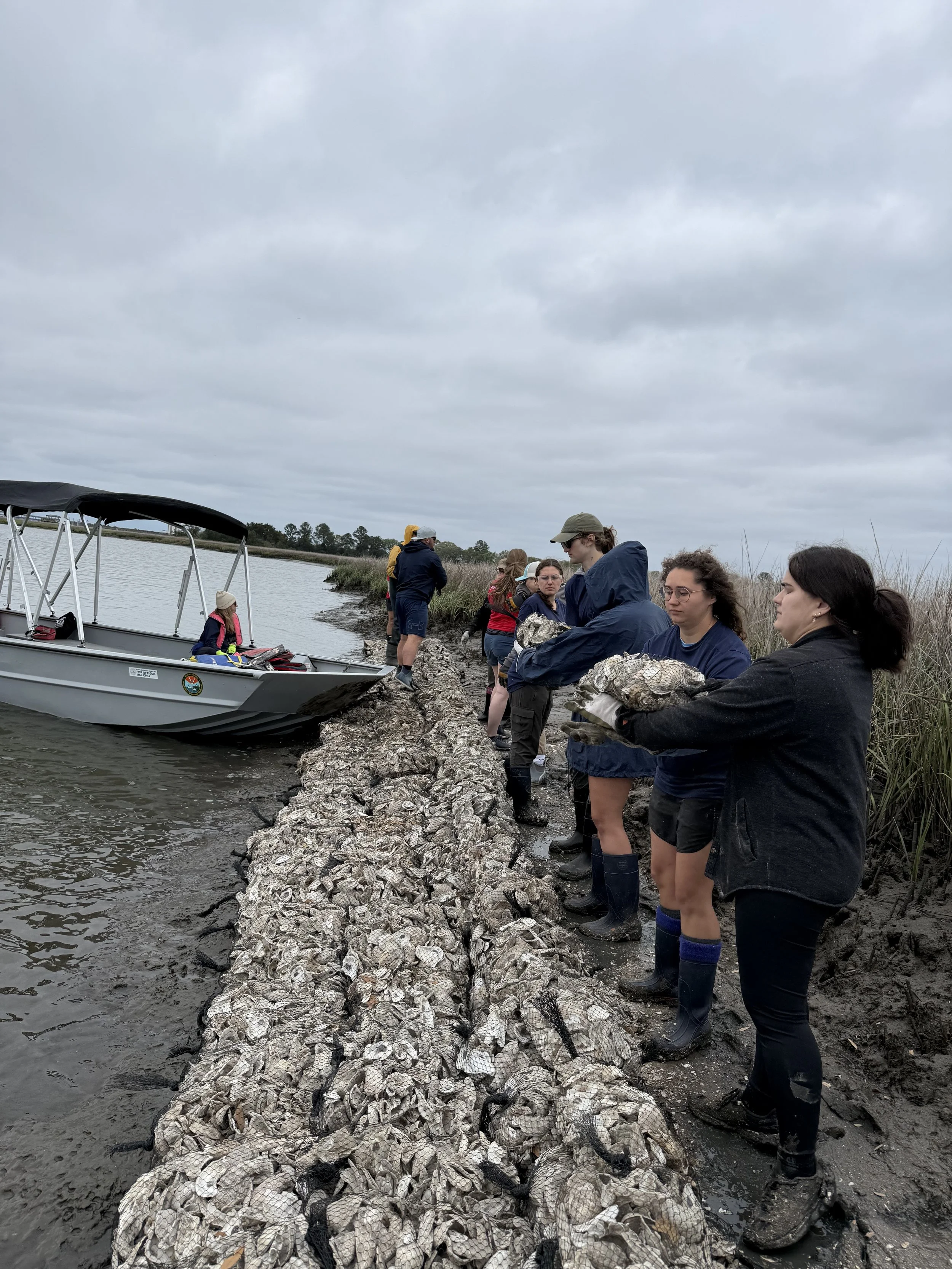
On April 27, 2026, I joined volunteers from Charleston Waterkeeper, The Sustainability Institute, and Avocet Hospitality at Charles Towne Landing State Historic Site — the site of the first permanent English settlement in the Carolinas, founded in 1670, and a place I know well as a Charlestonian — to deploy 550 bags of oyster shells along 100 feet of eroding marsh shoreline. The project was led by the team from SCORE — South Carolina’s Oyster Recycling and Enhancement program. By the time we loaded back onto the boats, something had shifted. Not in the marsh. In the people standing in it.
Why Oysters?
Andrina gathered the group for a briefing before we crossed to the site. He wanted us to understand what we were actually doing before we did it.
Old Town Creek has changed over time. Boat wakes, storm energy, and decades of erosion have eroded the shoreline, reducing the tidal flow that keeps the marsh alive. For four years, SCORE staff has been digging tidal creeks by hand — three of them, growing longer each year — and planting spartina grass to revitalize the system. But without something to anchor the shoreline itself, the erosion keeps winning. That’s where oysters come in.
A healthy oyster reef is nature’s seawall. The shells interlock and harden over time, absorbing wave energy and protecting the soft marsh edge behind them. As the reef grows, it creates calmer water, allowing marsh grass to take hold and further stabilize the bank. A self-reinforcing system — but only if you give it a start.
“Without oysters, all these marsh grass wetlands that you see would be eroded by boat energy and storm energy. The oysters are the foundation for everything you see out in this marsh.”
— Andrina, SCORE Program, SC Department of Natural Resources
Each bag will recruit approximately 700 adult oysters as larvae settle and grow. At 550 bags, that’s roughly 385,000 oysters — and a single adult filters 2.5 gallons of water every hour. At full recruitment, the reef we built that morning will filter nearly one million gallons per hour. From one morning’s work.
550
bags of oyster shells deployed
385,000
adult oysters at full recruitment
~1M
gallons of water filtered per hour
120+
species that call oyster reefs home
The Work Itself
We arrived at the site by three boats — a 25-foot aluminum workboat, a flat-decked vessel with a bow ramp carrying the bulk of the shell bags, and a third 20-footer that had to reduce its load crossing choppy Charleston Bay. The marsh stretched flat and grey-green on either side of the creek, the overcast sky keeping the temperature just cool enough to make sweatshirts necessary and hard work comfortable.
Pluff mud is deceptive — firm-looking from a distance, and it swallows you whole up close. The team laid down 18-inch-wide, eight-foot-long plywood boards as working platforms and placed pallets to keep the bags from sinking. We worked from those platforms throughout the morning, standing above the mud — though the occasional misstep off the board meant the pluff mud claimed a boot or two, to everyone’s amusement.
Thirty-five people make a long chain. The bags — plastic mesh, about 15 pounds each, packed with recycled oyster shells — moved quickly once the rhythm established itself: grab, turn, pass, grab, turn, pass. Charleston Waterkeeper brought community volunteers. The Sustainability Institute brought AmeriCorps workers. Avocet Hospitality sent staff for their corporate community service day. Three completely different groups, all standing on the same boards, doing the same work. By the end of the morning: 550 bags placed, 100 feet of new living shoreline built. It took a few hours. It will last, Andrina told us, about a hundred years.
Twenty-Five Years of Doing This
What happened at Charles Towne Landing wasn’t a one-off. SCORE has been running since 2001, when SC DNR launched it with a simple idea: collect the oyster shells restaurants were throwing away, put them back in the water, and let nature do the rest. Twenty-five years on, the program recycles approximately 88,000 bushels of shells every year — from restaurants, community drop-offs, and when needed, purchased from Louisiana — and has built 34 miles of living shorelines at more than 100 sites across 200 miles of South Carolina coast, from Hilton Head to the Grand Strand near Myrtle Beach. More than 36,000 volunteers. Over 80,000 hours of work.
One of SCORE’s most significant projects is around Parris Island — home to the Marine Corps Recruit Depot and one of the most erosion-vulnerable stretches of coastline in the state. The Department of Defense has been watching the shoreline retreat with real concern, and SCORE has been building oyster reefs to protect the island’s edges in partnership with the Marine Corps. An unlikely pairing — oyster shells and the US military — but erosion doesn’t care about jurisdiction.
“We have kind of a slushy mush of pollution out here. Without oyster reefs, it wouldn’t be as pretty.”
— Andrina, SCORE Program, SC Department of Natural Resources
From Anxiety to Action
Here’s the thing about eco-anxiety nobody tells you: it isn’t cured by information. Reading more reports doesn’t help. More statistics about species loss don’t move you past the paralysis — they deepen it. What moves you is doing something physical in the real world that has a measurable, lasting effect.
Standing in that marsh, I wasn’t documenting loss. I was building something. Part of a human chain placing the first shells of a reef that will still be filtering water and sheltering fish in 2126 — long after everyone in that chain is gone. There’s a particular kind of hope in that. Not passive hope. The kind you make with your hands.
Climate anxiety is real — especially among people who pay attention to what’s happening to the ocean. But anxiety is also energy looking for direction. The direction I’d suggest is a pair of old shoes, a free morning, and a shoreline that needs you.
A hundred years of reef. From one cool morning and 35 people who showed up.
SCORE runs volunteer events throughout the year along the South Carolina coast — from Hilton Head to Myrtle Beach and everywhere in between. No experience needed. Just show up. The plywood will be waiting.
see-the-sea.com · Independent ocean conservation journalism
Sources: SC Department of Natural Resources SCORE Program (score.dnr.sc.gov), Coastal America Partnership, SC DNR News Release October 2025