
Adapt & Protect
One Bucket at a Time
How volunteering can help a community adapt to protect against plastic pollution
see-the-sea.com · June 2026
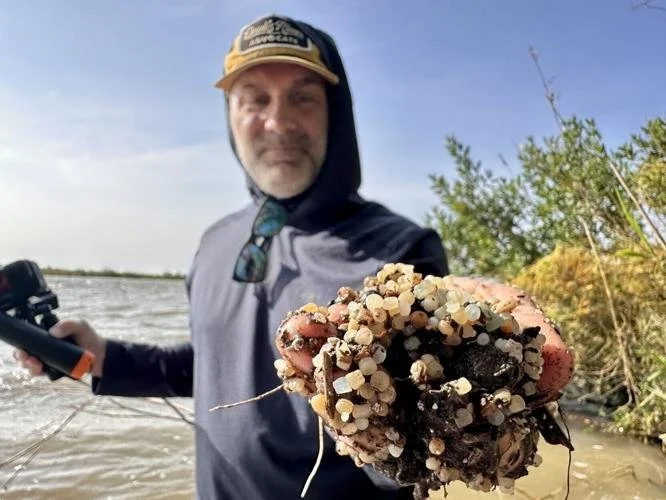
Charleston's marshes have spent thousands of years adapting to storms, tides, and the slow churn of erosion. Lately, they've had to adapt to something new: industrial plastic pollution drifting in from facilities along the harbor. Kneel at the edge of a tidal creek, and you'll find the evidence — small white pellets roughly 3/16th of an inch (4mm) caught in the reef mat at the high water mark, bobbing in the reeds, and wedged between the stalks of spartina grass. They're called nurdles, the raw material melted down into nearly every piece of plastic you own. And they're a sign of something else, too: how a community has had to evolve to protect what's left of this fragile estuary.
A single nurdle doesn't prove anything. It takes hundreds of them, each one logged with a date, a location, and a clear chain of custody, before a judge will treat a pellet as more than litter. That kind of patient, organized vigilance is itself a form of adaptation — a community building new defenses for a threat the marsh can't fight off on its own.
A New Kind of Shoreline Defense
Charleston Waterkeeper has spent years training ordinary people to do exactly that on the creeks and rivers feeding into Charleston Harbor. Under executive director Andrew Wunderley, volunteers walk the same stretches of shoreline on a rotation — sampling water, photographing outfalls, bagging pellets they find along the bank. It isn't a living shoreline you can see from a boat. It's a different kind of protective infrastructure — built from logbooks instead of oyster shells, but built for the same reason: because the marsh can't adapt to this threat without help.
When that documentation pointed toward a facility moving plastic pellets near the harbor, Charleston Waterkeeper didn't stop at a strongly worded letter. They partnered with the Southern Environmental Law Center, turning months of volunteer field data into the foundation of a legal claim — using the same citizen-suit provision written into the Clean Water Act specifically so a community can adapt its own defenses when regulators fall short.
“A nurdle by itself doesn't prove anything. A logbook full of them does.”
Proof That a Community Can Adapt and Win
This model didn't start in Charleston. In the late 1980s, Diane Wilson was a fourth-generation shrimper in Seadrift, Texas — no law degree, no lab coat, just a boat and a watershed she'd fished her whole life and watched begin to change. When she noticed plastic pellets and chemical discharge fouling San Antonio Bay, she didn't wait for someone else to act on her behalf. She started keeping her own records. She founded San Antonio Bay Estuarine Waterkeeper and organized what came to be known as the Bucket Brigade: volunteers fanning out along the bay, collecting nurdles by hand and recording exactly where they found them.
It took three decades. But in 2019, that volunteer-built evidence helped win one of the largest Clean Water Act citizen suits in U.S. history — a settlement of roughly $50 million against Formosa Plastics. Wilson taught herself to read discharge permits at her kitchen table and reshaped an entire community's defense against an industrial threat, using the same tools volunteers use on Charleston's creeks today: a bucket, a logbook, and a refusal to look away.
By the Numbers
2019 — the year Diane Wilson's citizen suit against Formosa Plastics settled
~$50 million — the settlement, one of the largest Clean Water Act citizen suits on record
Three decades — from first volunteer sample to final ruling
Charleston Harbor — where the same playbook is being adapted today, creek by creek
Why Adaptation Looks Like a Logbook
Adaptation isn't only about building taller dunes or sturdier reefs. Sometimes it's about building stronger evidence. Regulators can't be everywhere, and pollution rarely announces itself. It shows up quietly — among the spartina grass, in a jar of harbor water, in a stretch of marsh that the people who live near it know better than any inspector ever will. Protecting that marsh meant a community had to adapt how it defends itself — not with sandbags, but with documentation.
So, if you've ever wondered whether picking up plastic on a creek bank changes anything: it does. Done right — with a logbook and a little patience — it might be the difference between a polluter getting away with it and a polluter getting served.
What would you find if you looked a little closer at the water near you? And what would it take for your own community to adapt and protect vulnerable habitats? This is an example of how individual actions can contribute to a bigger action.
In early 2026, the Southern Environmental Law Center and Charleston Waterkeeper announced intent to sue multiple logistics firms for discharging plastic pellets into the Cooper River and Charleston Harbor. The legal action alleges violations of federal Clean Water and Resource Conservation and Recovery Acts, prompting a potential lawsuit to halt contamination of local waterways.