
Climate Change Timeline:
What Science Knew, What Industry Did, and How Politics Responded - A Timeline of Awareness, Obstruction, and Delay
Written By: Denny Frazier
Image: Shutterstock
Published: Jan 20, 2025
Last Updated: Jan 20, 2025
Approx. 6-minute Read
Key Takeaways:
Climate science is not new. Scientists have understood the greenhouse effect and the warming potential of carbon dioxide for over 125 years.
By the 1960s, the U.S. government had been formally warned that fossil fuel emissions could cause significant climate change.
Fossil fuel companies knew by 1970’s greenhouse gas emissions (GHG) would warm the planet and raise sea levels.
Public delay was not due to scientific uncertainty but from political resistance and corporate strategy, not lack of evidence.
Disinformation on the effects of GHG emissions by the fossil fuel industry was deliberate and strategic.
As the scientific evidence on the causal effects of increase GHG emissions on global warming strengthened, the fossil fuel tactics to sow doubt among the public evolved.
As congress considered a Cap and Trade policy to limit the industrialized emissions in 2010, the climate change became politically polarized as fossil fuel began to contribute billions of dollars into national political campaigns.
Impacts of climate change are now undeniable. It impacts amplify the severity natural disasters (drought. floods, strong of hurricanes, severity of wildfire and sea level rise).
Countries least responsible for massive amount of GHG emissions are most affected by their impacts.
This delay has increased the costs of mitigation and adaption and risks to human population.
This crisis is unfolding to limit its effects on the sustainability of the communities around the world urgent efforts are need.
The future is still being decided.
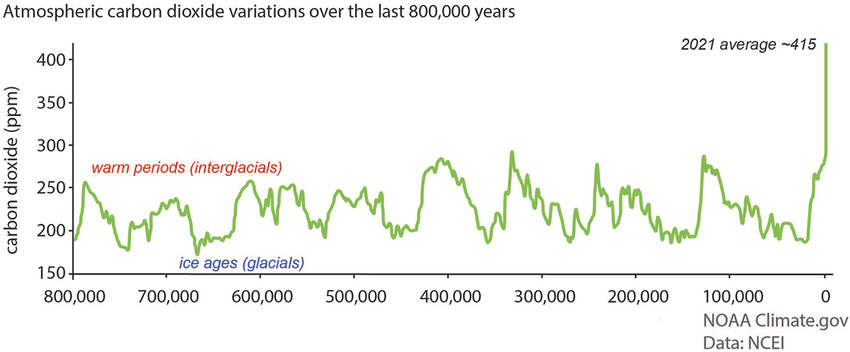
CO2 Levels over the past 800,000 years. Note the consistent pattern of glacial (ice age) CO2 concentrations around 180 ppm, and interglacial (warmer/pre-industrial) periods with around 280 ppm. The pre-industrial CO2 value was 277 ppm, and today it is around 415 ppm. Adapted from Lüthi et al. (2008).
1820s–1890s: The Greenhouse Effect Is Discovered
1824 – Joseph Fourier explains that Earth’s atmosphere traps heat.
1856 – Eunice Foote experimentally shows that carbon dioxide (CO₂) retains heat.
1896 – Svante Arrhenius calculates that burning fossil fuels could warm the planet.
Key point: Scientists understood the basics of human-driven warming more than 125 years ago.
1930s–1950s: Early Warnings, Rapid Industrial Growth
1938 – Guy Stewart Callendar links rising CO₂ from coal burning to rising temperatures.
After World War II, oil, gas, and coal use accelerated dramatically.
Climate science exists but is largely ignored in policy.
Political context: Industrial growth is prioritized; climate impacts are not yet part of the public debate.
1958–1960s: Measurement and Government Awareness
1958 – Charles Keeling begins continuous CO₂ monitoring at Mauna Loa, revealing a steady rise (the Keeling Curve).
1965 – U.S. President’s Science Advisory Committee warns President Lyndon Johnson that fossil fuel emissions could cause “measurable and marked” climate change.
Key point: The U.S. government was officially warned decades ago.
1970s: Industry Knows the Risk
1970s: Early Scientific Warnings, Quiet Industry Awareness
1970–1972: Scientists publish foundational research showing that increasing carbon dioxide (CO₂) from fossil fuel combustion could warm the planet.
1972: The UN Conference on the Human Environment (Stockholm) acknowledges human impacts on climate for the first time at a global political level.
Mid–late 1970s:
NASA scientist James Hansen and others refine climate models demonstrating future warming trends.
Oil companies, including Exxon, commission internal research confirming that burning fossil fuels would cause global warming and sea-level rise.
1977 – Exxon scientist James Black briefs executives: “There is general scientific agreement that the most likely manner in which mankind is influencing the global climate is through carbon dioxide release from the burning of fossil fuels.”
Public response: Limited awareness. Climate science is still largely confined to academic and government circles.
Key contrast: Science identifies a risk → Industry understands it privately → No public alarm.
1980s: Scientific Consensus Emerges, Industry Pushback Begins
1980s: Scientific Consensus Emerges, Industry Pushback Begins
1981–1988: Peer-reviewed studies show a clear link between rising CO₂ and global temperatures.
1988: Dr. James Hansen Director of NASA's Goddard Institute for Space Studies, testifies before the U.S. Congress: “The greenhouse effect has been detected.”
The Intergovernmental Panel on Climate Change (IPCC) was formed to assess climate science.
Late 1980s:
Fossil fuel companies and trade groups fund think tanks to emphasize uncertainty and risk, hiring PR firms to shift messaging from denial to “the science isn’t settled.”
Key contrast: Public scientific warning → Fossil Fuel begins organized doubt campaigns.
1990s: Climate Science Solidifies, Disinformation Becomes Strategic
1990s: Climate Science Solidifies, Disinformation Becomes Strategic
1990: First IPCC Assessment confirms human influence on climate.
1992: UN Framework Convention on Climate Change (UNFCCC) signed; nations agree that climate change is a shared threat.
1995: IPCC states that “the balance of evidence suggests a discernible human influence on global climate.”
1997: Kyoto Protocol negotiated to reduce emissions.
Industry response:
The Global Climate Coalition (oil, coal, auto companies) aggressively lobbies against Kyoto.
Internal memos from fossil fuel groups outline plans to “reframe the global warming as theory, not fact.”
Political misdirection:
Fossil fuel industry framed climate action as a threat to jobs, energy independence, and national sovereignty.
Key contrast: Scientific certainty increases → Political resistance hardens.
2000s: Public Awareness Grows, Polarization
Takes Hold
Early 2000s:
IPCC Third and Fourth Reports show stronger evidence of human-caused warming.
Climate denial becomes aligned with partisan identity, particularly in the U.S. with Republican siding with fossil fuel interest equating fossil fuel to national and economic security
2006: 'An Inconvenient Truth' documentary featured Al Gore, showcasing global warming science, alarming data on rising temperatures, extreme weather, and species loss. It served as a rallying cry for climate action, highlighted political inaction, and sparked debate and awareness.
2007: IPCC and Al Gore win the Nobel Peace Prize.
Industry strategy evolves:
Shift from outright denial to delay tactics:
Promote voluntary action over regulation
Emphasize individual responsibility
Advocate for future technological fixes instead of immediate cuts
Media issue:
“False balance” presents climate science as a debate despite overwhelming consensus.
Key contrast: Public awareness rises → Action delayed through polarization and distraction.
2010s: Climate Impacts Are Visible, Obstruction Persists
2013–2014: IPCC states with high confidence that humans are the dominant cause of warming since the mid-20th century.
2015: Paris Agreement signed by nearly every nation to limit warming to well below 2°C.
Simultaneously:
Fossil fuel companies continue expanding oil and gas production.
Political leaders question climate science or withdraw from international commitments.
Disinformation evolves:
Social media amplifies misleading narratives.
Climate action is reframed as elitist, anti-freedom, or economically destructive.
Youth and public movements emerge (e.g., climate strikes, Indigenous-led resistance).
Key contrast: Climate damage becomes undeniable → Policy response remains insufficient.
2020s–Present: The Era of Consequences and Reckoning
2021–2025:
Record-breaking heat, wildfires, floods, and coral bleaching events occur globally.
IPCC warns that the window to avoid catastrophic warming is rapidly closing.
Revelations:
Investigative reporting confirms fossil fuel companies knew about climate risks for decades and deliberately misled the public.
Current misinformation trends:
Downplaying severity (“adaptation is enough”)
Promoting fossil gas as a “bridge fuel”
Delaying action through claims of economic instability
Political misdirection continues:
Climate policies stalled or weakened.
Responsibility shifted onto individuals rather than systemic change.
Key contrast: Scientific clarity + lived experience → Still battling delay and denial.
The Big Picture:
The climate crisis is now a reality, affecting lives, economies, and ecosystems. Rising temperatures, heatwaves, floods, droughts, wildfires, and storms displace communities, strain resources, damage infrastructure, and increase health risks.
These impacts mostly affect those least responsible: low-income communities, Indigenous peoples, small island nations, coastal populations, and communities in the Global South. Ecosystems—from coral reefs and forests to glaciers and wetlands—are reaching irreversible thresholds, weakening systems that protect people and sustain livelihoods.
Looking ahead, projected impacts include accelerating sea-level rise, more frequent climate “whiplash” events, increased conflict over resources, widening economic inequality, and mounting humanitarian crises.
This crisis isn't due to scientific uncertainty. For decades, greenhouse gas risks were known, but delay stemmed from obstruction, misinformation, and political misdirection that hindered action, weakened policies, and protected short-term interests.
The result has been wasted time, rising costs, and more damage. Each year of inaction worsens warming, limits adaptation, and burdens future generations. Delay leads to tougher, costlier challenges, requiring immediate, transformative actions to protect vulnerable communities and ecosystems.
The Big Picture - Summary:
Science has been consistent for over 50 years: greenhouse gas emissions cause global warming.
Delay was not due to uncertainty, but to intentional obstruction, misinformation, and political misdirection.
The result: lost decades, higher costs, and greater harm—especially for vulnerable communities and ecosystems.