
OPINION · SEE-THE-SEA.COM
The Seven Stages of Climate Action
A journey from connection to purpose — and why the distance between knowing and doing is shorter than we think
By Denny Frazier · June 2026
In late June 2021, a heat dome settled over the Pacific Northwest unlike anything in recorded history. Temperatures broke all-time records across the region by margins that stunned climatologists. I was flying between Spokane and Seattle during those days, and as the plane banked south I looked out the window for Mount Rainier.
I’ve climbed Rainier. I know that mountain the way you know something you’ve moved through on foot — the route from Paradise, the snowfields, the ice features that serve as landmarks when you’re navigating at altitude. From the air, I’ve always been able to find the line of ascent without thinking about it.
I couldn’t find it. The snow and ice features I’d used to read the mountain were diminished or gone. The route I knew wasn’t there anymore. Researchers later confirmed that Rainier had lost 30 percent of its snowpack during the heat dome alone — five days of temperatures exceeding 13 degrees Celsius above normal at high elevations. The mountain had been measurably, permanently changed in less than a week.
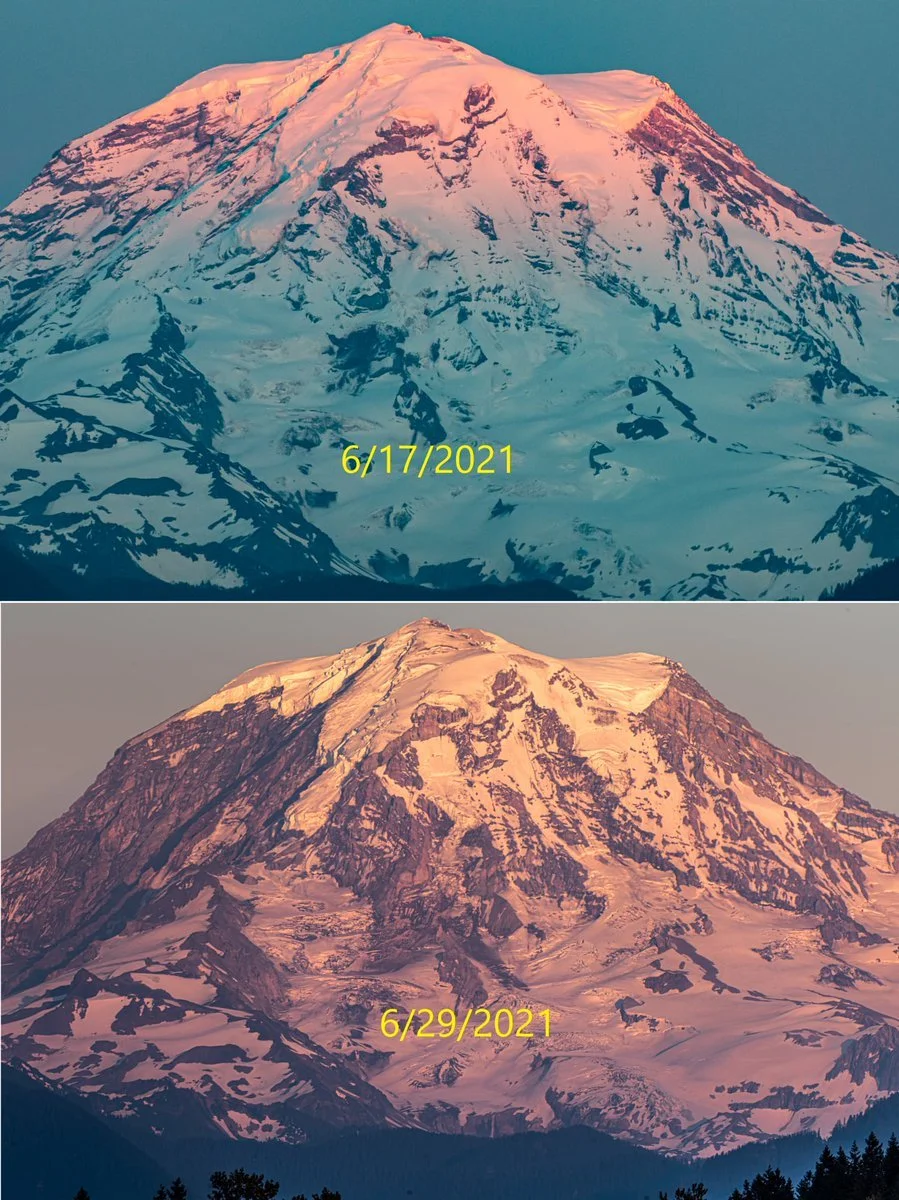
These photos, taken just 12 days apart, capture the 2021 Pacific Northwest heat dome's toll on Mount Rainier. Over 95 inches of snow melted at Paradise in 21 days — a 30% loss of the mountain's snowpack in a single event. Decades of warming have gone further still: Columbia Crest, the iconic summit, is no longer Rainier's highest point. Glacial melt has dropped the peak roughly 20 feet, exposing bare rock in its place. Credit: Northwest Avalanche Center / National Park Conservation Association
I sat with that for a long time. It’s one thing to read that glaciers are retreating. It’s another to look down at a mountain you’ve stood on and not recognize it. That moment didn’t make me a climate activist. But it struck me profoundly — the way only the loss of something deeply known can.
Most people who care about climate change can name a moment like that — when the abstract becomes personal, and the theoretical becomes visible. A storm that reached somewhere it shouldn’t. A reef that wasn’t there anymore. A place you’ve known your whole life that no longer looks like itself. The journey from concern to action rarely follows a straight line, but it tends to move through recognizable stages. Here’s how I’ve come to understand them.
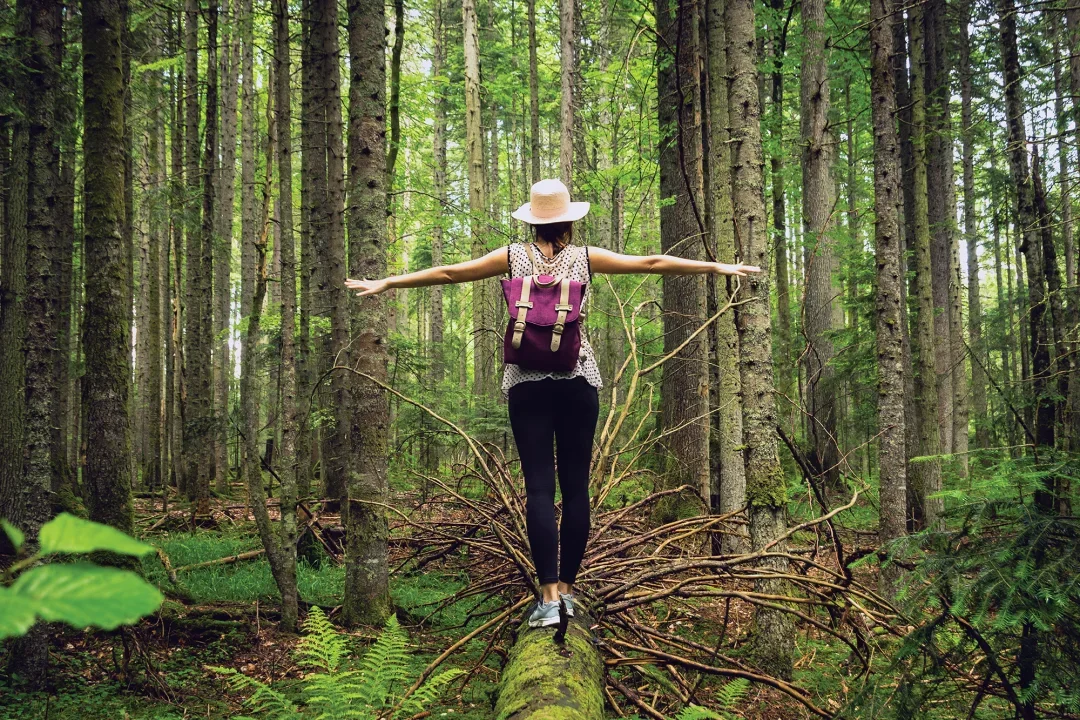
Standing on a fallen log, we slow down and listen to the forest around us — wind, soil, and living systems working together. In that connection, we remember that caring for the climate begins with recognizing our shared place within nature.
Credit: Oregon Adventure Coast
STAGE 1: A Connection to Nature
For most people, everything begins here. A childhood near the water. A love of forests or mountains or open sky. A sense — felt before it’s understood — that the natural world is worth protecting.
At this stage, concern is emotional rather than analytical. People notice disappearing species, polluted waterways, shrinking wild places. They may recycle, support conservation efforts, pick up beach litter. Climate change still feels distant — something happening to polar bears, not to people. But the emotional foundation is being laid. Without love for what’s at stake, nothing that follows takes root.
STAGE 2: Recognizing a Global Problem
Awareness gradually widens. Scientific reports, news coverage, and accelerating extreme weather events begin to form a pattern. Rising temperatures. Stronger storms. Longer droughts. Species in retreat. Climate change takes shape as a real, global challenge rather than a distant abstraction.
At this stage, most people accept the science. They understand that fossil fuels drive warming and that the trajectory is serious. Yet responsibility still feels like it belongs elsewhere — to governments, corporations, or future generations. According to Yale’s Program on Climate Change Communication, this is where much of the public currently sits: aware, concerned, but uncertain how the crisis connects to their own lives or choices.
STAGE 3: When It Gets Personal
This is the stage where the distance collapses.
For me, it was looking down from a plane at a mountain I’d climbed and not being able to find the route I’d followed on foot — the snow and ice features simply gone. For others it’s a flooded basement, a fishing season that no longer comes, a family member hospitalized during a heat emergency. Whatever the trigger, something shifts: the global becomes local, and the theoretical becomes something you can see with your own eyes.
This is also where eco-anxiety often takes root — a rational response, as the American Psychological Association notes, to a genuine threat. Behavior tends to change here: less waste, more conscious consumption, growing attention to personal choices. But beneath those actions, a harder realization is forming. Individual effort matters — and it isn’t enough.
“I’ve climbed that mountain. I know the route from Paradise, the ice features, the landmarks. From the plane, I couldn’t find them. The mountain I knew wasn’t there anymore.”
STAGE 4: Seeing the System
With time, the picture widens again. People begin to see that climate change isn’t primarily the result of individual failure — it’s the result of systems built around fossil fuels, extraction, and endless growth. Energy grids. Industrial agriculture. Global supply chains. These structures come into focus as the real drivers of emissions.
Recycling suddenly looks small next to a coal-fired power plant. Reusable bags seem insufficient when set against the scale of deforestation for global commodity markets. This realization can feel both clarifying and unsettling — clarifying because it points to where real change must happen, unsettling because it reveals how deeply the crisis is embedded in the infrastructure of modern life.
For me, this shift happened underwater as much as on land. A reef isn’t dying because of one bad actor — it’s dying because of accumulated decisions made by entire economies about what energy to burn, what fish to harvest, what coastlines to develop. The ocean taught me systems thinking before I had a name for it.
STAGE 5: Energy Literacy
At the heart of the climate crisis lies a simple truth: it is fundamentally an energy problem. The modern world runs on fossil fuels, and decarbonization means transforming how energy is produced, distributed, and consumed at every level — electricity grids, transportation, buildings, industry.
This is where awareness becomes practical. People begin to understand why renewable energy matters beyond symbolism, why electrification is essential rather than optional, and why efficiency improvements alone cannot close the gap. According to the Intergovernmental Panel on Climate Change, energy production accounts for more than three-quarters of global greenhouse gas emissions. Grasping that fact tends to mark a turning point — from generalized concern to informed, specific engagement.
STAGE 6: Interconnection and Justice
The deeper you look, the more connected everything becomes. Climate change is an environmental crisis, yes — but it’s also a public health crisis, an economic crisis, a justice crisis. The impacts don’t fall evenly. Low-income communities bear greater exposure to pollution. Coastal populations lose homes and livelihoods first. Farmers and Indigenous communities face disruptions long before most urban centers feel the effects.
Feedback loops emerge: warming accelerates ice loss, which accelerates warming. Deforestation alters rainfall, which disrupts agriculture. In the ocean, warming drives bleaching, which weakens reef structures, which reduces the coastal protection reefs provide against the stronger storms that warming also generates. The crisis is no longer just about carbon — it’s about resilience, equity, and what kind of civilization we’re building.
“A reef isn’t dying because of one bad actor. It’s dying because of accumulated decisions made by entire economies about what to burn, what to harvest, what to develop.”
STAGE 7: Purpose and Regeneration
The final stage is not despair. It is resolve.
People who reach this stage have moved beyond fear toward purpose. They’ve accepted that the goal is no longer to preserve the world as it was, but to shape what comes next. Climate action stops feeling like sacrifice and starts feeling like possibility — cleaner air, healthier communities, restored ecosystems, energy systems that don’t poison the places they power.
This is where sustained engagement becomes possible: voting and organizing, innovating and teaching, restoring land and advocating for policy. The question shifts from “How do we stop climate change?” to “What kind of world do we want to build?” That reframe changes everything. It converts anxiety into agency, and grief into work.
• • •
People move through these stages at different speeds. Some stall. Some circle back. The 2021 heat dome didn’t complete my journey — it accelerated it. Years later, feeling 80-degree water at 70 feet off Bonaire, I understood the same thing through a different sense: the system is changing faster than we’ve admitted, and the window for meaningful response is narrowing.
But windows don’t close all at once. And every person who moves from Stage Two to Stage Three, from personal concern to systemic understanding, from understanding to action — shifts the odds, however slightly, in the right direction.
The climate story is no longer only about what is happening to the planet. It is about how we choose to respond to it. That choice is still ours to make.
Where are you in this journey? And what would it take to move one stage further?
By Denny Frazier · see-the-sea.com · Impacts