
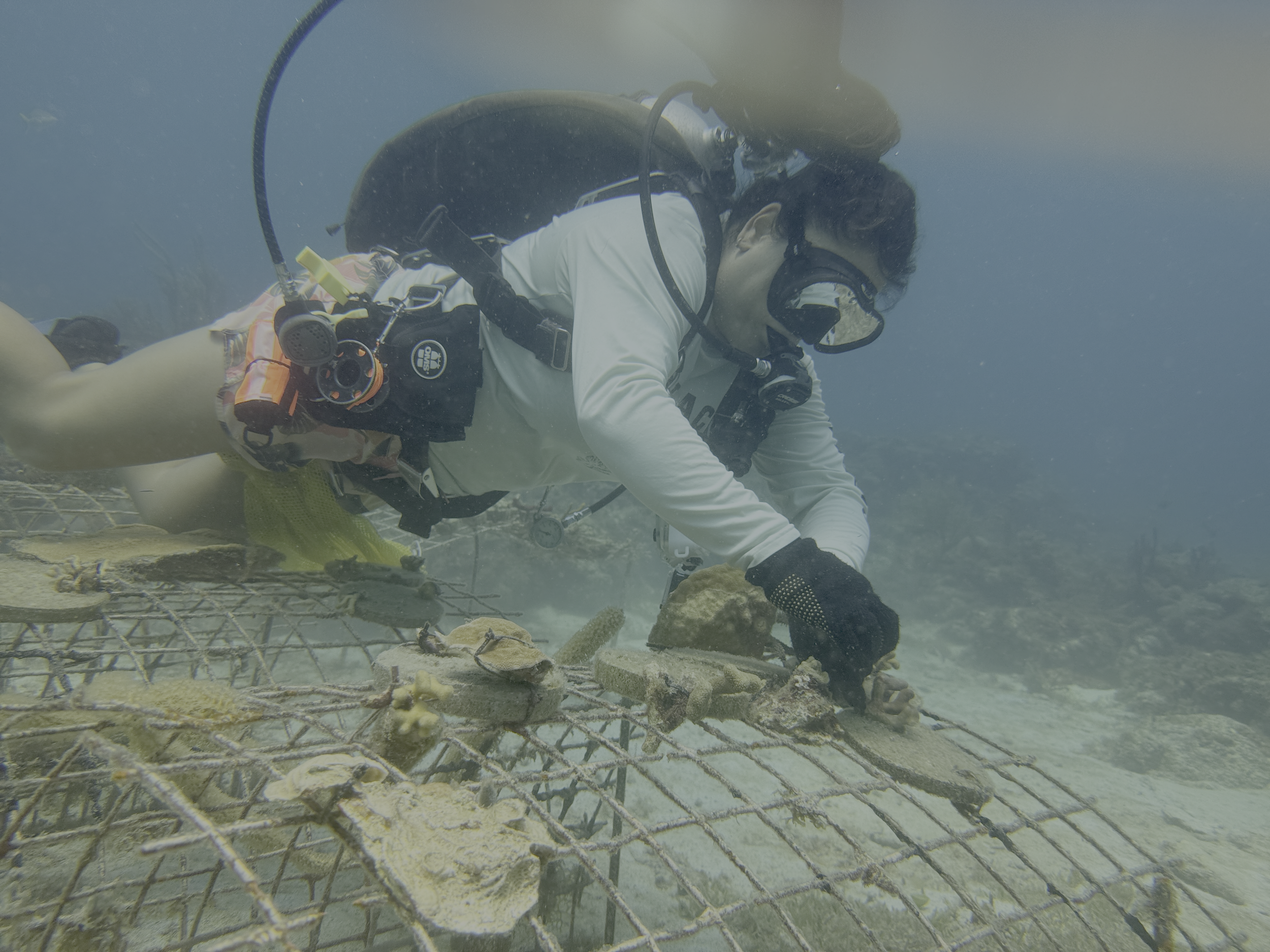
Nora Valdes, Operations Director of Deefer Dive Center, Cleaning around Coral Nursery at Jack a Dan Island, Carriacou Island, Grenada
Getting in the water, doing the work, and learning what it actually takes to restore a reef.
By Denny Frazier
Carriacou, Grenada • September 2026
Nora Valdes, Operations Director of Deefer Dive Center, Cleaning around Coral Nursery at Jack a Dan Island, Carriacou Island, Grenada
If you love coral reefs and want real, hands-on experience doing something about it — not donating, not sharing a post, but actually getting in the water and working — this one's for you.
My first dive in Carriacou, I didn't see a single coral.
I was underwater along the jetty, pulling out a massive amount of fishing line. That's not a complaint — it's the point. I'd spent six hours that morning learning what healthy reefs need to survive. That afternoon, I was clearing out one of the things killing them. By the time I surfaced, I understood something no classroom could have taught me: this work starts before you ever reach the reef.
I'm in Carriacou volunteering with Caribbean Reef Buddy at Deefer Diving. If you're eyeing a career in marine science and you know how competitive it is — or you just want to do something real — keep reading. There is room for you here.
DAY ONE: SIX HOURS OF CLASS, THEN INTO THE WATER
The morning was dense. Coral biology, reef ecology, the compounding pressures bearing down on Caribbean reefs right now — disease, warming, acidification, overfishing, nutrient runoff. Six hours of it. A lot to hold.
Then we geared up and got in. Our first dive was a Project AWARE cleanup — a structured, documented debris removal along the jetty and beach. No coral in sight, just the underside of a working dock and everything that accumulates there. It sounds unglamorous. It felt exactly right. You learn what you're up against before you start trying to fix it.
THE NURSERY
The coral gardens are anchored to the ocean floor — wire frame structures with coral fragments already attached when I arrived. Hard coral, soft coral, sponge. Some pieces tagged and tracked. Others not yet. All of them growing, slowly, toward the size where they can be outplanted back onto the reef.
And alongside the wire frames: structures built from cement and beer bottles. Improvised, resourceful, effective. The ocean doesn't care what the substrate looks like. If it's stable and hard, coral will grow on it.
The fragments came from the reef itself — pieces naturally dislodged, or broken off by damage. Nothing cut from a healthy colony. Coral gardening starts with what's already been lost and works to give it back.
Our job: keep it all alive. That means cleaning. A fine, hairy film grows on everything underwater — it attaches fast and firmly, and left alone it smothers the coral you're trying to grow. We worked through the structures with soft brushes, fragment by fragment. Then we measured and logged each piece — recording growth since the last session, building the record that turns effort into evidence.
The reef doesn't recover on its own timeline anymore. We're the ones keeping track now.
MOVE LIKE YOU'RE BARELY THERE
Buoyancy control isn't just a diving skill here — it's a conservation act.
One careless kick breaks a fragment that took months to grow. Brush against fire coral and you'll feel it immediately — it burns, and it doesn't apologize. Graze hard coral with an ungloved hand and you're looking at a wound that tropical water will not be kind to. The instructors push you on buoyancy from the first minute, and they're right to. The best thing you can do for a reef you're trying to restore is to move through it like you're barely there.
WHAT THE REEF HAS LOST
Understanding what's missing matters as much as knowing what's there.
Parrotfish, surgeonfish, and tangs are the reef's essential cleaning crew — scraping surfaces, grazing algae, making room for new coral to take hold. They literally create the space where recovery happens. And they're disappearing from these reefs, taken by overfishing. When the grazers go, algae wins. When algae wins, new coral can't recruit. The reef simplifies and stalls.
Hurricane Beryl hit Carriacou in July 2024 as a Category 4 storm, landing on reefs already weakened by two years of Stony Coral Tissue Loss Disease — a fast-moving, high-mortality coral disease with no cure. The staghorn and elkhorn coral that once built the Caribbean's most complex reef structures, both now IUCN Endangered, had been clinging on here. Beryl took the last of them. Every staghorn and elkhorn coral on Carriacou's reefs is gone.
That's not a reason to give up. It's the reason the nurseries exist.
THE LIONFISH DAY
One day we took a boat to the southern end of the island for lionfish removal. Lionfish are invasive — Indo-Pacific natives with no natural predators here, eating their way through juvenile fish populations with nothing to stop them. Divers hunt them with pole spears. We removed over half a dozen in a single dive. For one site, that's a real number.
And yes — we ate them. Lionfish are delicious. Turns out the ocean occasionally offers small consolations for very large problems.
THE MANGROVES
We visited a mangrove restoration site on the island. Not a cleanup — just time spent understanding the connection. Mangroves filter runoff, hold coastlines together, and raise the juvenile fish that eventually populate the reef. Carriacou's mangroves were hammered by Beryl. The restoration effort is slow, methodical, and necessary. Watching new growth push back in at the edges, you start to see the whole system — land, shoreline, reef — as one thing.
WHY COME HERE
If you're building toward a career in marine biology, you know how the field works. Experience is what separates candidates. Real field time — coral restoration, species monitoring, invasive removal, conservation work in a community that needs it — is what gets you there.
And if a career isn't the point? If you just want to do something that actually matters with your time? That's the right reason too. The reef doesn't care about your CV. It needs people willing to show up, learn, and work.
Week two is already underway. I'll keep bringing you along.
Follow the work at see-the-sea.com. To support what's happening in Carriacou's waters, Caribbean Reef Buddy and Deefer Diving are where to start.
see-the-sea.com • Field Report • Carriacou, Grenada • September 2026
