
Thirty boats. Thirty children's faces. Temperature data etched in steel at the bottom of the sea. Jason deCaires Taylor called it a warning. Then, the earliest Atlantic Category 4 hurricane on record arrived.
By Denny Frazier · see-the-sea.com
A FIELD REPORT - CARRIACOU, GRENADA - SEPTEMBER 2026
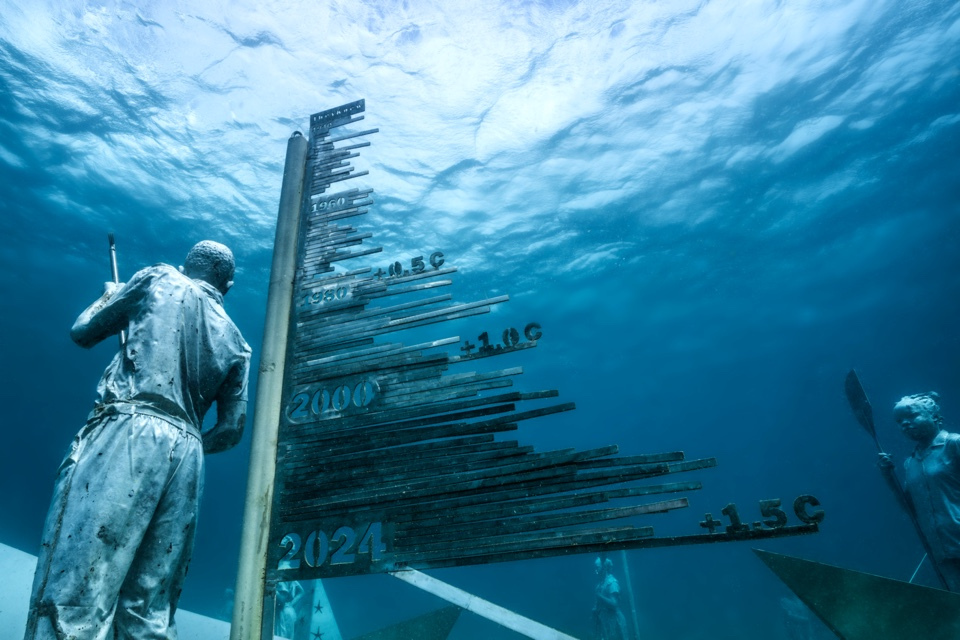
Jason deClaire Taylor: A World Drift underwater sculpture with the bar graph depicting an ever-increasing average world temperature rise. Photo credit: Jason deClaire Taylor
Thirteen feet underwater off the west coast of Carriacou, thirty steel origami boats sail into an uncertain future. Each boat carries a small figure. Each figure is a cast of local children holding a paddle, facing forward. Two of the boats have sails. These sails display a bar graph of global temperature data. This is the scientific record of a warming planet. The crew places the boats on the seafloor. In 2024, the average global temperature rose more than 1.5 degrees Celsius above pre-industrial levels. This marked the first time on record that it crossed this threshold, which the Paris Agreement aims to limit warming to. The artist planned to place these children underwater as a warning about what’s coming. Before the sculptures could be placed, Beryl arrived — the earliest Category 4 hurricane ever recorded in the Atlantic.
THE MESSAGE IN THE BOATS
"Rising sea levels, warming oceans, coastal erosion and the specter of increasingly ferocious weather events, such as hurricanes, cast a shadow over the future of these beautiful delicate ecosystems." — Jason deCaires Taylor
"A World Adrift" is an underwater sculpture by British-Grenadian artist Jason deCaires Taylor, unveiled in October 2024 near Jack-a-Dan Island. Positioned four meters below the surface, it is accessible to snorkelers and divers of all experience levels. Taylor, known for creating artificial reefs across the Caribbean and beyond for decades, designed this installation with distinct symbolism. The piece features thirty steel boats that resemble delicate origami, contrasting with the steel's permanence. While paper boats float briefly before sinking, casting them in steel maintains the tension rather than resolving it. The children depicted are named directly: climate refugees, representing real children from Small Island Developing States like Grenada who face uncertain futures as climate change threatens their way of life.
The children don't look up at the temperature data on those sails. They stand in front of the sails. Unfortunately, the average world temperature for 2024 exceeded 1.5°C above preindustrial levels. One year above 1.5°C doesn’t mean we’ve lost the Paris goal. The target is about long-term averages over decades. Scientists call this the overshoot era. This is a period in which warming may briefly go beyond that threshold. If we reduce our emissions aggressively, we could then bring temperatures back down. However, this outcome is becoming unlikely. The children in front of those sails will be the generation that experiences it.
The installation also honors Carriacou's cultural heritage. For centuries, local craftsmen have manually built wooden sailing schooners, relying on tradition instead of industrial tools. The origami boats symbolize this enduring craft. While climate change may not destroy the tradition itself, it will challenge the ecosystem that sustains it.
JULY 1, 2024: BERYL
Hurricane Beryl struck Carriacou on July 1, 2024, as a Category 4 storm, marking it as the earliest such hurricane in Atlantic history. This early-season event underscored the dangers posed by warm ocean waters and occurred well before the peak of the Atlantic hurricane season in September. Carriacou took a direct hit. Roofs were gone. The wind stripped the leaves. The mangroves, which serve as critical nurseries and filters for the reef, died when Beryl stripped their leaves. These leaves help manage salt carried in by storm surge. A 50-foot fishing vessel ended up beached at Harvey Vale, an unasked-for monument to the storm. Tourism, fishing, traditional boat-building, small-scale agriculture — the storm disrupted all it. Deefer Dive Center, the main dive operation on the island, closed on July 1. Beryl damaged its roof and the rainwater collection system it relies on. It didn't reopen until early September.
Two months of silence — while the reef outside absorbed its own version of the same blow.
Carriacou had help. The Grenadian government restored power and communications within days. Regional and international organizations provided food, shelter, and supplies. They didn't leave island residents to manage this alone. This work continues with volunteers helping to replace roofs and rebuild homes. However, outside help can't replace the specific, personal work of rebuilding a life. Phillip, a retired engineer, is still rebuilding his home out of pocket, by hand. Danty, a local conservationist, has had to move three times due to the housing shortage. This August, he planted palm and almond trees on the beach with his eight-year-old son. This is the next generation of roots, going in on purpose.
WHAT THE REEF HAS DONE SINCE
"A World Adrift" was installed three and a half months after Beryl. The reef got to work immediately.
Twenty-six months later: encrusting coral covers the steel hulls. Tunicates filter the water column from the figures' surfaces. Sponges colonize the crevices of the origami folds. Caribbean Reef Buddy, a marine conservation NGO, is affiliated with Deefer Dive Center. They helped plan and place the sculptures. They are also adding sponges to the rigging to speed colonization. They designed the rigging like a nursery, with more substrate, more vertical structure, and more surface area. This gave the reef more space to grow.
Discussions are underway to establish a small Marine Protected Area around Jack-a-Dan Island. The site already has designated buoys and anchor-free zones. This would legally protect the reef and the installation. The Grenadians are considering the agreement, but at least the conversation has begun.
THE CHILDREN IN THE BOATS
The children cast in steel at the bottom of Jack-a-Dan Bay aren't victims. Taylor designated them as navigators. Each small figure holds a paddle. They faced whatever the water brought.
The real children of Carriacou are confronting a threat while building a response. They have the Sandy Island/Oyster Bed Marine Protected Area (SIOBMPA) and a sculpture park. The reef is already encroaching on the park. They are also part of a community that acted quickly. The challenge is enforcing the MPA effectively. Enforcers must balance conservation with the community's subsistence needs.
Carriacou faces big challenges. These include ocean warming, rising sea levels, ocean acidification, stronger storms, and overfishing. They're the present, arriving in sequence. Taylor conceived A World Adrift as a warning. The hurricane arrived before the installation was even in the water. And the reef, given something to hold onto, started growing back.
The boats are still there. The children's faces are still watching. The coral spreading across the steel is slowly answering the question the installation has always posed: what kind of world are we leaving them?
TAKE ACTION
→ Follow Caribbean Reef Buddy's conservation work: caribbeanreefbuddy.org
→ Volunteer with Caribbean Reef Buddy through Deefer Dive Center in Carriacou, Grenada
→ View live CoralWatch reef health data from Carriacou: biocollect.ala.org.au/coralwatch/bioActivity/allRecords
→ Learn more about Jason deCaires Taylor's work and installations worldwide: underwatersculpture.com
→ Visit Instagram @see_the_sea26
