
Washington State Tore Down 2 Dams on the Elwha — What the Salmon Did Next Was Unbelievable
One tribe fought for a century. An activist painted a fake crack on concrete at night. Scientists watched in awe as nature rewrote their models. This is the story of what happens when a river gets its freedom back — and why it matters for every coastline on Earth.
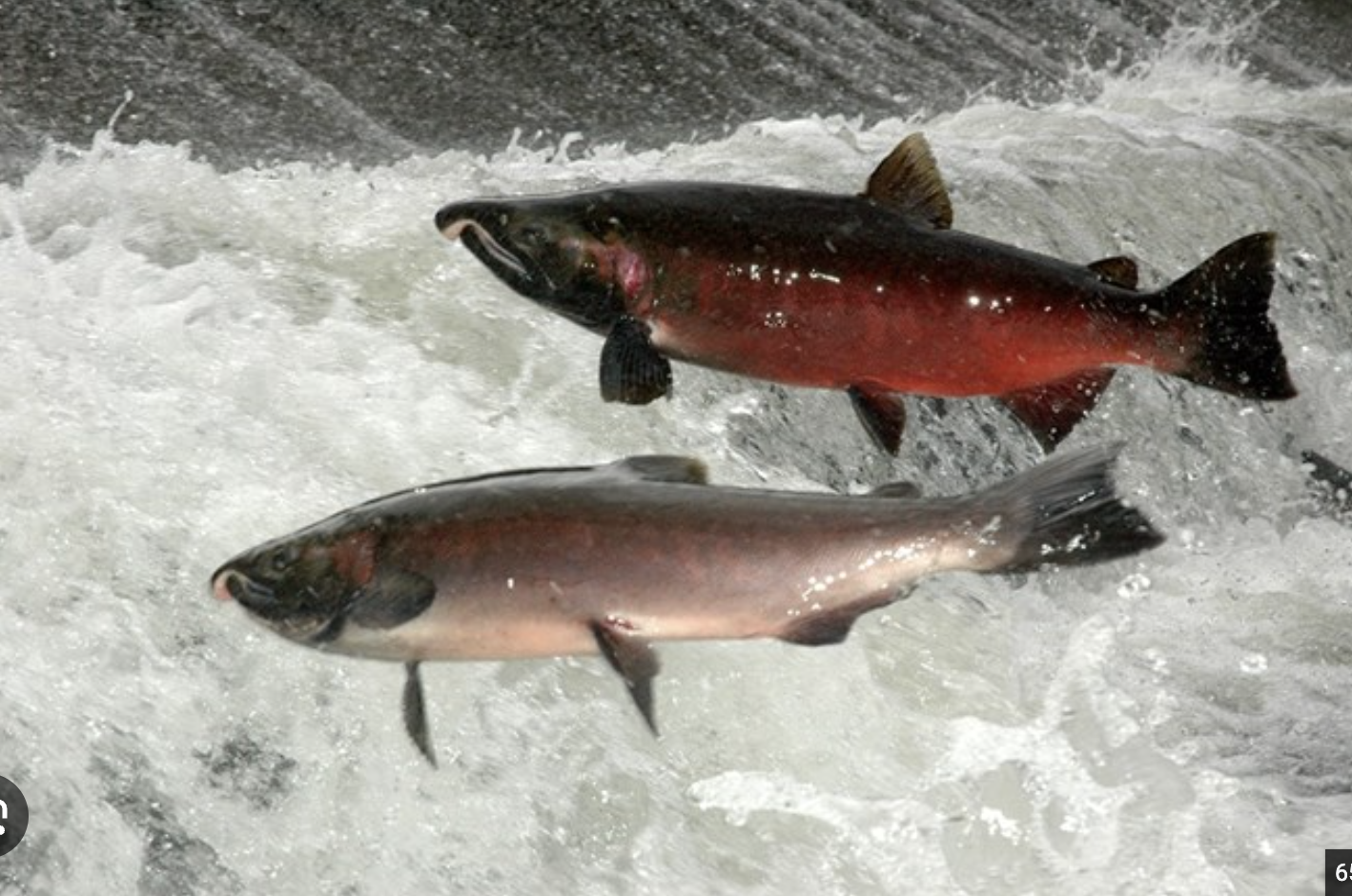
Chinook Salmon swimming and jumping their way up the Elwha River to a spawning ground unreachable for over a hundred years. Source: National Park Service 2025
In the summer of 2012, Phil Kennedy waded in the Elwha River. He watched as the shapes shifted in the murky current. Models predicted it would take years for salmon to return. Workers had only finished demolishing the first dam. The sediments still choked the river as the bed reshaped itself in real time. Then a shape surfaced — then another and another. Chinook salmon, moving upstream for the first time since 1913.
"We did not expect the Chinook to return yet," Kennedy said.
The river knew what it was doing.
A River That Powered a People
The Elwha River starts in the snowy peaks of Washington's Olympic Mountains. It flows 45 miles through old-growth forests before emptying into the Strait of Juan de Fuca. For thousands of years, this river was one of the most productive salmon systems on the Pacific coast. It was one of the few rivers in the U.S. where all five native Pacific salmon species returned to spawn. These salmon included chinook, coho, sockeye, pink, and chum. It also supported steelhead, bull trout, sea-run cutthroat, and Pacific lamprey. Annual returns once reached 392,000 fish.
The Lower Elwha Klallam Tribe has lived in this valley for over 8,000 years. Tribal stories describe chinook that were so large, some weighing over 100 pounds, that children couldn't carry them. Tribal members linked arms to drag the massive fish ashore. They called these fish ta'culh: king of kings in the Salish Sea. The tribe's entire cultural and economic life centered on the river. Archaeological evidence of 8,000 years of habitation along its banks supports this claim.
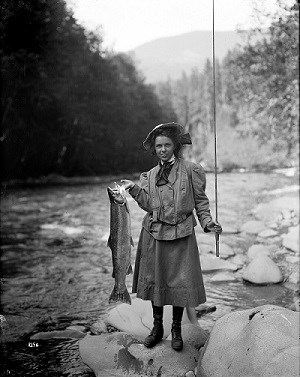
Historic image of a woman holding a salmon on the banks of a river. Photo: National Park Service
The river was also sacred in a literal sense. Tribal oral tradition speaks of a creation site along the Elwha. It's a rock formation where the creator bathed and blessed the Klallam people. Generations used this site for vision quests. The river and the salmon were not resources. They were family.
The Man Who Built a Dam Illegally — and Got Away with It
In 1910, Canadian entrepreneur Thomas Aldwell began purchasing land along the lower Elwha. He viewed the river's narrow gorges not as salmon habitat but as a cash machine. Hydroelectric power to fuel the booming timber economy. He formed the Olympic Power Company and began building a dam five miles from the river's mouth. He cut corners at every stage.
Aldwell failed to anchor the dam to bedrock. Instead built on unstable glacial sediment. More critically, he built no fish ladders — a direct violation of Washington state law. In 1912, the dam burst. The flood destroyed land the Lower Elwha Klallam Tribe had relied on for generations. Aldwell patched the dam, secured new investors, and began generating power by 1913. He named the reservoir after himself: Lake Aldwell. As this lake filled, it submerged the Klallam creation site under 40 feet of water. A sacred landscape, gone. To compensate for the missing fish ladders, the Olympic Power Company built a fish hatchery at the base of the dam in 1915. By 1921, officials shut it down. Almost no salmon were reaching it.
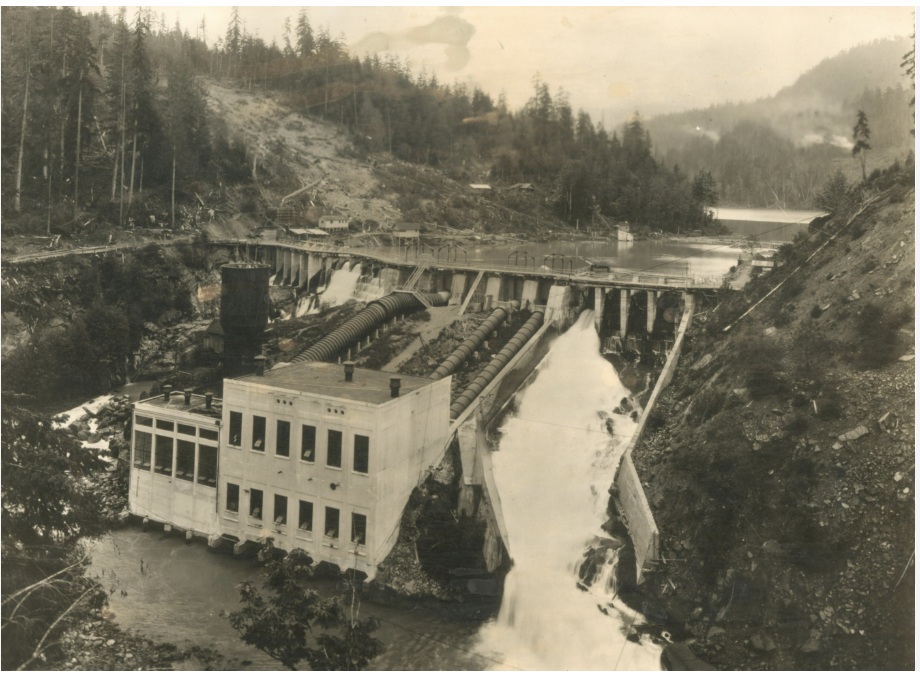
Historic Elwha Dam Powerhouse in 1913. Source: National Park Service, 2025
The Northwest Power and Light Company built a second, taller dam, the Glines Canyon Dam, 8 miles upstream in 1927. When Lake Mills filled, it also covered many of the Lower Elwha Klallam fishing camps.
Together, the two dams cut off more than 90% of the Elwha's spawning habitat. Annual fish returns declined from 392,000 to fewer than 3,000 naturally spawning adults. This was a decline of over 98%. Sockeye salmon on the Elwha didn't decline. They went locally extinct. By the 1940s, both dams powered a single customer: a paper mill in Port Angeles. One hundred miles of salmon habitat, for one industrial client.
The Long Fight
The Lower Elwha Klallam Tribe began fighting almost immediately. For decades, few outside the tribe listened.
In 1976, the Teton Dam in Idaho collapsed, killing 11 people. This sparked a nationwide safety inspection of every dam in the U.S. The Elwha Dam failed inspection. The Glines Canyon Dam's operating license had already expired. For the first time, the dam's renewal was uncertain.
The 1979 Boldt Decision significantly empowered the tribe by reaffirming treaty rights. This decision gave the Lower Elwha Klallam the right to half of the salmon that return to their traditional fishing areas. The 1855 Treaty of Point No Point established their fishing rights. The dams suppressed these people's fishing rights for over a century. When the operator of the Glines Canyon Dam sought to renew their license, the tribe initiated legal action. The National Marine Fisheries Service, NOAA Fisheries, the Sierra Club, and American Rivers supported the tribe in their lawsuit against the Glines Canyon Dam operators. The lawsuit dragged on for years
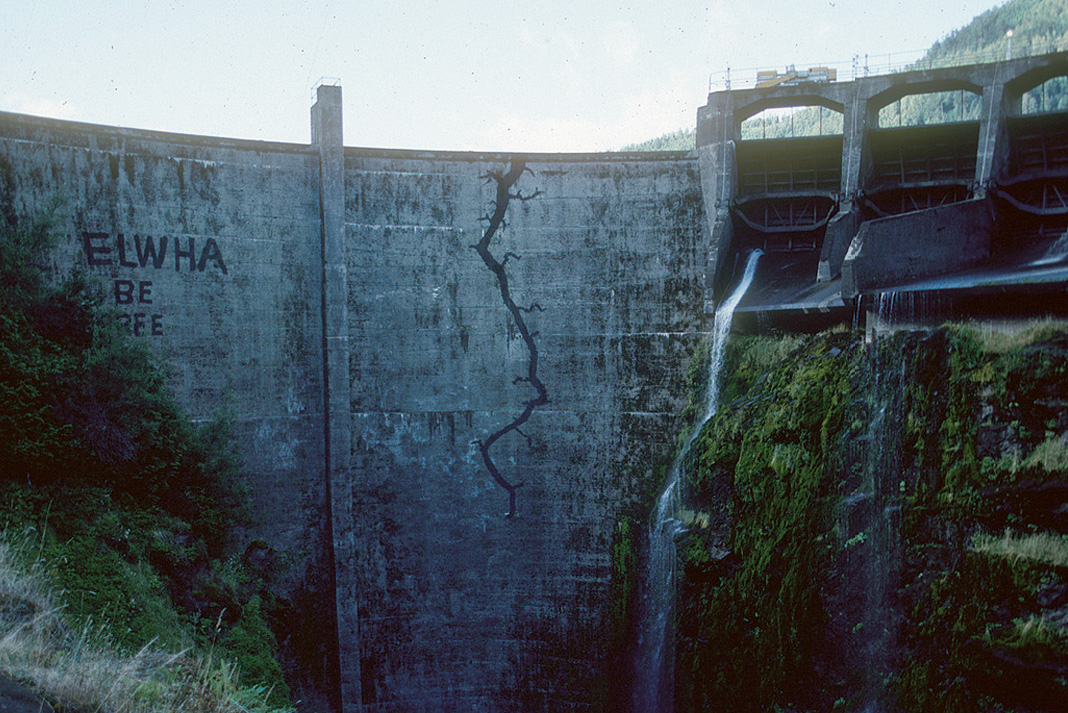
In 1987, an activist rappelled down Glines Canyon Dam and painted a giant fake crack and "Elwha Be Free”, Regional news outlets began reporting on the lawsuit, which increased public support to remove the dams. Photo Source: Mikal Jakubal
In September 1987, one activist broke through public apathy by rappelling down Glines Canyon Dam at night. They painted a large fake crack on the concrete, along with the message: ELWHA BE FREE. Photos of the act circulated widely across the Pacific Northwest. A dam that few residents had paid attention to suddenly gained a face—and a challenger.
The legal outcome became mathematically certain. Under the Endangered Species Act, several salmon species in the Elwha River were classified as endangered. This meant that the dams could no longer block the salmon from accessing their spawning grounds and required the installation of functional fish ladders. The cost of compliance was nearly as high as simply removing the dams. Neither operation could secure a new license.
In 1992, Congress enacted the Elwha River Ecosystem and Fisheries Restoration Act, marking the first time in U.S. history that a law authorized dam removal for ecosystem restoration. The Department of the Interior acquired both dams for $29.5 million. Federal stimulus funding was received in 2009. The total cost of the project amounts to $325 million, which includes the construction of two new water treatment facilities for Port Angeles's municipal water supply.
Nearly two decades after Congress first said yes, the machines finally moved.
Breaking It Down
On September 15, 2011, a barge-mounted excavator began removing concrete from Glines Canyon Dam. The Elwha Dam's removal started four days later. Actor and longtime river advocate Tom Skerritt told the crowd: "Elwha, be free."
This project involved a unique demolition process. Both dams contained around 30 million tons of sediment, including sand, silt, clay, and decomposing organic matter that had built up over the past century. Engineers carefully dismantled the structures over three years, allowing the river to release sediment in controlled intervals rather than through a sudden flood. The Elwha Dam demolition was completed in March 2012, and the final section of the Glines Canyon Dam was removed on August 26, 2014. For the first time in over a century, the Elwha River flowed freely from snowfield to sea.
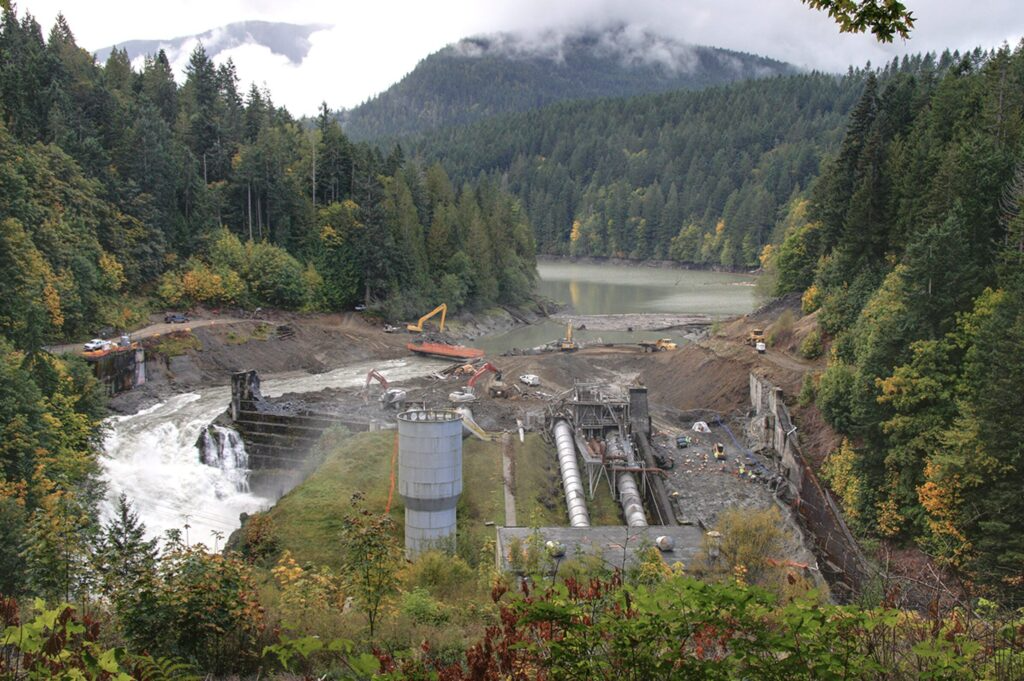
Deconstruction and removal of the Elwha Dam on the Elwha River in Washington State, captured around October 2011. Photo Source: USGS
As Lake Aldwell drained, a remarkable sight emerged from the silt: the Klallam creation site. This sacred rock formation reappeared two months before the first Chinook salmon made their way upstream.
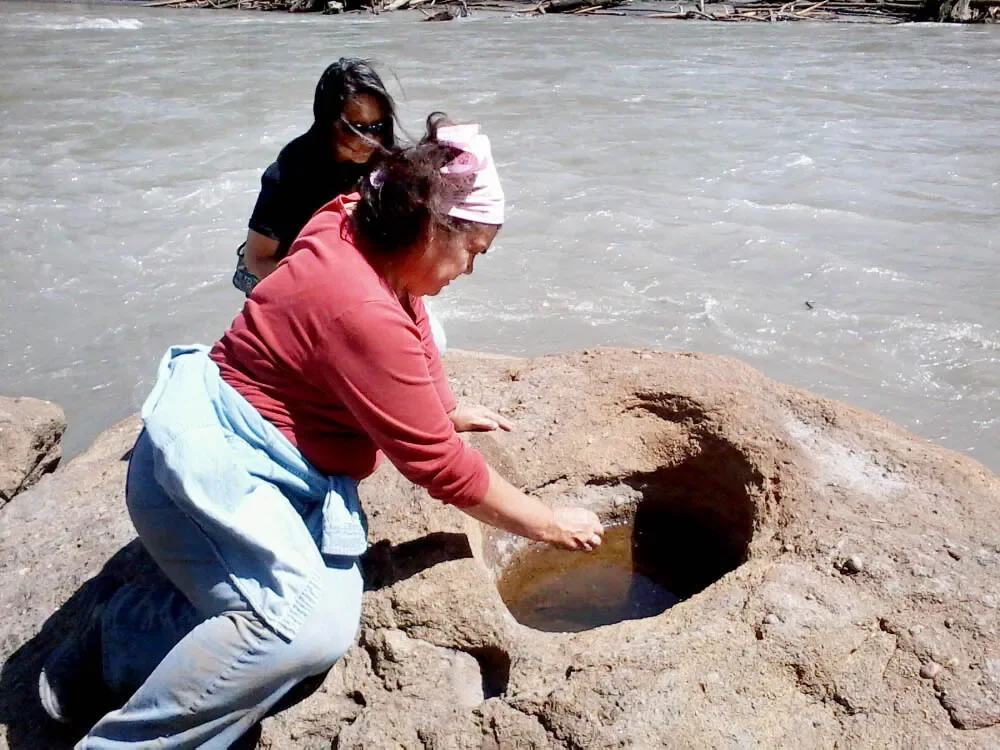
Jamie Valadez, a Klallam language teacher, dips a pendant into water at a rock bowl at the Lower Elwha Klallam tribe’s creation site during their first visit in almost a hundred years. Photo Source: Wendy Sampson
"The River Will Never Recover"
That claim was loud when the first machines arrived. And in those early years, critics had material to point to.
After the Elwha Dam was breached, Lake Aldwell drained over several weeks. The exposed lakebed looked like a moonscape. It had grey mud and silver skeleton trees, but no gravel or vegetation. When water returned, the Elwha tore through the accumulated silt like a firehose. Turbidity spiked to ten times normal levels. The river turned murky with the scent of mud, and swirled with trees and roots in brown surges. In spring 2013, biologists found thousands of dead juvenile Chinook stranded in isolated pools following a sudden drop in water levels. Observers saw ravens, eagles, otters, and mink along the banks. NOAA and tribal biologists estimated that the removal process resulted in the loss of 90 to 95 percent of fish and macroinvertebrates in the affected area.
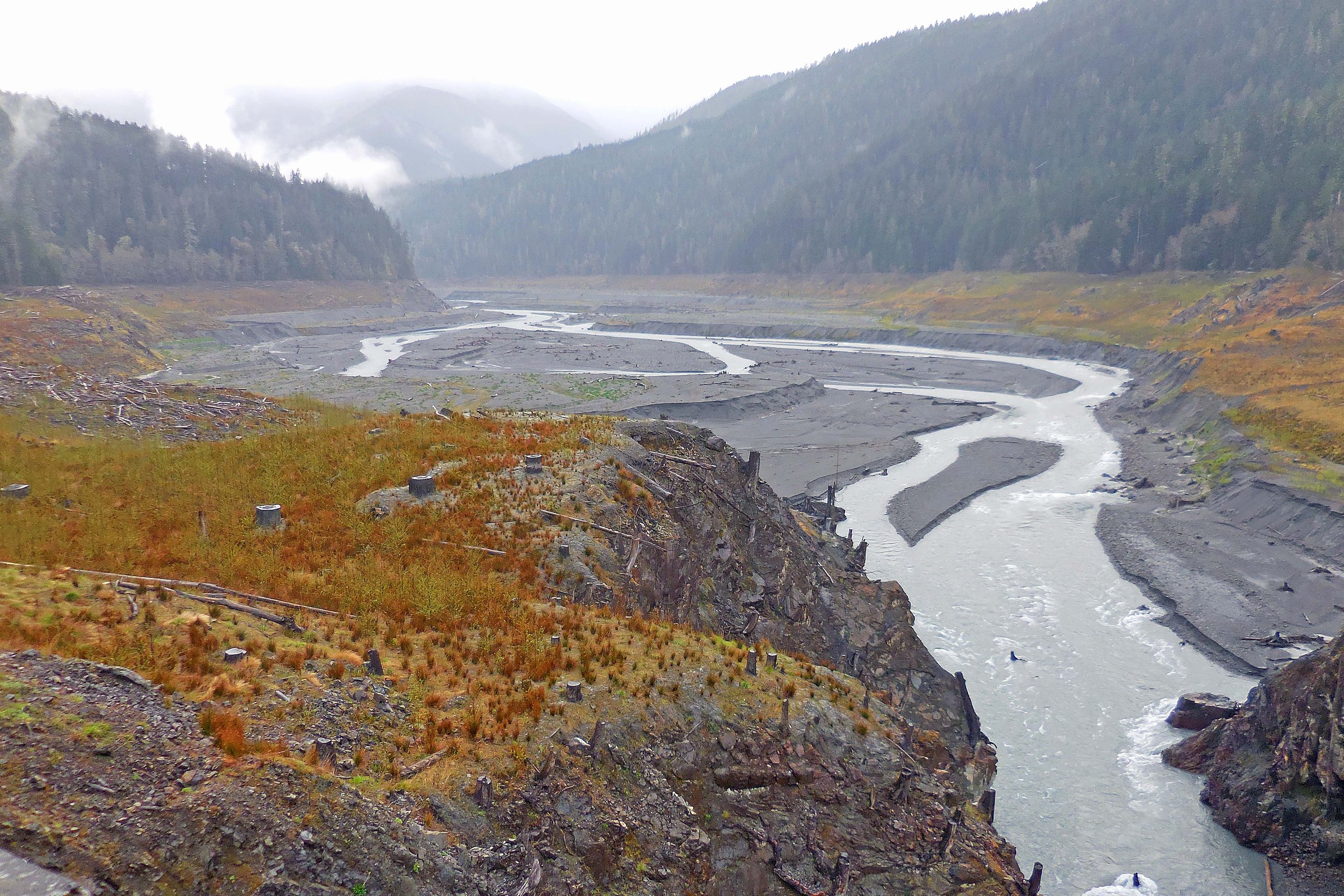
Revegetation in the river valley at the Elwha River restoration site. Both dams held back 30 million tons of sediment, which had to be released slowly to protect downstream infrastructure. Remodeling continues with each major storm. Source USGS
This was not a failure. Scientists and tribal resource managers had accepted this die-off as a necessary cost of healing. Clear water in the tributaries provided refuges for some young fish. Large populations of rainbow trout and bull trout held on above both former dam sites. The river had to be broken further before it could recover.
The Return
What happened next confounded every model.
In June 2012, researchers observed wild steelhead above the former Elwha dam site, occurring months earlier than anticipated. They navigated sediment-laden waters to access habitats they had never encountered before. By August, Chinook salmon were spawning in areas of the river that had been dammed for a century. Research led by George Pess revealed that all nine migratory fish runs returned to the old Elwha dam site within 31 months, with eight out of nine species appearing above the Glines Canyon site within 60 months. Remarkably, bull trout passed the upper dam site even before the last concrete was fully removed.
Some rainbow trout did something that hadn't been seen in decades: they went to sea and returned as summer steelhead. The dams had likely suppressed this behavior for generations. Now, it was reemerging from genetic memory.
In September 2016, USGS scientists found Chinook carcasses above both former dam sites. These fish had completed their entire life cycle in waters their ancestors hadn't reached since 1913. Nature closed a loop broken for over a century.
By 2019, adult Chinook returns reached their highest level since the late 1980s, with over 7,600 fish counted. Coho demonstrated even more significant growth.
The 30 million tons of sediment didn't smother the coast. It rebuilt it. Where shorelines had eroded nearly two feet per year for 70 years, about 715 acres of new beach, sandbars, and shallow lagoons formed at the river's mouth. Dungeness crabs colonized the new shallows. Sand lance and surf smelt found new spawning habitat. Native dune plants established within seasons. Kelp forests that had vanished during peak turbidity returned. Coastal scientist Anne Schaffer, who has watched the delta build for over a decade, called it "a geologic event that occurred in human time."
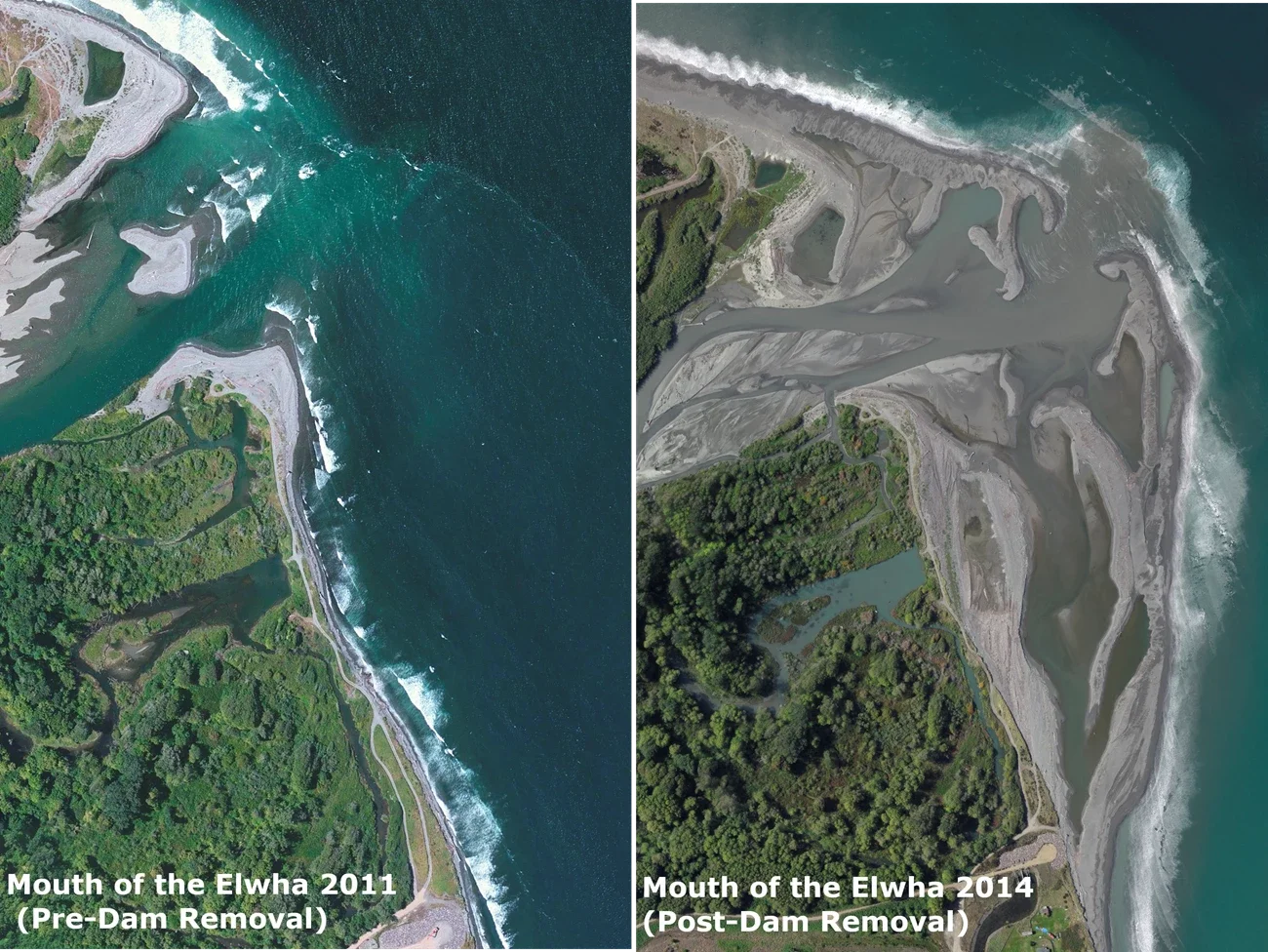
Change in the mouth of the Elwha River following dam removal. Approximately 715 acres of new beach, sandbars, and shallow lagoons formed at the river's mouth. Source: National Park Service, 2025.
The food web rewired itself from the bottom up. Returning salmon carried marine nitrogen and phosphorus into freshwater. These nutrients fed aquatic insects, juvenile fish, and riparian forests. American dippers, small birds that dive for insects in the stream, quickly followed the salmon. Researcher Christopher Tonra documented marine-derived nutrients in the dipper's blood within a few seasons of the fish's return. Roosevelt elk have migrated across 700 newly exposed acres, attracted by a century's worth of accumulated nutrients that provide the exact browse they prefer. Kim Sager-Fradkin of the Lower Elwha Klallam Tribe called it "a buffet table."
October 9, 2023
For twelve years after the first dam came down, the Lower Elwha Klallam Tribe chose not to fish the Elwha. Despite treaty rights. Despite the law being on their side. They waited, giving the salmon populations the time they needed. A people who had already endured a century of displacement practiced an extra twelve years of voluntary restraint.
On October 9, 2023, that wait ended.
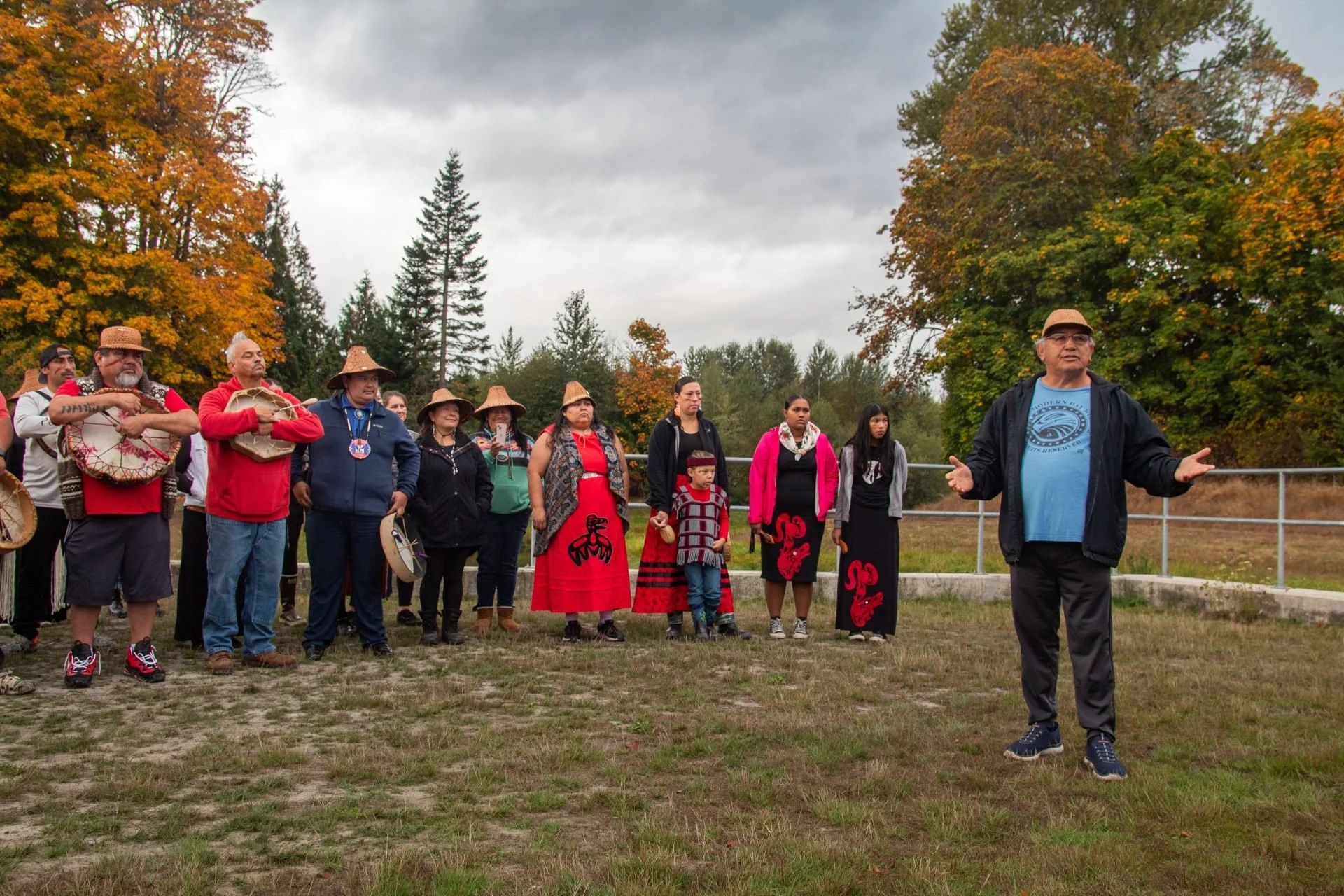
Lower Elwha Klallam Tribe Vice Chair and fisherman Russ Hepfer speaks during a small ceremony before opening the fishery on Oct. 9. Drummers, singers, and dancers from the tribe stand behind him. Photo source: Tiffany Royal
Over 100 tribal members gathered on the banks of the Elwha. There was a welcome song, a prayer song, and a salmon song. Then the tribe opened the first fishery on a free-flowing Elwha River in over a century.
The quota was small — 400 coho out of an expected run of about 7,000. Chinook and steelhead populations were still too fragile and off-limits. Tribal members chose rods and reels, but they fished.
The quota was small — 400 coho from an expected run of approximately 7,000. Chinook and steelhead populations were still too fragile and off-limits. Tribal members chose rods and reels. But they fished.
Loretta Charles, the tribe's 91-year-old eldest member, waded in that day. She remembered her father catching salmon so large she couldn't have carried one alone. On October 9, 2023, on a river that had been free for over a decade, Loretta Charles fished. By season's end, tribal members had caught 177 coho.
The number matters less than what it represents. This symbolizes a river and its people, reconnecting in a careful, joyful reawakening for the first time in a hundred years.
What the Elwha Told the Klamath — and Why This Matters
In 2023, four dams were removed on the Klamath River in Oregon and California. This surpassed the Elwha as the largest dam removal in American history. Engineers didn't start from scratch. They drew directly from the Elwha experience. This included sediment modeling, revegetation timelines, and salmon reintroduction planning. Chinook appeared above the old Klamath dam sites within a year of removal. This occurred even faster than they did on the Elwha.
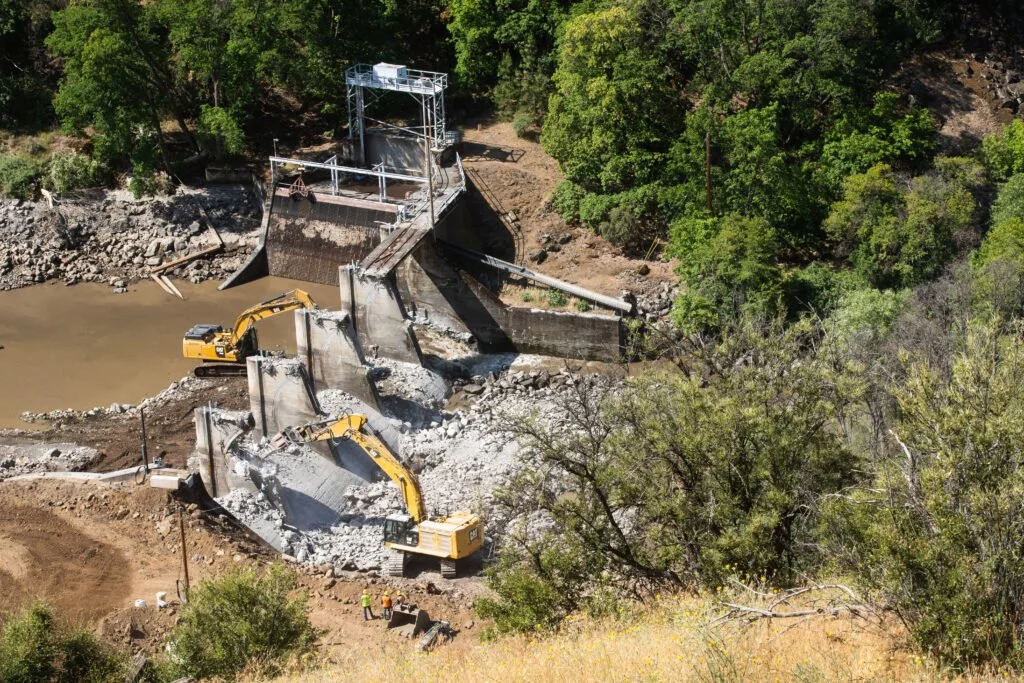
Copco 2 dam removal on the Klamath River, California. Photo Source: Shane Anderson, Swiftwater Films
Every river that recovers teaches us something that makes the next restoration easier. The Elwha showed that when you remove the right barrier, rivers don’t just slowly recover — they race toward it.
That knowledge is important beyond any single watershed. In a world where climate change is reducing mountain snowpack and warming freshwater, Pacific salmon are under increasing pressure. The Elwha demonstrates that removing the right obstacle can lead to recovery in a way that exceeds expectations. Connected rivers are more resilient. Resilient rivers protect resilient coastlines. They also protect the coastal communities and Indigenous peoples whose lives are connected to them.
The Lower Elwha Klallam Tribe fought for over a century to reclaim something that should never have been taken in the first place. A dam was built illegally, without fish ladders, on a foundation Aldwell knew was unstable. That dam operated for 98 years and nearly erased a species, a culture, and a sacred landscape. It took a coalition of tribes, scientists, activists, and federal agencies to reverse what one man's greed created in a season.
In 2025, the United States removed 100 dams across 30 states. This effort reconnects over 4,893 miles of river to the ocean in a single year. This the greatest length of upstream habitat restored in recorded history.
Phil Kennedy is still working on the Elwha. The river he stood in — waist-deep, astonished — in summer 2012 is different now. The water is clear. The gravel bars are real. The fish are there, and they know exactly where they are.
What surprised you most about this story? The next chapter is already being written.
Sources: NOAA Northwest Fisheries Science Center; National Park Service – Olympic National Park; National Geographic (Michelle Nijhuis, 2014); U.S. Geological Survey; Lower Elwha Klallam Tribe; American Rivers; Duda et al. (2021), "Reconnecting the Elwha River," Frontiers in Ecology and Evolution. Northwest Treaty Tribes, October 2023, American Rivers May 17, 2024
