
We Saw a Living Fossil — And It Might Not Be Around Much Longer
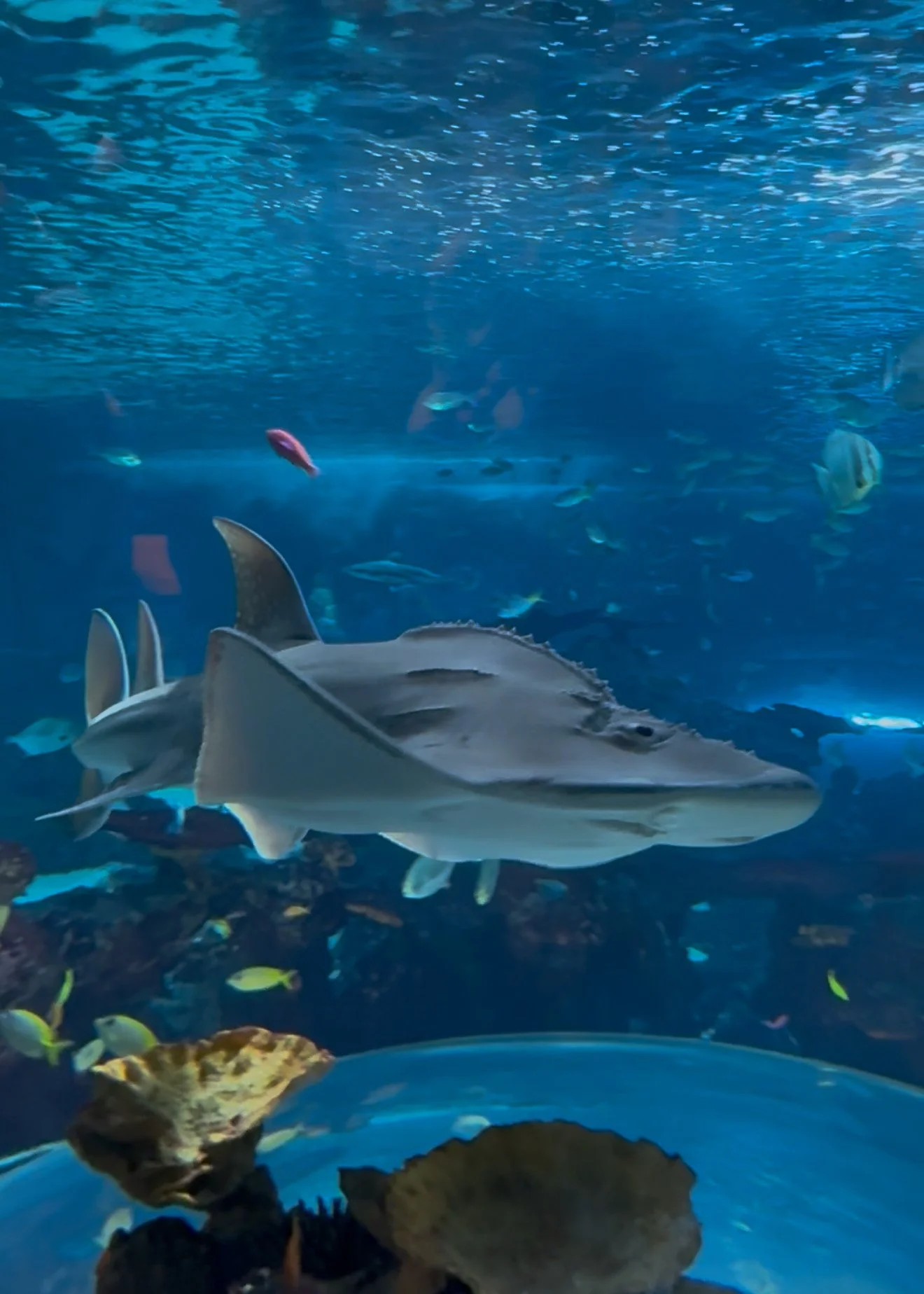
Bowmouth Guariarfish at Seattle Aquarium
On July 27th, we walked into the Seattle Aquarium expecting to be wowed. We were not prepared for this.
Tucked inside the stunning Ocean Pavilion, gliding slowly through the blue-lit water, was a creature that stopped us cold — a bowmouth guitarfish. Part ray, part shark, all prehistoric. If a kid drew you a dinosaur shark, this is exactly what you'd get. And somehow, impossibly, it's real.
We stood at that tank longer than we'd like to admit.
The Fish That Time Forgot
The bowmouth guitarfish (Rhina ancylostomus) has existed in its current form for millions of years. Millions. It outlasted the dinosaurs. It was swimming through ancient Indo-Pacific seas long before humans ever set foot on a coastline.
Its common name comes from its longbow-shaped mouth and guitar-shaped body. Technically, it's a ray — not a shark — because it has a flat body, wing-like pectoral fins, and its mouth and gills are on its underside. But its dorsal fins and overall shape give it a distinctly shark-like silhouette. It's genuinely unlike anything else in the ocean.
Adults grow to about 8 feet long and can weigh up to 300 pounds. They cruise close to shore at depths of 65 feet or less, using their incredible sense of smell to hunt crabs, lobsters, and clams along sandy or muddy seafloors. Their jaws and flat teeth are built specifically for crunching through shells — nature's perfect tool for the job.
And yet, despite millions of years of survival, this animal is now on the edge of extinction.
Critically Endangered — and Running Out of Time
The International Union for Conservation of Nature (IUCN) classifies the bowmouth guitarfish as Critically Endangered — the highest risk category before extinction in the wild. Fishing records suggest we've lost more than 80% of the species in recent years. Some populations may already be gone entirely.
The threats are familiar and devastating: overfishing, bycatch (being accidentally caught in commercial fishing nets), and the absence of marine protected areas across much of its Indo-Pacific range. Globally, an estimated 100 million sharks and rays are killed by humans every year. Bowmouth guitarfish are caught and sold in food markets across Asia, where fishing for them remains legal in many regions.
A creature that survived millions of years could disappear within our lifetime. That's not dramatic — that's the science.
The Nine Pups That Changed Everything
Here's where the story gets both heartbreaking and hopeful.
In early 2023, a pregnant bowmouth guitarfish was caught in a commercial set net off the east coast of Taiwan — a legal catch in those waters. While being held at a local fishing center, she gave birth to nine live pups. No one saw it coming.
Fred Fan of Fred Fan Aquatics, a conservation partner in Taiwan, quickly stepped in. He knew that releasing the mother and pups back into unprotected waters would likely mean they'd be caught again. Instead, he reached out to the Seattle Aquarium to find them a safe, long-term home.
Late one night in January 2023, all nine pups arrived at the Seattle Aquarium's offsite Animal Care Center. As one team member described it: "It's really hard to prepare for that moment when you first take the lid off, and you see one of them swimming around. My first feeling — there was a little bit of fear. We're talking about an endangered species, and at the time there were only 30 to 40 of those animals in aquariums around the world. To have nine in one location was a big number." Casey Zinkievich, Aquarist at the Seattle Aquarium
That fear quickly turned to joy. The pups were in remarkable condition.
After quarantine, eight pups were distributed to the Georgia Aquarium, Shedd Aquarium, and Disney's Animals, Science and Environment — all accredited institutions with the expertise to care for them.
One female remained in Seattle. She's the one we met.
Meet the Girl Eating Dungeness Crab for Dinner
The bowmouth guitarfish living in the Seattle Aquarium's Ocean Pavilion is thriving. Her care team describes her as fast-growing and enthusiastic at feeding time — which, given her diet, makes sense. She receives restaurant-quality, sustainably sourced Dungeness crab, spiny lobster, Pacific white shrimp, and bony fish. Her keepers say it plainly: "If we wouldn't eat it ourselves, we shouldn't be providing it to the animals in our care."
The crunchiness of crustaceans isn't just a preference — it's essential. It helps maintain her specialized teeth, the same ridged, flat chompers her species has used for millions of years.
Watching her move through the water, it's easy to forget how precarious her existence is. She's calm, purposeful, ancient-looking in the best possible way. Standing at her tank, you feel the weight of what's at stake.
The Global Push to Save a Species
The Seattle Aquarium isn't working alone. In November 2023, Fred Fan, aquarium teams from around the world, academic researchers, and conservation leaders gathered at Shedd Aquarium in Chicago for a summit dedicated entirely to preventing bowmouth guitarfish extinction. The focus: how accredited aquariums can build a coordinated species recovery program, including conservation breeding that could one day allow pups to be released back into the wild.
It's a long road. Restoring wild populations requires genetic diversity, trusted partnerships, and — the most precious resource of all — time. A critically endangered species doesn't have much of it.
But there is momentum. There is a team. And there are now bowmouth guitarfish in expert care across North America, with more being learned about them every day.
What You Can Do Right Now
You don't have to be a marine biologist to make a difference. Here's how to act:
Visit and support accredited aquariums. Places like the Seattle Aquarium fund conservation programs, research, and species recovery directly. Every ticket matters.
Advocate for marine protected areas. The biggest gap in bowmouth guitarfish protection is the lack of no-fishing zones where they live. Support organizations pushing for expanded MPAs in the Indo-Pacific — including Oceana, WCS, and Shark Guardian.
Choose sustainable seafood. Use the Monterey Bay Aquarium's Seafood Watch guide to make choices that reduce pressure on ocean ecosystems and cut down on destructive bycatch.
Spread the word. Most people have never heard of a bowmouth guitarfish. Share this story. Show someone the photo. The more people who know this animal exists, the more people who might care about saving it.
Follow the science. The IUCN Red List (iucnredlist.org) tracks endangered species in real time. Stay informed. Support the researchers making this data possible.
A Creature Worth Fighting For
Walking away from that tank on July 27th, we kept coming back to one thought: this fish survived millions of years. Continental drift. Ice ages. Mass extinctions. And now it faces a threat it was never equipped to handle — us.
But we can choose differently. The nine pups born in Taiwan, the team that flew through the night to bring them to safety, the scientists gathering in Chicago to map out a future — all of it proves that intervention works. That care works. That we can work.
The bowmouth guitarfish is not a myth. It's not a fossil. It's alive, right now, gliding through a tank in Seattle — and through coastal waters from South Africa to Japan to Australia, where local communities hold real Pavilion — and check out the Seattle Aquarium's bowmouth guitarfish story for more on her journey from Taiwan to the Pacific Northwest.
Watch the Seattle Aquarium's care team welcome their bowmouth guitarfish pup: YouTube. Power to protect or destroy what remains of its wild population.
See it. Learn it. Fight for it.
The ocean doesn't need our pity. It needs our action. 🌊
Want to see her for yourself? Visit the Seattle Aquarium's Ocean
