
Getting My Blue On — And Why the Ocean Still Needs Us
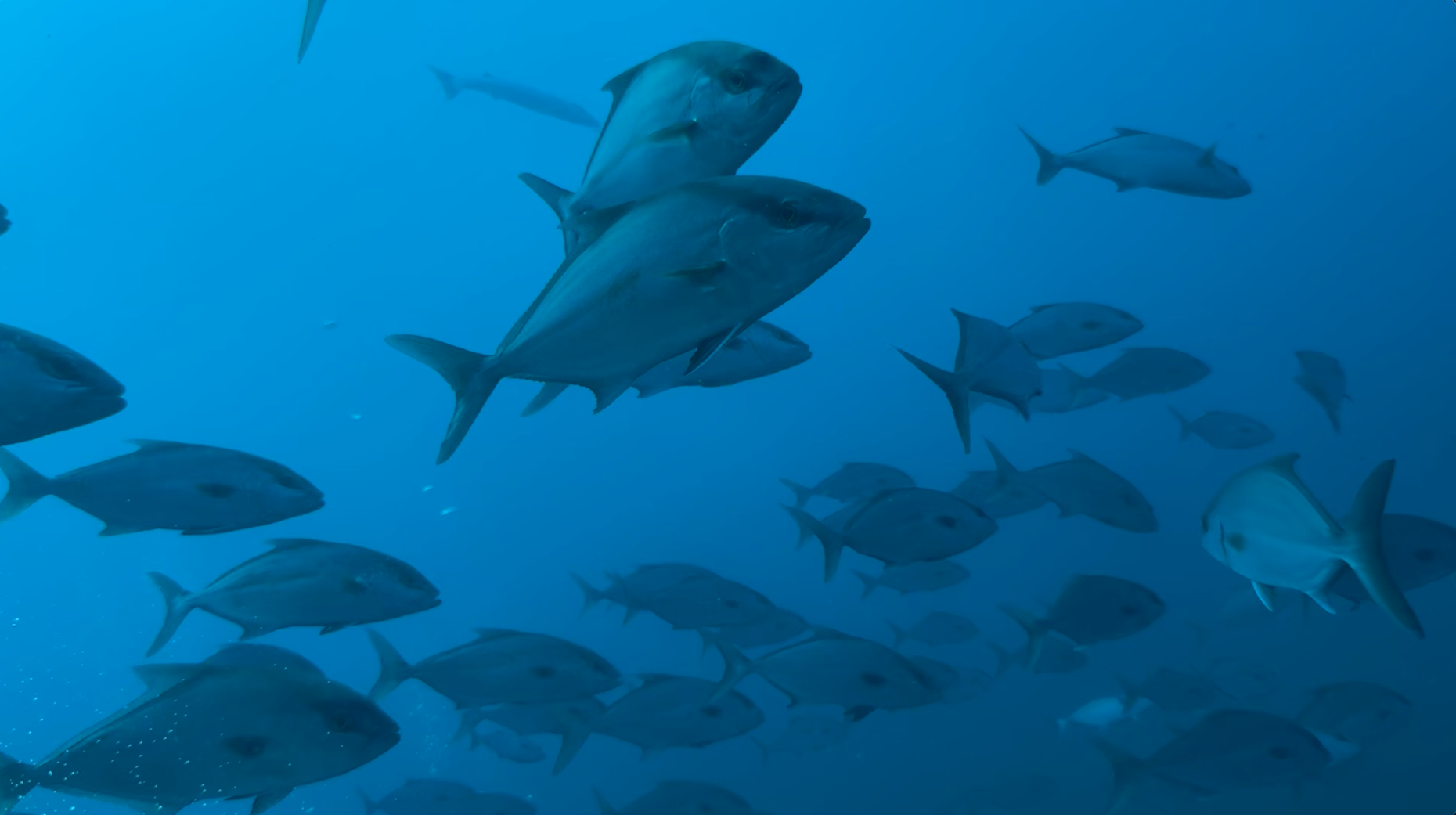
This is what awaited us when we slipped beneath the surface of the Atlantic. It was breathtaking — so much life, so much motion. I needed this.
After months of reporting on the cascading effects of warming oceans, getting below the thermocline and swimming alongside amberjack and swirling schools of baitfish felt like a kind of medicine.
I call it getting my "Blue On." Wallace J. Nichols coined the term "Blue Mind" to describe the mildly meditative, calm state the brain enters when a person is near, in, on, or under water. His research shows that proximity to water decreases the stress hormone cortisol while increasing feel-good neurotransmitters like dopamine, serotonin, and oxytocin. For ocean journalists, it's not just a mood boost — it's a reminder of exactly what we're fighting for.
Much of this summer has been spent traveling, writing at See-the-Sea.com, and documenting the state of our seas on Instagram. The stories have been heavy: the US administration ordering the removal of ocean observation instruments, the opening of National Monuments to commercial fishing, coral collapse surrounding Bonaire, and the relentless tide of plastic pollution. Every story matters. But the weight accumulates.
So diving the SS Hebe was exactly the reset I needed. She's a 250-foot Dutch merchant freighter that sank after colliding with the HMS St. Cathan in 1942 — resting at 100 feet of depth, roughly 40 miles off the coast of South Carolina. Eighty years on, the Hebe is gloriously alive, draped in marine life and thick with fish. Wrecks like this are a testament to the ocean's resilience when given even a sliver of peace.
But the ocean doesn't let you forget for long.
Cruising back toward Murrells Inlet, still salt-crusted and sun-warmed, I trailed my hand over the side of the boat. The water felt like a bath — not in a good way. Our captain called it out: 92 to 94°F at the surface. He said we have El Niño to thank for keeping the East Coast relatively quiet this season. El Niño pumps up wind shear across the Atlantic and bends the jet stream into a position that tears the tops off developing storms before they can find their legs. For now, it's holding. But he looked out at that glassy, overheated water and said what we were both thinking — the moment those conditions shift, temperatures like these don't just feed hurricanes. They turbocharge them.
I thought about that on the ride home, watching the horizon. Just days earlier, Hurricane Lala had skirted the Hawaiian Islands — later knocked down to a tropical storm, but it didn't much matter to the families on the Big Island who spent the August 15–16 weekend riding out flash floods, mudslides, and darkness. The eye never officially made landfall. The outer bands didn't care. Standing on the deck with the Atlantic slipping past beneath us, warm as bathwater, it was hard not to feel the distance between what I'd just witnessed below the surface and what the surface itself was becoming.
The evidence of a warming ocean is never far away — not even on a dive that felt like joy.
We cannot continue burning carbon and treating the consequences as someone else's problem. But we also cannot afford to lose hope, because hope is what drives action. The Hebe reminds us what thrives when we protect rather than exploit. The 92°F water reminds us what is at stake if we don't.
Get in the water if you can. Vote for ocean protections. Support the scientists monitoring our seas. And keep paying attention — even when the news is hard.
The ocean is still worth saving. I've seen it with my own eyes
