
The Administration ordered the removal of the Ocean Observation Initiative’s instrument monitoring the AMOC, but Congress moved to halt the action.
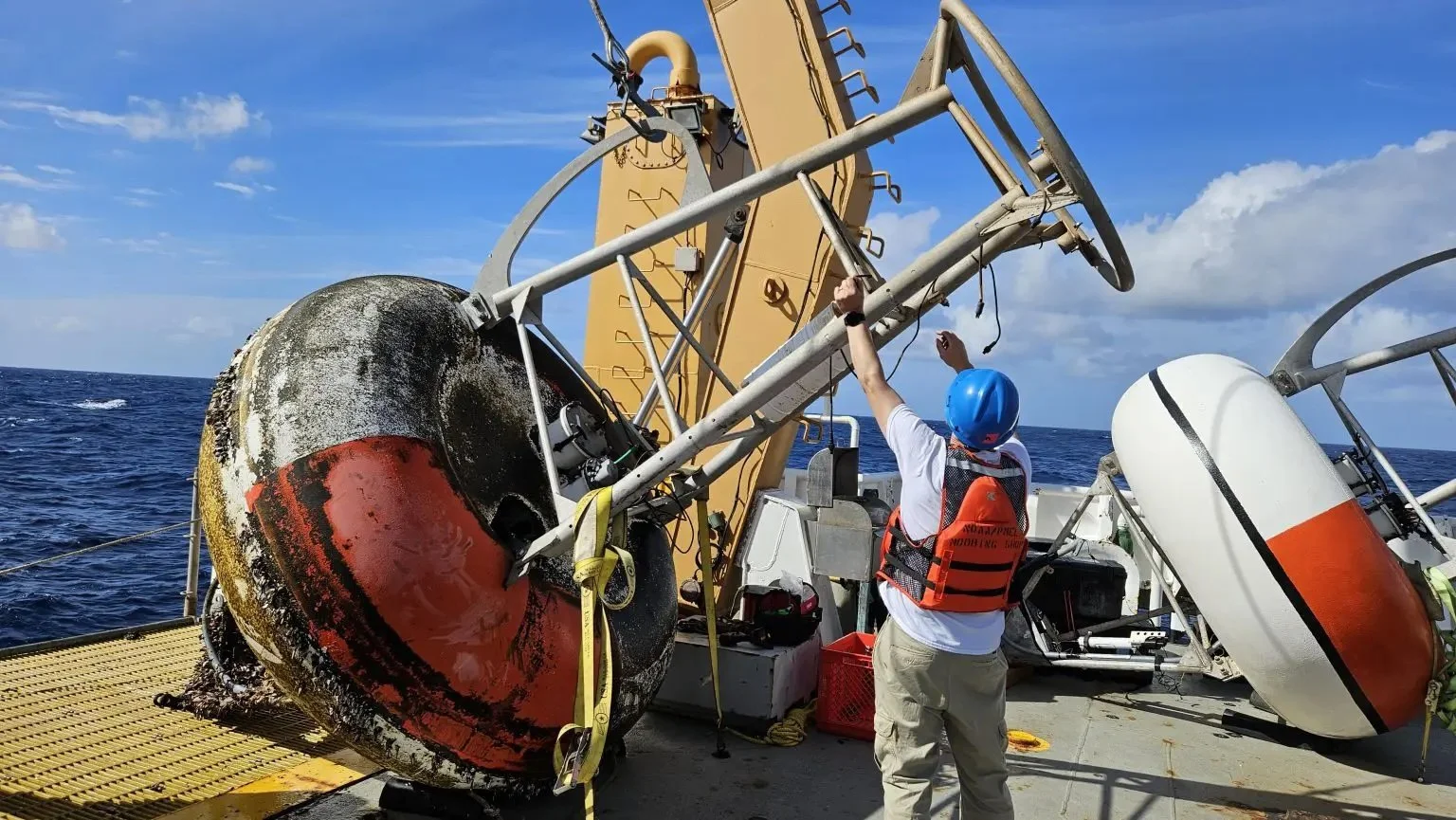
Buoy Recovery onto the NOAA Ship Gordon during the PIRATA Northeast Extension Cruise.
Photo: NOAA
Adapt and Protect | See the Sea.
On June 1, 2026, the National Science Foundation announced it was dismantling the Ocean Observatories Initiative — a $368 million network of over 900 deep-sea instruments installed in 2016, a decade into a planned 25-year mission. Ships were headed out that month. NSF called it a “nimbler approach” to research priorities. Scientists called it something else. “This reflects the further lack of understanding that the current administration has of scientific value,” said Craig McLean, NOAA’s former acting chief scientist. “We push the United States back into a rear seat in global scientific leadership.”
These weren’t ordinary buoys. Instruments 9,200 feet down in the Irminger Sea have tracked the Atlantic current system, some scientists fear is weakening toward collapse. Off Oregon, Washington, and Alaska, sensors measured the ocean conditions fisheries depend on. This data also underpins how coastal communities plan for what’s already happening to them: more frequent flooding as warming water expands and ice melts. Westport, Washington, has watched seawater creep into its downtown. The Quinault Tribal town of Taholah is relocating to higher ground. Florida calls its version “sunny-day flooding” — tides rising with no storm in sight. This is the instrumentation that tells coastal towns how fast the clock is running.
Then came the pushback. Senators Jeff Merkley (D-OR) and Lisa Murkowski (R-AK) introduced a two-page bill, “Save Our Sensors,” that would block federal funds from being used to decommission the OOI until NSF completes a full review with stakeholder input. Murkowski’s objection was as much about process as substance: “NSF moved forward on their own, not only unilaterally, but really with no warning, no heads up. They didn’t even bother to check in.” The Senate passed the bill by unanimous consent on June 17.
One day later, NSF reversed course entirely: “Effective immediately, NSF will not proceed with further removal or de-scoping of equipment.” Murkowski called it “a massive win for coastal communities and fishermen around the country.” Restoration is already underway — Oregon State oceanographer Edward Dever expects one of the six removed moorings to be back in place by the end of summer.
It’s not locked in yet. The bill still needs to clear the House, and this is the third year running that this program has faced a funding threat.
What You Can Do
Contact your House representative and ask them to back the Save Our Sensors Act — especially if you’re in Oregon, Washington, Alaska, or North Carolina. Follow the Ocean Observatories Initiative Facilities Board (ooifb.org) for the House vote. And share this: a $368 million ocean monitoring network almost disappeared quietly. It only survived because people made noise.
The ocean doesn’t get a vote in Congress. We do.
Sources
National Science Foundation, “Update on Ocean Observatories Initiative,” June 18, 2026
The New York Times, “Trump Administration to Dismantle Ocean Monitoring System,” June 1, 2026
The New York Times, “Trump Administration Backs Off Plan to End Ocean Monitoring,” June 18, 2026
The Guardian, “Trump administration reverses decision to scrap ocean monitoring system,” June 18, 2026
Yahoo News, “Bipartisan pushback saves ocean buoy network off Washington, Oregon coast,” July 1, 2026
Sen. Jeff Merkley and Sen. Lisa Murkowski, press statements, June 2026
