
The Shell Game That's Saving Our Coasts
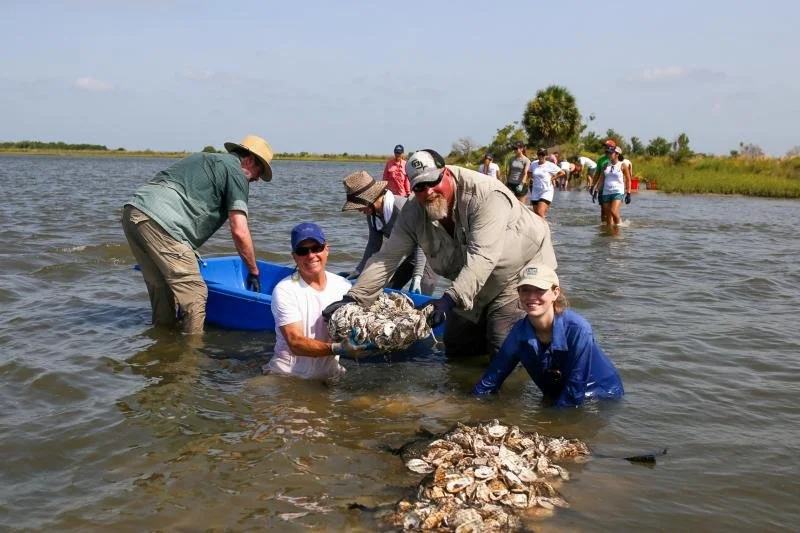
Volunteers build an oyster reef from recycled oyster shells. Credit: Galveston Bay Foundation.
Picture a five-gallon bucket sitting outside a seafood restaurant on a Tuesday morning. It smells like salt and brine. Inside: a pile of empty oyster shells, still glistening, still curved like little bowls. To most people, that's trash headed for a dumpster. To a growing network of scientists, volunteers, and conservationists stretching from Corpus Christi to Puget Sound, it's raw material for a living reef.
That's the quiet genius behind oyster shell recycling — and it's happening at scale. Right now, at least 29 major programs along the Atlantic, Gulf, and Pacific coasts are doing exactly this: collecting shucked shells from restaurants and the public, curing them for three to six months, then deploying them back into coastal waters where baby oysters can latch on and grow. The result isn't just a reef. It's a water filtration system, a storm buffer, a fish nursery, and a carbon sink — all built from what used to be landfill waste.
"Currently, the oyster supply chain is linear and extractive with oysters going to restaurants and the majority of those shells going into a landfill," says Michael Biros, Restoration Programs Director for the Coalition to Restore Coastal Louisiana. "We're working to close the loop so that shells go back in the water where they can grow new oysters and help protect these communities."
"If we can get members of the public out to build an oyster reef, it's an act of defiance against the odds." — Michael Biros, Coalition to Restore Coastal Louisiana
Why the Shell Is the Point
Here's the biology that makes all of this work. Baby oysters — called spat — can't settle just anywhere. They need a hard surface, and they strongly prefer the calcified structure of other oyster shells. Without it, most larvae drift and die. With it, they attach, grow, and begin building the three-dimensional architecture of a living reef. Each bag of spent oyster shells can recruit as many as 450 new oysters. With around 350 bags going into a single reef rebuild, that's millions of new gallons of daily filtration — happening where none existed before.
The problem is that over the last century, we've stripped coastal waters of that substrate. Overharvesting, dredging, oil spills, and the simple act of throwing shells in landfills instead of returning them to the water has broken the cycle. Gulf Coast oyster populations have declined by 85 percent or more. The Chesapeake Bay's oysters were once so abundant that the entire volume of America's largest estuary was filtered approximately once a week, with water visibility exceeding 50 feet. Today, they're a fraction of what they were. In New York Harbor, native oysters were functionally extinct by the early 20th century.
Shell recycling programs are trying to reverse that — one bucket at a time. A single adult oyster filters up to 50 gallons of water per day. A restored reef filters millions. And now, thanks to a national network of programs working in parallel, the shells that once ended up in landfills are being put back to work.
450
new oysters recruited per bag of recycled shell
350 bags
go into a single SCORE reef rebuild
Gulf Coast: Where It's Most Urgent
The Gulf Coast has the densest concentration of oyster recycling programs in the country — and the urgency is real. The Gulf yields 70 percent of the shrimp and oysters caught in the U.S. and supports more than 30 percent of the nation's recreational fishing trips. Rising sea levels and intensifying hurricanes consume land here at a rate of up to one football field every 100 minutes. Studies show oyster reefs can reduce wave energy by 76 to 99 percent. Every reef counts.
In recognition of that, NOAA's Office of Habitat Conservation awarded $5 million to Restore America's Estuaries to expand shell recycling in Louisiana, Florida, Alabama, and Texas. The funds are flowing to five established programs — Coalition to Restore Coastal Louisiana, Galveston Bay Foundation, Alabama Coastal Foundation, Tampa Bay Watch, and the Pensacola and Perdido Bays Estuary Program — to build new reefs, engage new restaurant partners, and bring underserved communities into the work.
In Houston, chef Aaron Bludorn of Bludorn and Navy Blue put it simply: "We recycled 16 tons of oyster shells last year. This is an easy lift for us. You put a bin by the dish pit and then you move it next to the dumpster. The Galveston Bay Foundation collects the shells, washes and dries them, and then they use them. I think it's important for chefs to support these projects because we're the ones with the microphone."
In Alabama — the number one oyster processor in the country — the Alabama Coastal Foundation has recovered 22.6 million shells since 2016. In Texas, the Harte Research Institute's Sink Your Shucks program, launched in 2009, has reclaimed more than 3.5 million pounds of shell and restored over 45 acres of reef habitat across the Mission-Aransas Estuary — including Copano, Aransas, and St. Charles Bays. Each spring, community volunteers gather at Goose Island State Park to build the foundations of new reefs and living shorelines. Larger deployments go out by barge into deeper bay waters, building subtidal reefs protected from future harvest.
Tampa Bay Watch's "Shells for Shorelines" program — funded in part by a $1.1 million NOAA grant — is rebuilding reef habitats across Tampa Bay. Mississippi's Save Our Shells initiative, the Coalition to Restore Coastal Louisiana's program (launched in 2014, the first of its kind in the state), and NOAA's Gulf Regional Oyster Network tie the whole region together into a coordinated system that shares best practices and troubleshoots shared challenges.
The Gulf yields 70% of U.S. shrimp and oysters — and its oyster reefs are the infrastructure holding the coastline together.
Protecting Sacred Ground
Some of the most powerful reef work on the Gulf Coast isn't just about water quality or storm protection. It's about protecting land that belongs to Indigenous communities — land that is disappearing.
Louisiana has more than 800 historic tribal mounds, some older than the Egyptian pyramids. Many are at risk of being swallowed by the rising Gulf. Last year, several hundred volunteers and members of the Pointe-au-Chien tribe armored 400 feet of shoreline surrounding an ancient burial mound with 200 tons of bagged oyster shells. A reef built previously on Pointe-au-Chien land held up against Hurricane Ida — the second-most damaging hurricane to make landfall in Louisiana after Katrina.
"It is very important to protect our land because we are so connected to it like our ancestors before us," says Cherie Matherne, Cultural Heritage and Resiliency Coordinator for the Pointe-au-Chien Indian Tribe. "Putting out the oyster shells attracts crabs, shrimp, and fish. This work connects everything all together."
With NOAA funds, the Coalition to Restore Coastal Louisiana is expanding this work to the Grand Bayou Indian Village and the Grand Caillou/Dulac Band of Biloxi-Chitimacha-Choctaw, with tribal partners receiving stipends for their involvement — a model of conservation partnership that centers the communities most at risk.
Atlantic Seaboard: From the Harbor to the Salt Marsh
Stretch from Maine to Florida and you find a different flavor of oyster restoration — one built heavily on citizen science, restaurant partnerships, and urban waterways that many people had written off decades ago.
The Billion Oyster Project in New York Harbor is perhaps the most visible example. High school students at New York Harbor School on Governors Island grow oysters, build reef structures, dive to monitor reefs, and conduct marine biology research as part of their career education — all in service of returning native oysters to waters that haven't seen them in a century. The Oyster Recovery Partnership (ORP) in the Chesapeake Bay, which created the Shell Recycling Alliance in 2010, reclaims shell free of charge from restaurants and seafood businesses, cleans and seeds it with baby oysters, and puts it back into the Bay. The Chesapeake Oyster Alliance has set a goal of adding 10 billion oysters to Virginia and Maryland waters. The North Carolina Coastal Federation's Recycle for Reefs program and Virginia's Oyster Recovery Partnership extend the model down the coast.
Georgia has Shell to Shore, which cures collected shells for six months before hauling them to the coast to build living shorelines and oyster reefs. Florida has FL.O.O.R. — the Florida Oceanographic Oyster Restoration program. Martha's Vineyard has its own Shell Recovery Partnership. The network is wider and denser than most people realize.
South Carolina runs one of the most community-embedded programs on the East Coast. SCORE — the South Carolina Oyster Recycling and Enhancement program, managed by SCDNR — operates more than 30 public collection sites across the state, conducts as many as 40 oyster reef rebuilds per year, and monitors restored sites to track progress. Michael Hodges, an oyster restoration biologist at SCDNR, puts it plainly: "Oysters and marshes are the lifeblood of the estuaries. And the reason we want to get people involved is so we can introduce them to the great importance of our ecosystem; they then become spokespeople for their natural resources."
The work looks like this: shells collected at drop-off sites statewide are left outside to cure for three to six months. Then volunteers load them into mesh bags and form human zipper lines — passing bags hand to hand from truck to boat. In spring 2022, on Daufuskie Island, volunteers navigated pluff mud at low tide to pack bags into neat rows, securing them with rebar to create a long rectangular reef slab. Five years after SCORE's first Daufuskie build, Hodges pointed to the result: bivalves growing tall and sharp, waves of spartina marsh grass growing right against the reef. "That's exactly what we're looking for," he said. "It's habitat creation, erosion control. A living shoreline."
In Florida's Pensacola Bay area, OysterCorps — a workforce development program for 18- to 25-year-olds managed by Franklin's Promise Coalition — is training young people in restoration skills while rebuilding the community's historic ties to the bay. "Doing this work helped me realize I want a career in shoreline restoration," says Anthony Grabin, a former OysterCorps member now serving as field coordinator. South Carolina's half-million acres of salt marsh — the most of any Atlantic state — give programs like SCORE both the urgency and the scale to matter.
30+
public oyster shell collection sites across South Carolina through the SCORE program
Pacific Coast: Native Oysters, Deep Roots
The Pacific Coast tells a slightly different story. Commercial oyster aquaculture has long defined West Coast shellfish culture, but native oyster restoration is a quieter and newer effort, driven by the same impulse: put the shells back.
The Wild Oyster Project in San Francisco Bay trains volunteers as community scientists — collecting discarded shells from Bay Area restaurants, running curing stations, and monitoring native Olympia oyster growth at restoration sites. The Olympia oyster, the only oyster species native to the Pacific Coast, had nearly disappeared from San Francisco Bay by the early 1900s. Restoration work is bringing it back, one monitored plot at a time. In Washington State, the Puget Sound Restoration Fund focuses on Olympia oyster recovery as part of broader nearshore ecosystem restoration. The Bay Foundation anchors similar work in the kelp-and-estuary-rich waters of Southern California.
What You Can Actually Do
The entry point here is genuinely low. Most of these programs need two things: shells and people.
If you eat oysters — at a restaurant, at a backyard shuck, at a festival — ask where the shells go. Many coastal restaurants are already partnered with recycling programs. If yours isn't, most programs will help get them enrolled. Drop-off locations for the public are expanding up and down all three coasts. South Carolina alone has more than 30.
If you want to do more, volunteer days are where these programs live. Bagging shells, building reef modules, monitoring restoration sites, acting as community scientists — none of it requires a marine biology degree. "When community members are involved, they realize that actions have impact," says Serra Herndon, Habitat Restoration Director for Tampa Bay Watch. "And when they go home and tell their neighbor or friends or whomever, the positive story reverberates."
The math is almost absurd in the best possible way. Each bag of recycled shells can recruit up to 450 new oysters. A single adult oyster filters up to 50 gallons of water a day. One reef rebuild — 350 bags, one Saturday morning, dozens of volunteers — adds millions of gallons of new filtration to an estuary that desperately needs it. The shells sitting outside a seafood restaurant this Tuesday morning aren't trash. They're infrastructure.
"Once you shuck 'em, don't just chuck 'em." — Galveston Bay Foundation
From New York Harbor to Daufuskie Island to Goose Island State Park to San Francisco Bay, 29 programs are running the same play: take the shell, cure it, put it back. And behind each one, the same unlikely partnership — restaurants and regulars, scientists and students, volunteers who showed up on a Saturday morning and found themselves building a reef.
What would our coastlines look like if we'd been doing this for the last hundred years? And what will they look like in another fifty, if we start now?
Programs Near You: Find One, Get Involved
Gulf Coast
• Coalition to Restore Coastal Louisiana
• Galveston Bay Foundation Oyster Shell Recycling
• Sink Your Shucks (Harte Research Institute, TX)
• Tampa Bay Watch — Shells for Shorelines
• Mississippi Gulf Coast Save Our Shells
• Gulf Regional Oyster Network (NOAA / Restore America's Estuaries)
• Pensacola & Perdido Bays Estuary Program / OysterCorps
Atlantic Coast
• Billion Oyster Project (New York Harbor)
• Oyster Recovery Partnership / Shell Recycling Alliance (Chesapeake Bay)
• North Carolina Coastal Federation — Recycle for Reefs
• SCORE — SC Oyster Recycling and Enhancement (SCDNR)
• G.E.O.R.G.I.A Oyster Restoration Project
• FL.O.O.R. — Florida Oceanographic Oyster Restoration
• Martha's Vineyard Shell Recovery Partnership
Pacific Coast
• Wild Oyster Project (San Francisco Bay)
• Puget Sound Restoration Fund (Washington)
• The Bay Foundation (Southern California)
Sources & Further Reading
NOAA Fisheries — Gulf Coast Oyster Shell Recycling (March 2024): fisheries.noaa.gov
FSU Marine Lab — Oyster Shell Recycling Programs Review (Feb 2024): marinelab.fsu.edu
Local Palate — Oyster Shell Recycling for a Coastal Cure (Erin Byers Murray): thelocalpalate.com
Harte Research Institute — Sink Your Shucks: harteresearch.org
SCORE Program — SCDNR: score.dnr.sc.gov
Coalition to Restore Coastal Louisiana: crcl.org
Oyster Recovery Partnership: oysterrecovery.org
Wild Oyster Project: wildoysters.org
