
A sunken tugboat, a soft brush, and the question of what Carriacou's reef needs to heal itself.
Carriacou Field Report · Week Three · Part Two
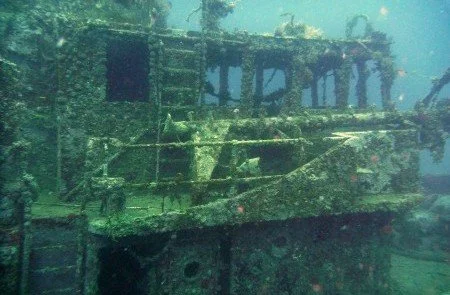
The wheelhouse of the Boris, a sunken tugboat off Mabouya Island, Carriacou. Photo: Carriacou.biz.
New here? Part One followed a baited camera off Sandy Island and found the top of the reef's food pyramid nearly empty.
The short version
What's wrong: Carriacou's reef has lost its top predators and most of its grazers, the fish, urchins, and crabs that keep seaweed off coral.
What's working: Islands a day's sail away are raising urchins and king crabs to put the grazers back. In Florida, king crabs cut seaweed in half.
What you can do: Scroll to the end. Most of it costs nothing.
The Boris
Ninety feet down, the light turns blue-green and quiet. On Saturday, I hovered in front of the wheelhouse of a sunken tugboat called the Boris. Giant star coral covered nearly every inch of it. Hundreds of polyps, every one of them out and feeding.
Nobody planted that coral. It just grew.
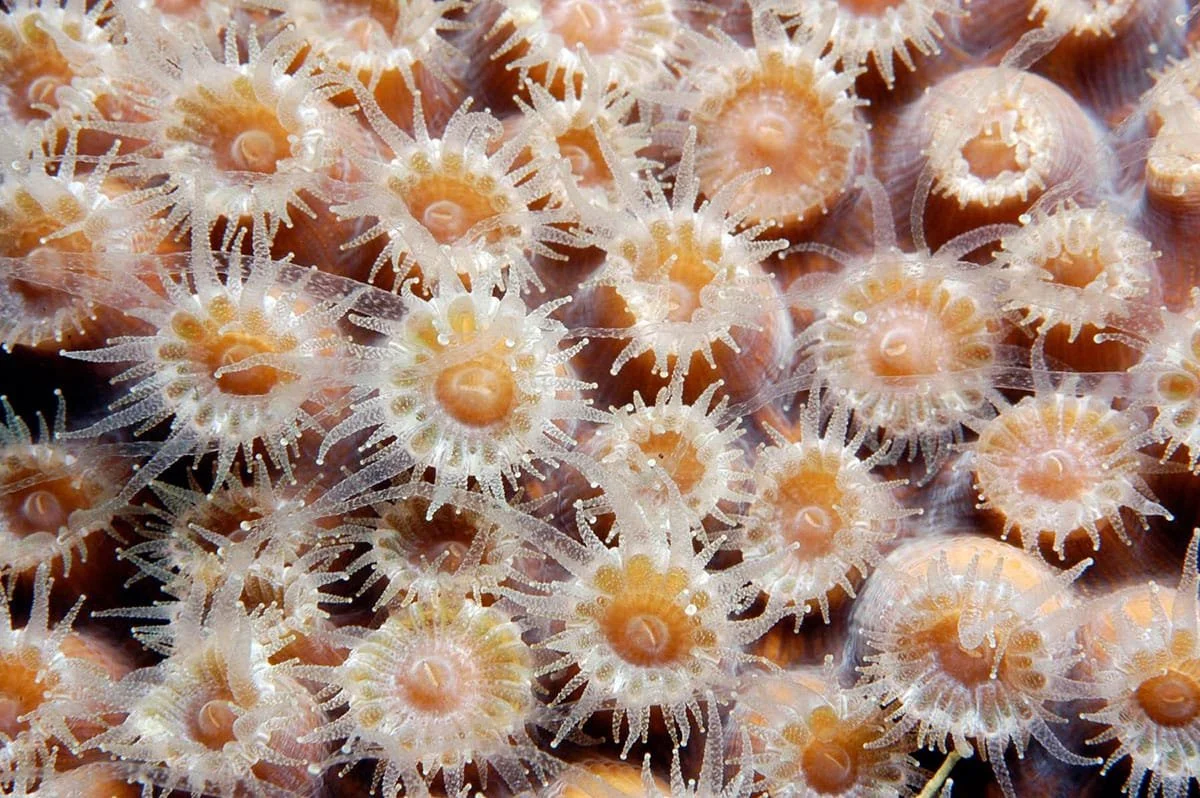
Giant star coral polyps covering the Boris's pilothouse. Photo: NOAA|Neil MacDaniel.
Deefer Dive Center and Dive Carriacou sank the 100-foot tug off Mabouya Island in 2007. The dive-shops websites used to promise sharks and barracuda here. Not lately. We saw a few snappers and jacks.
On the shallow reefs nearby, at Mabouya Garden and Jack-A-Dan, it was brown seaweed and pale coral. Very few crabs or fish in sight.
In Part One, our baited camera found the top of Carriacou's reef nearly empty. For two weeks before that, I'd worked at the bottom, cleaning coral and sponge fragments for Caribbean Reef Buddy's (CRB) coral garden. One question kept nagging me.
We were growing coral. But what about everything coral needs around it?
Why the Boris Thrives
Two reefs 100 meters apart can feel like different planets. One's a swaying forest of sea fans and sea rods. The other's a field of brain coral boulders. Same ocean. The difference is the address: how deep, how rough, how much runoff, and where the currents carry coral larvae.
The Boris is in a good location. At ninety feet, the water stays cooler during summer heat waves. It sits far from the runoff that clouds the shallows. Its steel rises off the bottom into the current, which carries in plankton for the coral to eat and fresh larvae to settle. And for nineteen years, it's been a clean, hard surface with no seaweed to fight.
Shallow reefs got the opposite deal: the hottest water, the most runoff, and the fewest grazers to keep seaweed down.
Coral Has Two Jobs
Coral is a builder. Each polyp builds a limestone cup around itself. Over centuries, billions of cups become the reef's caves, ledges, and holes. A goby perches on a brain coral, running a cleaning station for groupers. A blenny peeks out of an old wormhole, like a tenant at the window. Grunts and snappers school beneath the overhangs.
Coral is a farmer. Algae called zooxanthellae live inside its tissue and turn sunlight into food, up to 90 percent of the coral's energy. And coral shares. Its mucus feeds the base of the food chain. Butterflyfish pick at its polyps. On spawning nights, its eggs feed the plankton-eaters.
Coral is the house and the kitchen.
When the farm fails. When the water stays about 1°C (1.8°F) above the warmest normal summer month, coral expels its algae. That's bleaching. A bleached coral isn't dead yet, but it's starving. In our CoralWatch survey, we scored 540 corals at five sites. Most sat on the pale end of the chart.
Lose the coral and both jobs fail. The food goes first. Then the skeletons crumble, and the hiding places go with them.
Who Keeps the Middle in Check
Part One covered the top of the pyramid, so here's the short version. Sharks, barracuda, and big groupers sit at the top. Graysbies, coneys, and moray eels are the middle managers. Each level keeps the one below it honest. Just by being around, big predators keep smaller fish close to shelter, eating in shifts instead of stripping one patch bare.
The people of the Caribbean have spent a century fishing out that top. Nassau grouper are now critically endangered. Into the gap swam lionfish, which hunt the young grazers the reef needs most. A lionfish cull isn't just pest control. It's filling in for predators the reef has lost.
The Brush
Which brings me to the brush.
CRB's coral garden sits off Jack-A-Dan Island, near the A World Adrift sculptures. Wire frames and cement-and-beer-bottle structures hold coral and sponge fragments broken off by storms and anchors. Once a week, a volunteer hovers over each frame and gently brushes it clean.
Brushing is the program's biggest job. I didn't understand why until Predator Week. With so few grazers, the garden grows more algae than the reef around it. Volunteers do by hand what doctorfish, blue tangs, and urchins used to do for free.
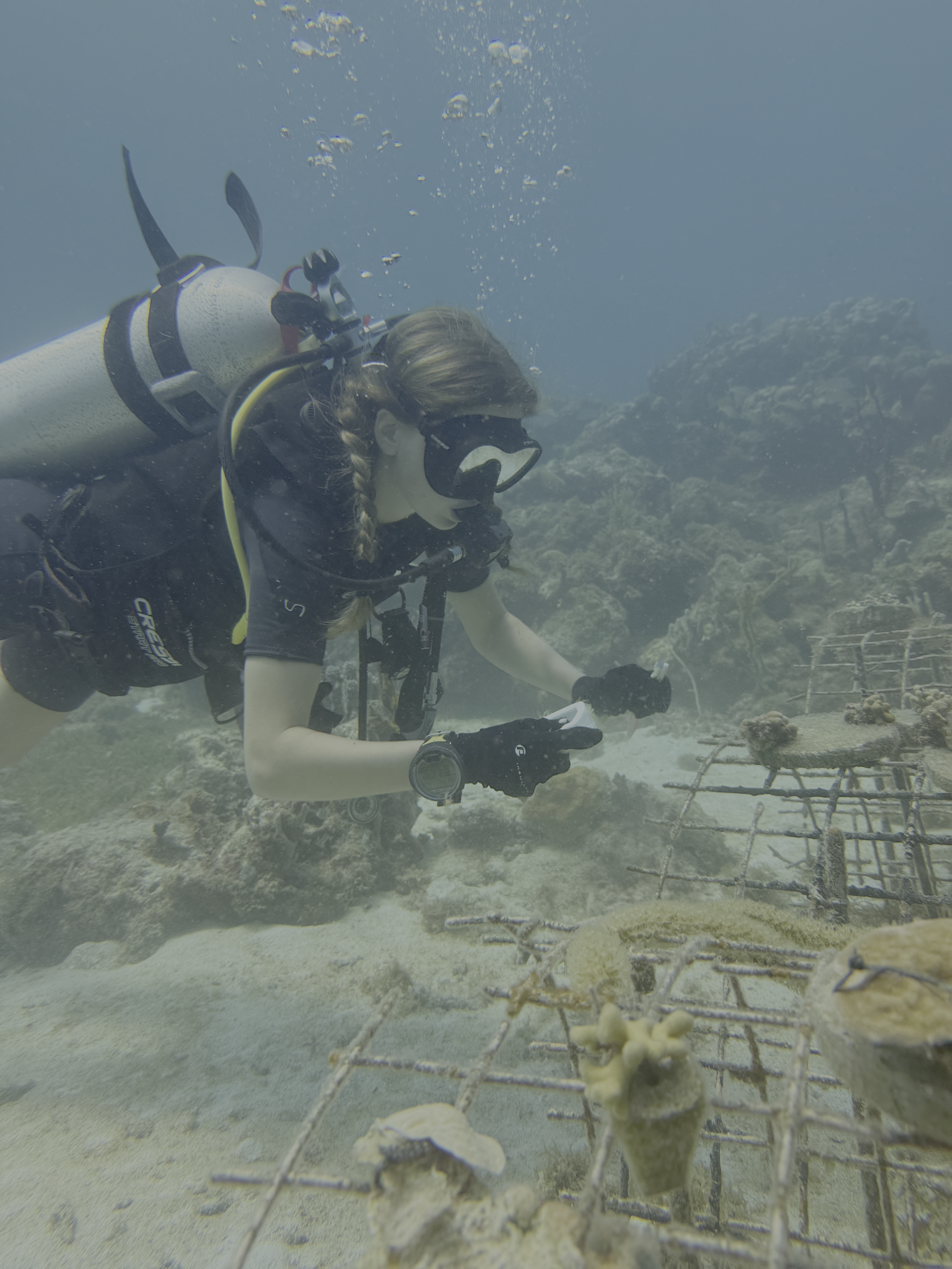
A volunteer brushes a thin film of algae and bacteria off nursery corals, a job grazers like Doctorfish and long-spined urchins would perform on a healthy reef. Photo: Denny Frazier
The good news: the fix for that missing middle already exists, on islands a day's sail away. First, the hard years.
Four Hard Years
Nora Valdés runs operations at Deefer and has dived these reefs for nineteen years. She walked me through the last four.
In 2022, stony coral tissue loss disease (SCTLD) killed 70-90% of the boulder corals. In 2023, a marine heat wave killed the next batch. Then, on July 1, 2024, Hurricane Beryl hit as a Category 4. It swept away the entire garden, including the staghorn and elkhorn CRB had planted off Mabouya, and the island's last branching corals. Today those species are raised only at Quarantine Point, on Grenada's mainland.
This season, NOAA's Coral Reef Watch put the islands north of here at Bleaching Alert Level 2: severe bleaching and significant coral death likely. Next year worries me more. On October 8, the World Meteorological Organization warned that El Niño could be one of the strongest since 1950. Strong El Niños often make the next year one of the hottest on record.
The garden I worked on in Week One is CRB's third try.
From Coral to Seaweed
Across the Caribbean, overfishing, hurricanes, heat, and disease have flipped reefs from coral to seaweed. Scientists call it a phase shift. On Carriacou, the winners are Forked Ribbon algae (Dictyota), and Encrusting fan-leaf algae.
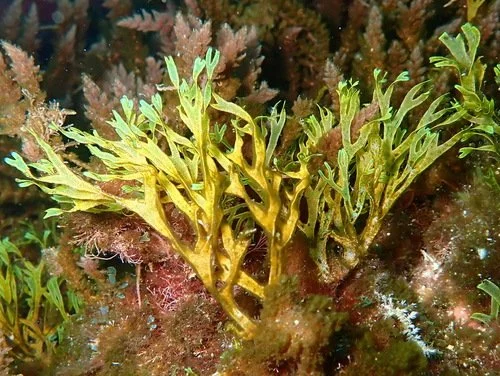
Forked Ribbon algae (Dictyota). Photo credit: Sylvain Le Bris
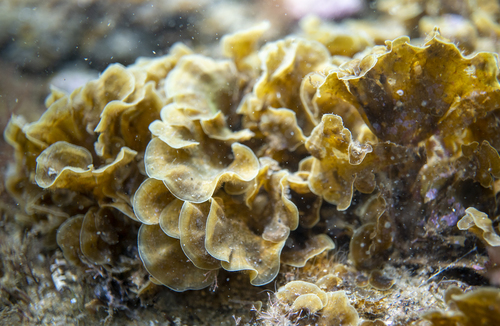
Encrusting fan-leaf alga (Lobopora). Photo credit: Wayne Martin
A seaweed reef isn't empty. But it's simpler: fewer hiding places, fewer kinds of fish, fewer snapper and grouper to catch. And seaweed smothers young coral before it can start.
If nothing changes, there won't be much left to save.
What's Missing
CRB has built a lot: a coral nursery, a lionfish culling program, a predator survey, an artificial reef, volunteers all summer. On paper, there's even protection. The only marine protected area the government says is still active is the Sandy Island Oyster Bed Marine Protected Area.
So, what is this reef missing to heal itself?
The answer kept coming back to the same thing: grazers. A major Caribbean-wide report says the same.
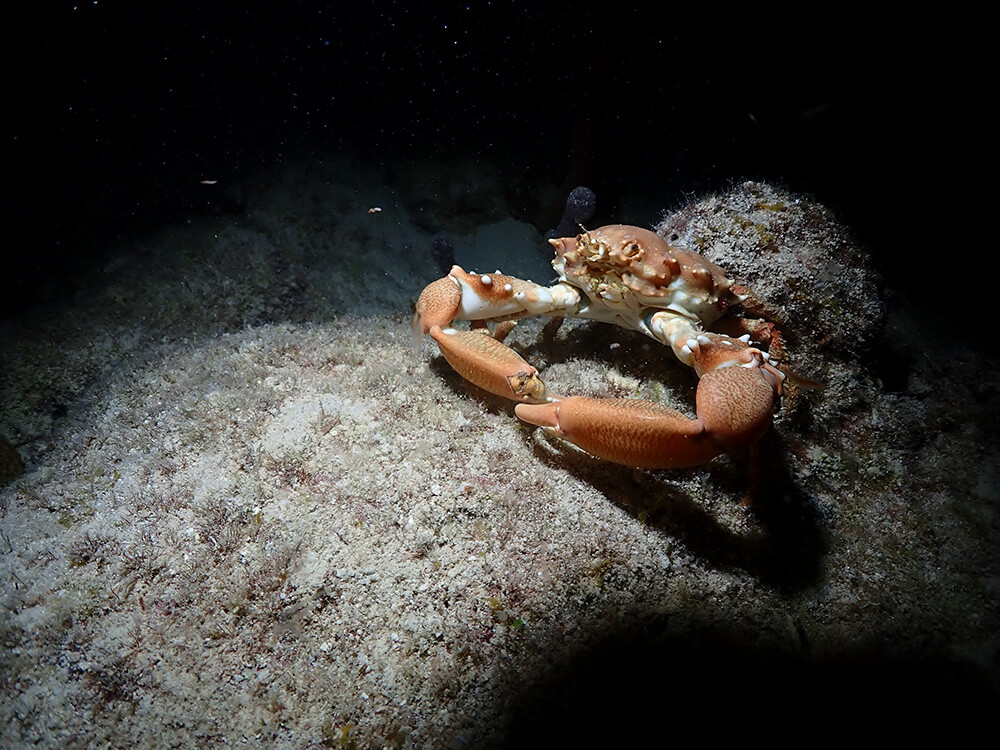
Scientists in the Florida Keys National Marine Sanctuary are reintroducing the Caribbean king crab (Maguimithrax spinosissimus), a "reef goat" that eats smothering seaweed and clears space for coral. Photo: Ben Edmunds/NOAA.
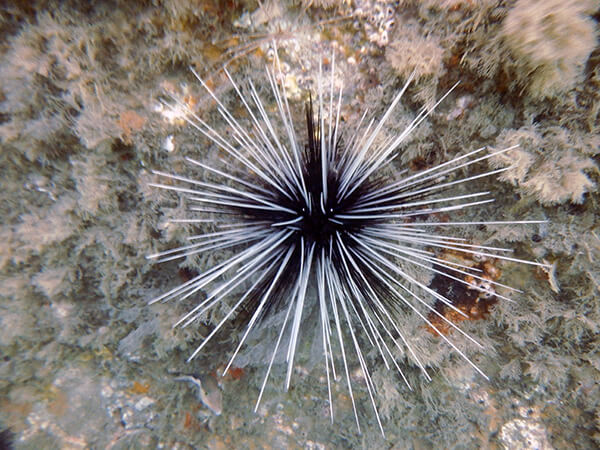
A long-spined sea urchin (Diadema antillarum) on fleshy algae in the Florida Keys. Photo: Rachel Plunkett/NOAA
Islands a Day's Sail Away
A 2024 study by Butler and colleagues found that coral struggles to recover on seaweed-heavy reefs without grazers. So neighbors are putting the grazers back.
• Florida: In a 2021 study on patch reefs, Caribbean king crabs cut seaweed in half in a year. In March, Mote Marine Laboratory released its first hatchery-raised king crabs.
• Saba: Researchers have released lab-raised urchins.
• St. Kitts and Nevis: A new program trains fishers to farm king crabs in cages, restoring reefs and earning off-season income.
Grenada has no program to bring back its grazers.
Islands a day's sail away are building cages.
Who's Left to Guard What We Plant?
Deefer's new owner, Kevin Pernick, has started meeting government officials. His first meeting wasn't about the reef. It was with the Minister of Youth, about teaching Carriacou's kids to swim.
An island that can swim can see its own reef.
Deefer's plan is to listen and share, not lecture. The fishers know where the snapper used to be and where the parrotfish are going. Deefer brings camera footage, CoralWatch scores, and the science. The Grenadian government establishes policies and provides funding. Put them in one room, and the community develops solutions. That might mean leaving grazers on the reef, placing mooring buoys to protect reefs from anchor damage, or managing Marine Protected Areas effectively.
The swimming lessons are the long game. A kid who can swim can snorkel. A kid who can snorkel can see the difference between a coral garden and a bare reef. Give it fifteen years, and the island has its own divers, guides, and reef biologists.
The Reef Is a Job
Here, the reef isn't a nature story. It's the economy.
Tourism brings Grenada over half a million visitors a year and more than a fifth of its economy, and much of what they come for is underwater. Reefs are where snapper and lobster grow up. They also blunt storm surge. Beryl damaged or destroyed 98 percent of Carriacou's buildings in one afternoon.
The reef is the breakwater the island never had to build.
Grenada's climate plans now treat coral restoration as coastal defense. Its Blue Economy strategy bets that the ocean can create jobs and income while being managed well enough to survive climate change. In a nation of about 117,000 people, where about one in twelve workers can't find a job, and closer to one in three young people, that bet matters.
But the foundation is cracked. A 2025 review by the Grenada Sustainable Development Trust Fund found that only Sandy Island & Oyster Bed, one of Grenada's four marine protected areas, is actively managed. It called the rest dormant: no staff, no approved plans, no patrols, no mooring fees collected. Even at Sandy Island, the Tourism Authority has had to find emergency money for patrols.
Nobody has written a plan for Carriacou's sharks. The grazers are a line item nobody has funded. But the shape is right. Plant the coral. Build the structure. Protect the water.
Back to the Boris
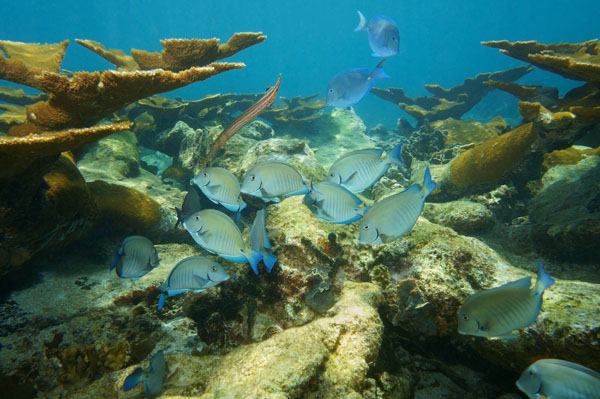
A school of Doctorfish grazes a reef, scraping algae off rock and clearing space for young coral to settle. Photo: Saltwater Aquarium Blog
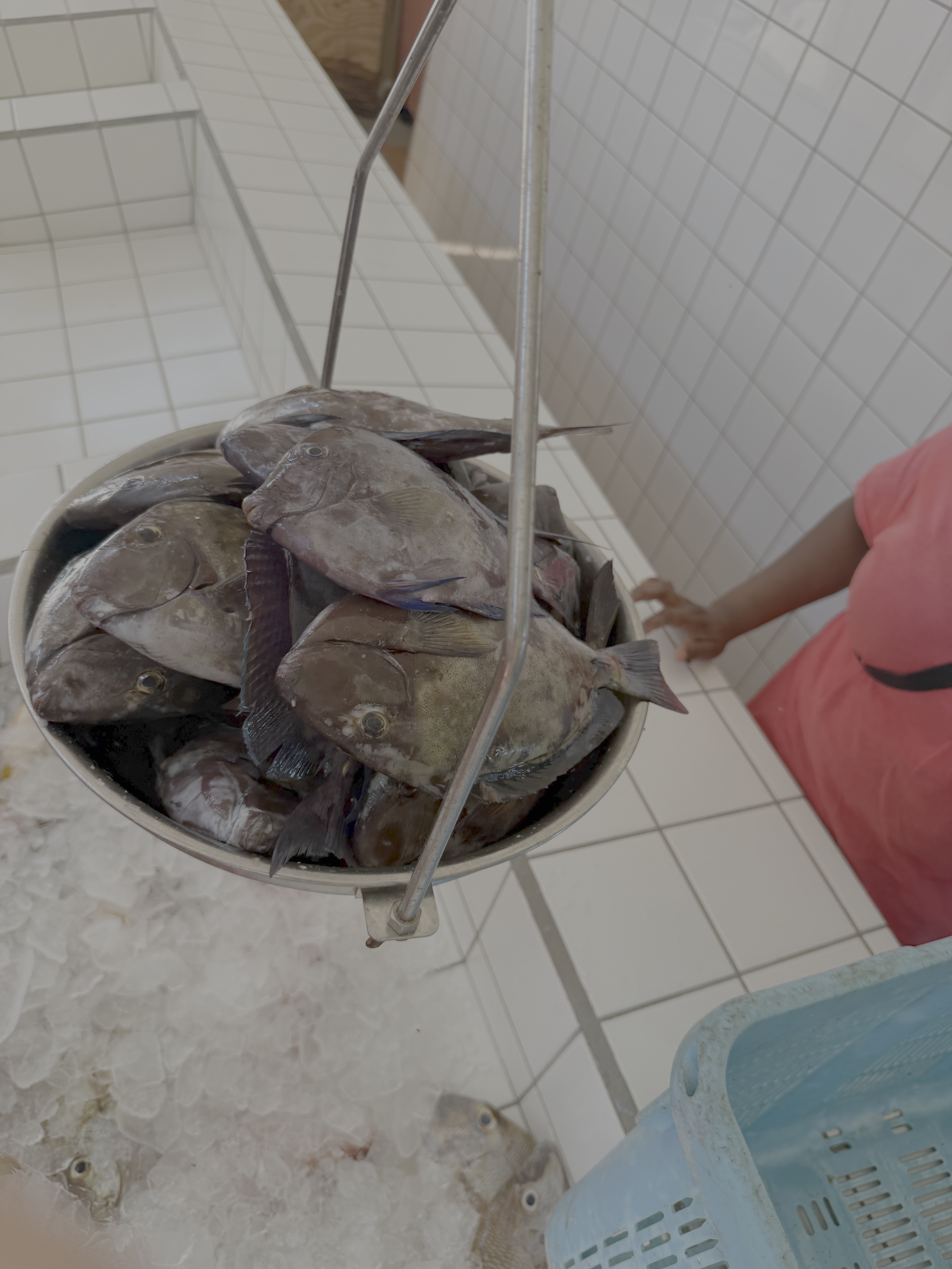
The same grazers for sale at the Hillsborough fish market.
Same market. Same bin. In Part One, it held a blacktip shark. This time, it held the grazers.
I don't want to end with someone planting coral. That's the pretty half of the story. The other half is a brush, a cage, and a bin at the fish market.
I'd rather end on the Boris. Nineteen years ago, two dive shops sank a tugboat off Mabouya. On Saturday, I hung in front of its wheelhouse and watched a reef that built itself. Nobody planted it. The water warmed, the sharks left, and it grew anyway.
A reef is a pyramid. But it's also a community that wants to come back. Caribbean Reef Buddy has more people, plans, and hard-won knowledge than ever. The base is being rebuilt. The middle has a blueprint. The top is a question we've finally begun to ask.
If a tugboat can become a reef, what could this island become?
What You Can Do
You already know to order the lionfish. Here's what's next.
From anywhere, for free:
• Follow and share Caribbean Reef Buddy. Attention is how small programs get funded.
• Push for climate action. Heat killed Carriacou's 2023 coral. No amount of brushing beats a marine heat wave.
• Use Seafood Watch to choose seafood that doesn't empty the reef.
When you travel:
• Skip parrotfish and other grazers on the menu.
• Dive with operators who cull lionfish and use moorings.
• Support marine protected areas. Pay the mooring fees, and ask where the money goes.
If you can give:
· Direct monetary donation to broader Caribbean coral reef efforts; similar non-profits include:
o REEF Environmental Education Foundation at https://www.reef.org/donation/donate-reef
o Reef Response https://www.reefresponse.org/make-a-donation-1.
If you can go:
• Volunteer with Caribbean Reef Buddy or a similar program for two to eight weeks. Training is included.
At home:
• Join a local restoration group. You don't need a coral reef to restore a reef ecosystem. Oyster reefs, salt marshes, and seagrass beds need hands too.
Sources
Muscatine, in Coral Reefs, Ecosystems of the World 25 (1990); Williams et al., Scientific Reports 16:25819 (2026); Manzello et al., Science (2025); Butler et al., Frontiers in Marine Science 11:1329028 (2024); Spadaro & Butler, Current Biology 31:853–859 (2021); Roth et al., Ecology (2020); McManus & Polsenberg, Progress in Oceanography (2004); Alvarez-Filip et al., Proceedings of the Royal Society B (2009); Paddack et al., Current Biology (2009); GCRMN, Status and Trends of Caribbean Coral Reefs; Plunkett, National Marine Sanctuaries (June 26, 2026); Mote Marine Laboratory (March 28, 2026); St. Kitts and Nevis Information Service (June 6, 2025); Grenada Sustainable Development Trust Fund, Grenada's Marine Protected Areas: Biophysical and Governance Insights (2025); Grenada Protected Areas System Plan, Part 2 (OBAPAO); Government of Grenada Climate Resilience Portal, Tourism (climateresilience.gov.gd); Central Statistics Department of Grenada, Labour Force Survey, Q2 2025; UN World Population Prospects 2024; Caribbean Development Bank (2024), youth unemployment; NOAA Coral Reef Watch, Windward Caribbean Islands 5 km Regional Bleaching Heat Stress Gauges, Version 3.1 (accessed October 9, 2026); World Meteorological Organization, (October 8, 2026); field notes, class notes, and dive log, Carriacou, September 7–12, 2026.
