
What to expect from Congress before January, and where the ocean fits in?
Congress and the Coast, Part One of Two
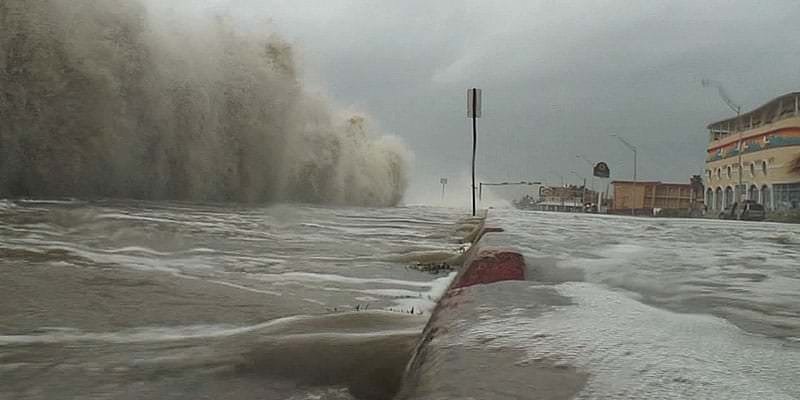
From the NOAA video on Hurricane Storm Surge. Source NOAA
It happens on clear mornings now. No storm, no wind, just sunshine. Seawater quietly rises through storm drains. It spreads across the street and laps at front steps.
They're called king tides. A generation ago, they were a curiosity. Today they're a calendar event in Miami and Norfolk, Annapolis and Charleston, Boston and San Francisco. People plan their commutes around them. Businesses stack sandbags on sunny days.
On November 3, Americans went to the polls with a lot on their minds. The economy. Health care. A war with Iran. And for many, especially younger voters, the climate. CIRCLE, the youth-voting research center at Tufts University, found that one in five voters under 30 listed climate change as a top three issue.
Some voters didn't wait for Washington. In Charleston County, South Carolina, about 64 percent approved a sales tax extension. This will fund a seawall, flood repairs, and protected greenspace. Two years earlier, the same county had voted a version of it down.
Democrats won control of both chambers of Congress. But they don't take over until January 3, 2027.
So, what happens between now and then?
What to expect from this lame duck
We call the weeks between an election and the day new members are sworn in the lame-duck period. The outgoing Republican majority still runs both chambers. Congress returns on November 9. Greenberg Traurig reports that the House has 20 scheduled legislative days. The Senate has 22 days before the new Congress starts.
That's not much time. Here's what's likely to fill it.
A fight over how long to fund the government. The current stopgap funding bill expires December 11. If nothing passes, the government shuts down. Republicans would like to lock in full-year spending while they still hold the gavel. Democrats would rather wait. The American Prospect, citing House sources, says Democrats will likely agree to a short extension. It may be "for just two or three months at most." That would push the big budget decisions into early 2027.
A fight over war money. In June, the White House requested Congress for an $87.6 billion supplemental package. This money is mainly for the war with Iran. It also includes aid for farmers and a response to Ebola. The Pentagon has also asked for a $1.5 trillion defense budget for the coming year. Many Democrats want to attach conditions to that money. Republicans and the White House say it's needed to support troops and restock weapons.
An impeachment vote. Rep. Thomas Massie, a Kentucky Republican, has filed articles of impeachment against Defense Secretary Pete Hegseth over the war in Iran. Arizona Democrat Yassamin Ansari has filed her own. Speaker Mike Johnson sent the House home early in September, which delayed a vote. A vote is now expected after the House returns. Removal would take 67 votes in the Senate.
A permitting showdown. Senate Majority Leader John Thune set a key procedural vote for November 9. This vote is on a bipartisan bill to speed up approvals for energy and infrastructure projects. It needs 60 votes.
An expired farm bill. The 2018 farm bill expired September 30. Republicans want to finish a new one now. Some Democrats would rather shape it with their own majority next year.
Setting up 2027. Democratic leaders are planning their next steps. They want to restore the expanded Affordable Care Act subsidies that ended at the start of the year. This won't pass in the lame duck session. However, both parties are setting their boundaries for upcoming battles.
That's a crowded six weeks, and none of it is easy. We need to keep the government open. There's a war to fund or end. An impeachment vote is coming up, and a farm bill has already expired. Climate barely makes the list. But that's how Washington works. The ocean rarely gets its own bill. It rides inside the ones that must pass. It’s part of a funding line that keeps NOAA’s hurricane forecasters and fisheries scientists working. It's in the flood insurance deadline that millions of families depend on. A permit rule determines whether offshore wind farms can keep operating. It also includes farm conservation programs that prevent fertilizer from entering our bays. So, the real question for this lame duck isn't whether Congress will pass a big climate bill. It won't. Can we protect what’s working, plan, and ensure resilience is in every deal that finishes? Here's where to look.
Protect what's working
The science that keeps us safe. One agency affected by the December 11 deadline is NOAA, the National Oceanic and Atmospheric Administration. Most people use NOAA every day without knowing it. It's behind the hurricane track on the evening news and the forecast on your phone. It counts fish so fishing seasons can open. It maps the coastline and tracks coral bleaching. It runs the tide gauges that tell cities when the next king tide is coming.
The White House asked Congress to reduce NOAA's budget to about $4.54 billion. This is nearly a quarter less than this year's $6.17 billion. It also aimed to eliminate the office that manages NOAA's climate, weather, and ocean research labs. It wanted to cut the National Ocean Service, which oversees coastal management, by more than half.
The Republican-led House Appropriations Committee didn't go along. Its bill funds NOAA at about $5.85 billion. That's still a cut, but a much smaller one, and it keeps the labs open.
There's a pattern here worth knowing. Last year, the White House proposed eliminating every coastal zone management grant to the states. Congress kept them at $81.5 million. The final NOAA budget came out essentially level. Presidents propose. Congress decides. Congress typically protects key issues when many people speak up.
Flood insurance for millions of families. Also on December 11, the National Flood Insurance Program loses its legal authority. This isn't just a beach-house issue. The program includes about 4.5 million policies and over $1.3 trillion in property. It covers areas from Gulf Coast suburbs to Midwestern river towns. If it lapses, it can’t sell new policies. Home sales in flood zones may stall since lenders often require flood insurance to close.
Congress has kept it alive with 36 short-term extensions since 2017. It also owes about $20.5 billion. Here's something people across the spectrum agree on: the program needs fixing. Many conservatives argue it encourages building in risky areas and leaves taxpayers to pay. Many conservationists agree and seek reform that helps families relocate and supports natural buffers like marshes, dunes, and wetlands. The likely outcome during the lame-duck session is another extension. The real reform battle will happen next year.
The wind farms are already in the water. The November 9 permitting bill has a rule that limits when an administration can revoke permits for approved projects. This is important because the administration plans to reopen permits for several offshore wind projects in the Northeast. One of them, Revolution Wind off Rhode Island, became fully operational this week. It can power about 350,000 homes.
Set up what comes next
The bill that builds coastal defenses. The Water Resources Development Act, or WRDA, is likely the most bipartisan bill you’ve never heard of. It authorizes Army Corps of Engineers projects: levees, harbors, coastal storm defenses, and ecosystem restoration. This year's version passed the House 415 to 9. The Senate version increases efforts to address harmful algal blooms. It also aims to complete a plan to reduce toxic blooms linked to Lake Okeechobee in Florida.
WRDA doesn't fund projects, but it doesn't allow anything to be built without its involvement. Charleston's planned seawall is a partnership with the Army Corps. Observers expect WRDA to be one of the few things Congress actually finishes this year.
The permitting debate. The November 9 bill is one that people who care about the climate genuinely disagree on. Supporters argue that clean energy can’t grow if every transmission line takes ten years to approve. Skeptics fear that quicker reviews will lead to weaker standards. They worry that oil and gas projects will benefit as much as wind and solar. California Rep. Jared Huffman called the administration's concessions "cheap window dressing." If the vote fails, Greenberg Traurig thinks permitting will stay a top bipartisan priority for 2027. Either way, the details will shape how fast the country can build clean power for years.
The farm bill is an ocean bill. It sounds like a stretch. It isn't. When the farm bill expired, conservation programs fell into limbo. This includes the Conservation Reserve Program. It pays farmers to plant grass buffers. These buffers hold soil and soak up fertilizer.
That fertilizer has to go somewhere. It runs off fields into streams, then rivers, then the sea. Every summer it feeds a low-oxygen dead zone in the Gulf where fish can't survive. It fuels algal blooms in Lake Erie, the Chesapeake Bay and along Florida's coasts. What happens on a farm in Iowa shows up in an oyster in Louisiana. No matter what farm bill comes out this year or next, the conservation programs must stay strong.
Make resilience part of every deal
Big bills get the headlines. Small bills often do the work. And the lame duck is when small bills hitch rides on big ones.
Several bipartisan ocean bills are waiting for a ride right now:
Ocean observing: The House passed a bill to fund buoys and sensors. These tools track ocean temperature, currents, and coastal hazards.
Regional Ocean Partnerships: Rep. Mike Ezell, a Mississippi Republican, and Rep. Suzanne Bonamici, an Oregon Democrat, want to extend federal support for coastal states working together on resilience and fisheries.
Digital Coast: The Senate passed a bill from Sen. Tammy Baldwin, a Wisconsin Democrat, and Sen. Lisa Murkowski, an Alaska Republican, to keep NOAA's coastal mapping tools running for local planners.
National Estuary Program: The House passed a reauthorization of this program, which protects water quality in estuaries nationwide.
Look at those names. Mississippi and Oregon. Wisconsin and Alaska. Coastal resilience is one of the last places in Washington where party lines blur. Floodwater doesn't check anyone's voter registration.
What you can do in the next five weeks
You don't need to be a policy expert. You need about four minutes.
1. Call. The Capitol switchboard is (202) 224-3121. Ask for your representative, then each of your senators. Staffers log every call by topic.
2. Be specific. Try: "Protect NOAA funding in any December deal, don't let flood insurance lapse and pass the water resources bill." Specific asks get logged as specific asks.
3. Say where you're from. "I live on the coast" or "my town floods every spring" lands harder than any statistic.
4. Do it before December 11. That's when the money and the flood insurance run out.
5. Get your hands wet. Find your local Waterkeeper, Sea Grant office or restoration group. Plant dune grass. Bag oyster shell. Count fish. Policy protects the water. Showing up reminds you why.
Then pass this along to someone who thinks nothing gets done in Washington. If you're new here, subscribe. Part Two looks at what the new Congress can actually do starting in January, and what it can't.
The question I'm sitting with
The election is over. The headlines will move on to war funding and impeachment and shutdown deadlines. Most people will never hear about a NOAA budget line or a flood insurance extension.
That's exactly where we build resilience from changes in the ocean.
So, here's what I keep wondering. If voting was the first step, what does it look like to keep showing up when nobody's watching?
