
What a new Congress can do for the ocean in 2027, and what it can't
Congress and the Coast, Part Two of Two
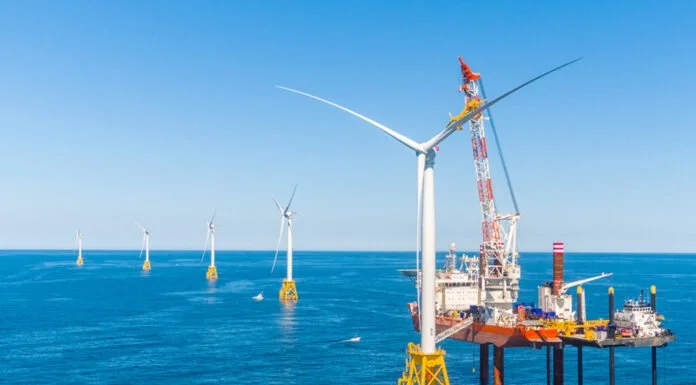
TURBINES AT the Revolution Wind offshore wind farm, which reached full operational status, developer Orsted A/S announced Thursday. / COURTESY ORSTED U.S. OFFSHORE WIND
Somewhere south of Block Island, a row of turbines is turning in the wind. On November 5, Ørsted announced that Revolution Wind is fully operational. That's 704 megawatts, enough to power about 350,000 homes in Rhode Island and Connecticut.
It almost didn't happen. The Trump administration ordered work stopped in August 2025. In December, the administration halted it again, along with four other East Coast wind projects. In January, a federal judge granted an injunction, and the crews went back to work. At the time, the project was about 87 percent done.
By March, it was sending its first power to the New England grid. Now all of it is spinning. And the fight isn't over. In October, the Justice Department asked a court to let Interior reconsider the project's approval.
That's where we are. Real things are getting built. But they're getting built in a fight, and the fight has rules. Starting January 3, Congress gets to change some of those rules.
So, let's be honest about what a new Democratic Congress can do, and what it can't.
First, the reality check
Democrats will hold at least 54 Senate seats and a solid House majority. That's a big shift. But three things haven't changed.
The president still has the veto. Donald Trump is in office until January 2029. Overriding a veto takes two-thirds of both chambers, and nobody has that.
The Senate still has the filibuster. Most legislation needs 60 votes. Fifty-four isn't sixty.
Laws already on the books stay there. Last year's One Big Beautiful Bill Act cut clean energy tax credits hard. Wind and solar projects had to start construction by July 4, 2026, or be placed in service by the end of 2027, to qualify. Homeowners lost the residential solar credit at the end of 2025. A new Congress can't simply vote that away.
Leonardo Martinez-Diaz of the Carnegie Endowment put it plainly. Without the White House and a filibuster-proof Senate, he wrote, the new Congress "will not be able to change the overall direction of decarbonization policy."
Feeling deflated? Hang on. That's not the same as saying it can't do anything. Congress has two tools that matter even without the president's signature. Political folks call them the gavel and the purse.
The purse: Congress decides where the money goes
Every year, Congress writes 12 spending bills. Starting in January, Democrats write the first drafts.
Last spring, the White House asked to cut NOAA by roughly a quarter. It wanted to eliminate the office that runs NOAA's climate, weather and ocean research labs, and cut the National Ocean Service, which handles coastal management, by more than half. Even the outgoing Republican House rejected most of that.
A Democratic Appropriations Committee can go further. It can restore funding for fisheries science, coral reef programs, Sea Grant, coastal zone management and the research fleet. Spending bills still need the president's signature. But they have to pass, or the government shuts down. That gives the people writing them real leverage.
It also means ocean money competes with everything else. The Pentagon has asked for a $1.5 trillion defense budget, and the war with Iran has its own $87.6 billion request. NOAA's budget gets settled in the same negotiations.
There's a catch, though. Writing money into law doesn't help if the money never gets spent.
The Government Accountability Office is Congress's nonpartisan watchdog. It has repeatedly found that the administration illegally withheld money Congress approved. On September 25, with five days left in the fiscal year, the White House announced it would hold back about $810 million across 11 accounts and let it expire. One of those accounts was ocean money: $8.7 million from a program that gives developing countries debt relief in exchange for protecting tropical forests and coral reefs. GAO said the move broke the law. Separately, GAO found that EPA's termination of more than $1.5 billion in Community Change Grants, meant for climate resilience and pollution cleanup in disadvantaged communities, was also illegal.
So the most important ocean work the new Congress does might not look like ocean work at all. It might look like dull legal language in spending bills. This money must go out by this date, to these programs, or else. It might also mean strengthening GAO's power to go to court, a power GAO has never actually used.
Unglamorous? Totally. But it's the difference between a coral lab that exists on paper and one that has staff and a boat.
The gavel: the power to ask questions in public
The second tool is oversight. When a party controls a committee, it controls the hearings and the subpoenas.
Democrats aren't being subtle. After the election, Sen. Ron Wyden, the top Democrat on the Senate Finance Committee, posted a one-word message: "Subpoenas."
Here are the ocean questions I'd want answered under oath.
What happened to NOAA's people? By May 2025, more than 2,400 NOAA employees had left through layoffs, buyouts, and early retirements, roughly a fifth of the agency. The fisheries science centers lost 234 people, and the Alaska Fisheries Science Center lost more than half its staff. Those scientists count fish so fishing seasons can open. The National Weather Service has been rehiring, but as of June it was still more than 300 people short of where it started in 2025. What has that done to forecasts, fish counts, and hurricane preparedness? Congress can find out.
What's the real reason for the offshore wind stop orders? The administration cited classified national security risks when it halted five projects. Federal judges have repeatedly let the projects resume. Congress can ask to see the evidence.
What did the government pay to make wind leases go away? In March, the administration reached a deal with TotalEnergies to cancel its offshore wind leases in the New York Bight and in Carolina Long Bay, off North and South Carolina. In settlements like these, developers give up leases in exchange for payments and usually agree to invest in non-wind energy. How much public money has gone into these deals, and what did taxpayers get? If you live anywhere from New Jersey to the Carolinas, that's a question about your own coastline.
A fair note. Republicans will call a lot of this political theater, and some of it will be. Republicans ran plenty of hearings on Biden-era climate spending, and Democrats said the same thing then. But oversight is also how the public learns facts that would otherwise stay buried. Hearings build a record. Records shape the next law.
The must-pass bills: where deals happen
Even with divided government, some bills have to pass: government funding, the annual defense bill, flood insurance, the farm bill, and the water resources bill if it slips into next year.
Each of those is a vehicle. Small bipartisan provisions often ride along on must-pass bills. That's how a lot of ocean policy becomes law. Not in a big climate bill with a fancy name, but in a section of a spending package nobody read.
And coastal resilience has real Republican allies. Rep. Mike Ezell of Mississippi co-leads the Regional Ocean Partnerships bill with Oregon Democrat Suzanne Bonamici. Sen. Lisa Murkowski of Alaska co-leads coastal mapping legislation with Wisconsin Democrat Tammy Baldwin. Rep. David Valadao, a California Republican, teamed up with Virginia Democrat Don Beyer on a federal flood resilience program modeled on the one the country has used for decades to reduce earthquake risk.
With Democrats writing the first drafts, those ideas have a better shot at the final package. The smart move is to build where both parties already agree: flood protection, ocean data, fisheries, estuaries and marshes. Floods hit red districts and blue districts alike.
The long game: getting ready for 2029
Congress can also write the bills it can't pass yet.
That sounds pointless. It isn't. Many of the Inflation Reduction Act's ideas were drafted and refined for years before the votes existed. When the window opened in 2022, the homework was done.
A new Congress can now hold hearings on what coastal communities need and write detailed bills. That could mean restoring clean energy credits, funding voluntary relocation from the most dangerous floodplains, supporting blue carbon restoration in marshes and seagrass, and modernizing flood insurance so it pays to protect wetlands instead of rebuilding in the same spot. Then, whenever the politics line up, the bills are ready.
Climate scientist and author Ayana Elizabeth Johnson keeps asking a question that sticks with me: what if we get it right? Part of getting it right is having the plan finished before the moment arrives.
Don't forget the states
Congress isn't the only place that changed on November 3. Democrats flipped governorships and state legislative chambers and flipped attorney general offices in states including Texas and Georgia. Attorneys general can sue. Governors run coastal programs. Statehouses can pass their own clean energy and resilience laws.
Sometimes the most important vote isn't on a candidate at all. In Charleston, South Carolina, county voters just approved a $4.25 billion sales tax extension that includes money for a seawall, flood fixes and protected greenspace, with the Army Corps as a partner on the seawall. That's federal and local working together, which is how most real coastal protection happens.
Being fair about the other side
Some readers won't agree with me, and they deserve a fair hearing.
The administration argues that NOAA's research budget can be trimmed without hurting core forecasting. Many fiscal conservatives see the flood insurance program as a debt trap that encourages building in harm's way. Some fishermen and coastal residents oppose offshore wind over its effects on fishing grounds, whales, and ocean views. Nantucket residents are in court right now over one of these projects.
Those are real arguments. My view, after decades in the water, is that the evidence for funding ocean science and coastal resilience is overwhelming. But the best way to win this debate is to take the other side seriously.
What you can do, starting now
A new Congress listens hardest in its first few months, while new members are still learning what their voters care about.
1. Find your new members. If your district or state changed hands, your new representative or senator is building a staff right now. Email their transition office. Tell them the coast matters to you.
2. Show up to town halls. Bring one specific question about NOAA, flood insurance, or offshore wind.
3. Watch the hearings. Oversight hearings are streamed. Clip the moments that matter and share them. You're the distribution system.
4. Comment on spending bills. When committees ask for public input on NOAA and EPA funding, they mean you. Short, personal, specific comments work.
5. Get your hands wet. Find your local Waterkeeper, Sea Grant office or restoration group. Plant dune grass, bag oyster shell, count fish. Policy is how you protect the water. Restoration is how you remember why.
Share this with someone who thinks nothing changes in Washington and subscribe if you haven't. I'll be following these fights all year, from the places where the money and the water meet.
One last image
Back to those turbines. Somebody had to keep showing up in court. Somebody had to keep the crews on the boats. Somebody had to keep believing the thing was worth finishing.
The new Congress can't do everything. It can fund the science, protect the money, ask the hard questions in public and get the next big bill ready.
The question is whether the rest of us will keep showing up long enough to finish it.
