
The Whole Reef: The Empty Top
A camera on the sand off Carriacou shows what happened to the top of the pyramid.
Field Report · Carriacou, Grenada · Week Three Part 1 · September 2026
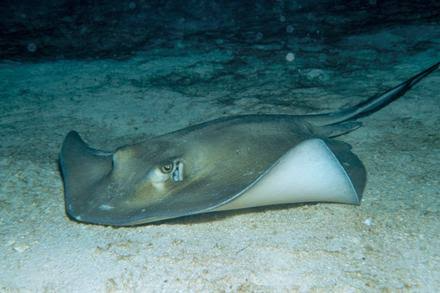
Southern Stingray Photo Credit: Monterey Aquarium
The stingray showed up a little past the halfway mark.
Four of us huddled around a laptop at Deefer Dive Center, watching a patch of sand fifty-one feet down off Sandy Island. That morning we had set a BRUV there, a Baited Remote Underwater Video rig: a PVC frame, a tube of frozen fish guts, a bag of chum, concrete blocks, and a GoPro on a pole. Then the hardest part: leaving.
In the first half of the video, the locals had the place to themselves. A curious coney grouper. Yellowhead and bluehead wrasse. A trunkfish nibbling leftovers. Goatfish working the bottom. Yellowtail snapper darting in at the bait.
Then they left. All of them. Empty sand.
A southern stingray slid in from the edge of the frame, four feet across. It passed the bait and slid out. Came back, ate, left again. Four visits. The crowd stayed away.
That's the whole reef in ninety seconds.
The pyramid, from underneath
I spent Monday in a classroom at Deefer, where Caribbean Reef Buddy (CRB) runs its volunteer program, reviewing the food pyramid. Algae at the bottom. Grazers above them. Small hunters. Big hunters. Sharks at the top. Only about 10 percent of the energy at each level reaches the next. That's why a reef needs a huge base to hold up a few sharks.
The predators at the top are few, and they've been disappearing quietly. You can dive a reef with no sharks and think it looks fine. I did, for years.
Now lay that pyramid over the reefs we dove this week. At the bottom: turf algae on dead coral, seagrass on the flats, tiny algae inside the coral. Eating that: parrotfish, urchins, king crabs. Above them, the wrasses and young snapper from Friday's video. Then the coney, the morays, the barracuda, the ray, the lionfish. And at the top, the reef sharks that should be here. One nurse shark showed up on video this week. That was the top.
The only reef shark I saw all week was in the bait.
The chum came from the Hillsborough fish market. In the bin, among the guts, was a blacktip shark's head. Next to it, four unborn pups, each as long as my forearm. Someone had caught a pregnant female near shore by hand. He could have let her go. Instead, she went to market, then into our chum bag.
Carl Wisdom, our Predator Week instructor, said CRB has dropped BRUVs all season. The footage shows nurse sharks and stingrays, never reef sharks. One afternoon of video is a glimpse. A season is a pattern. At the top of Carriacou's pyramid, the camera keeps finding a bottom-feeder and a ray.
This is the Caribbean now. Global FinPrint, the biggest reef-shark survey ever, used over 15,000 baited cameras on 371 reefs in 58 countries. Nearly one in five had no sharks. Five common reef-shark species are down 60 to 73 percent worldwide. The number that matters: reef sharks are twice as common in fully protected areas as on fished reefs. Would educating the fisherman have saved that blacktip? A patrol boat? I don't know. But she puts a face on the loss.
Remove the sharks and mid-sized predators rise. They eat the grazers. Algae overruns the coral. It's a simple story, and I want to handle it carefully, as the FinPrint scientists do. Their words: reef sharks "likely play an important role." The exact link between shark loss and coral decline is still debated.
The lower links aren't in doubt. Friday's video showed how it works. The crowd left when a predator arrived. Fear changes where, when, and how long fish eat. With all its big predators, a reef feels that pressure all day. Without them, it doesn't.
What this reef has already lost
The problem is that the grazers are missing too.
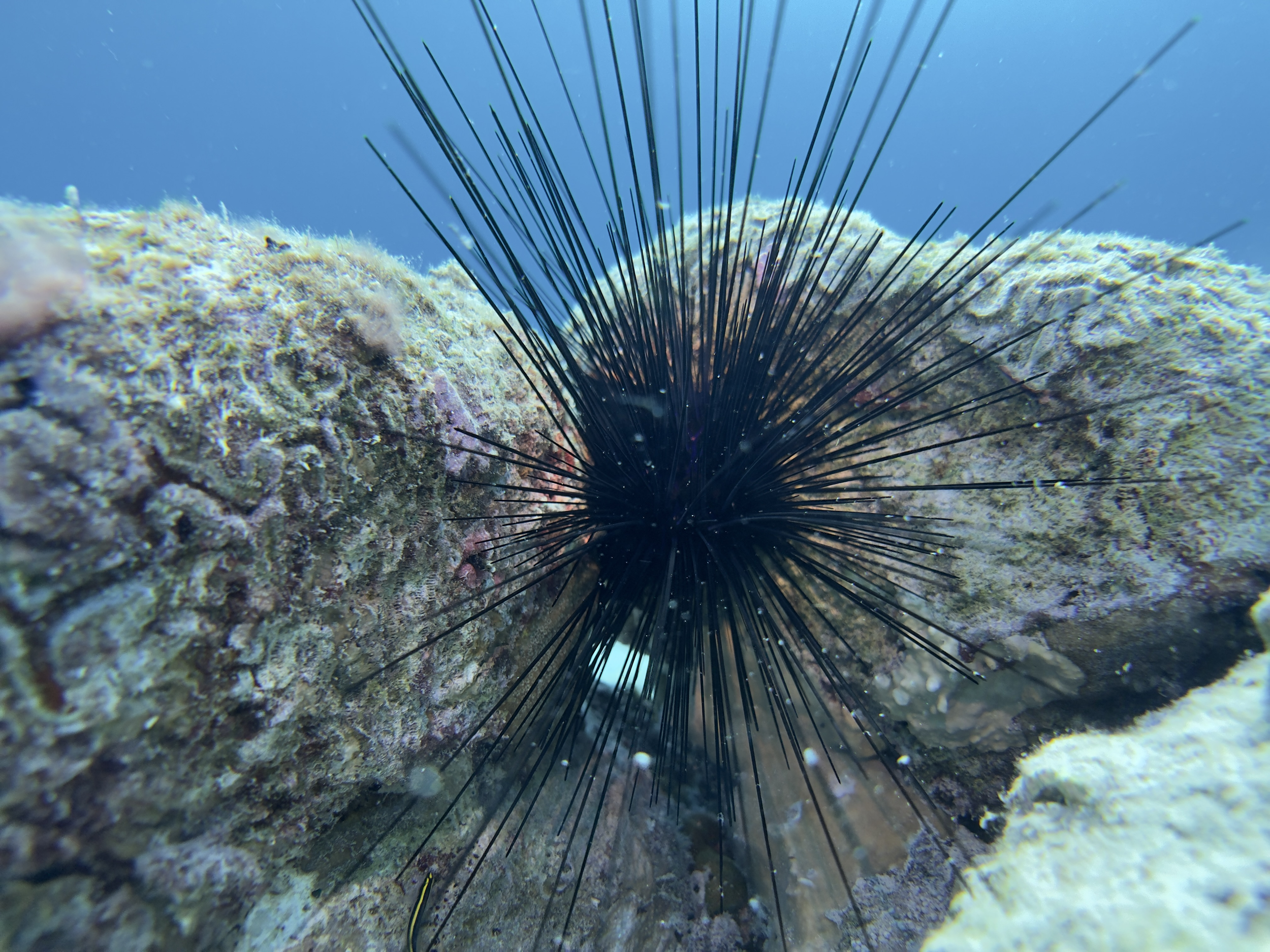
Long-spined sea urchin (Diadema antillarum) Photo Credit: Denny Frazier
The Caribbean's great lawnmower was a Long-spined sea urchin called Diadema, and it has died twice. In 1983 and 1984, a mystery disease killed about 98 percent of them in thirteen months. Forty years later, they were back to about 12 percent. In 2022, a second die-off struck 25 countries and territories in four months, killing up to 99 percent at monitored sites. This time, scientists found the killer: a single-celled parasite.
Why don't the urchins return? A study from Saba, out last year, changed how I saw that video. Baby urchins were everywhere, but they thrived in only one spot: an artificial reef with a hole for each urchin and fewer wrasses and hogfish. The problem wasn't numbers. It was shelter, and the small fish that eat young urchins before they're big enough to escape. The bluehead wrasse. The yellowhead wrasse. The first fish at the bait on Friday.
With the sharks gone, the middle of the pyramid is eating more grazers. So are people. Windward Islands fishermen now target parrotfish and surgeonfish because snapper, grouper, and jacks are scarce. Last September, Grenada graded its marine protected areas. Herbivore biomass dropped from Poor to Critical. Urchins are rare. Seaweed is spreading.
And then there's the fish that isn't supposed to be here.
On Wednesday we dove Deep Blue, a reef near The Sisters rocks where a sunken tugboat lies eighty feet down. We took ten lionfish off that reef in one dive: four on my spear, three each for Oscar and Teegan. On the wreck itself, none. An octopus watched us from a rusted pipe, a native predator minding its business.
In the 1990’s, Lionfish escaped from Florida aquariums and spread across the Caribbean within ten years. Nothing here eats them. A female can release about 30,000 eggs every four days. According to NOAA, lionfish can live 15 years or more: roughly 5,000 offspring a year, 75,000 over a lifetime. A staggering number. On a small Bahamian reef, one lionfish cut native juvenile fish by 79 percent in five weeks. Parrotfish and wrasse fry are especially at risk.
We took 27 lionfish this week. Carl says that's normal. Three off two reefs on Tuesday. Ten off Deep Blue on Wednesday. The difference wasn't the reef. It was how long since anyone had hunted there. CRB had skipped Deep Blue for a month or two, and the lionfish moved back in. Culling works. It never ends.
We measured each lionfish: length, weight, mouth width, stomach contents. CRB records the data. The smallest went to Harry, the dive center's cat. The biggest went into Oscar's ceviche. The invader becomes data, then dinner.
Next week
That's the top and the middle of Carriacou's pyramid: sharks gone, grazers scarce, an invader filling the gap. In Part Two, I'll go to the bottom, where the coral lives, and to the people trying to grow it back. It starts with a sunken tugboat and a soft brush.
What you can do now
Order lionfish when it's on the menu. If you dive, choose operators who cull lionfish and report sightings to REEF. And if you fish, let the parrotfish and the pregnant sharks go.
Sources. MacNeil et al., Nature 583:801–806 (2020); Simpfendorfer et al., Science 380:1155–1160 (2023); Goetze et al., Nature Ecology & Evolution 8:1118–1128 (2024); Hylkema et al., Frontiers in Marine Science (2023); Hewson et al., Science Advances 9:eadg3200 (2023); Hylkema & Klokman, PeerJ 13:e20418 (2025); Albins & Hixon, Marine Ecology Progress Series 367:233–238 (2008); Hyman et al., Scientific Reports 16 (2026); Grenada Coral Reef Foundation for the Grenada Sustainable Development Trust Fund (Sept 15, 2025); NOAA Fisheries, lionfish life history (⚑ verify lifespan and offspring figures); USGS Nonindigenous Aquatic Species database; REEF (Reef Environmental Education Foundation); field notes, class notes, and dive log, Carriacou, September 7–12, 2026.
