
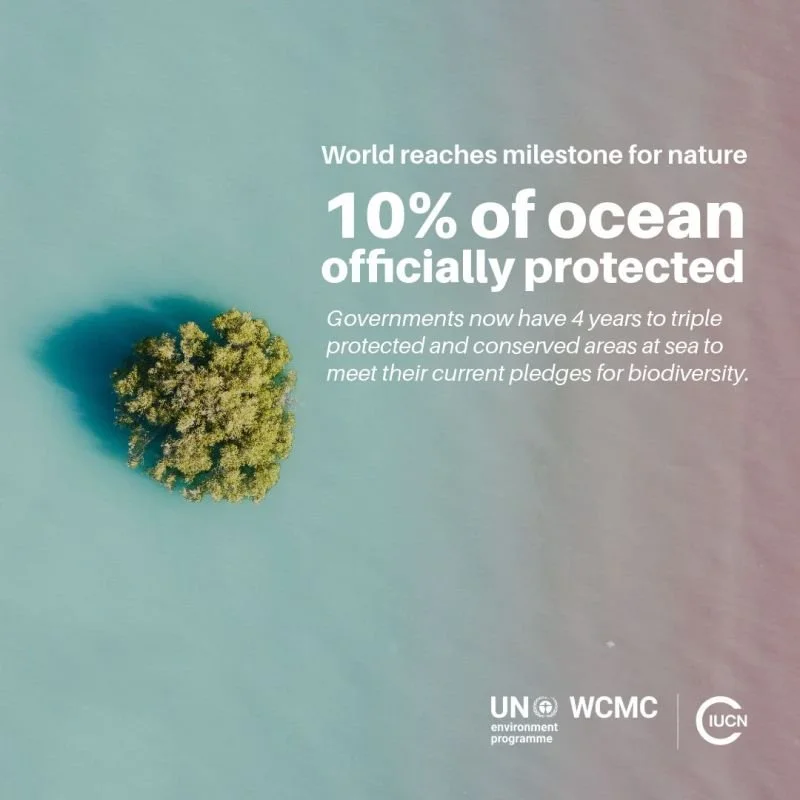
The World Has Protected 10% of Its Oceans — Now Comes the Hard Part
The journey to 10% accelerated sharply in 2025, which saw the biggest single-year jump in ocean protection in nearly a decade. New marine protected area designations across the Pacific, Atlantic, and Indian Oceans drove much of that momentum — and the stories behind those designations reveal what determined action can look like.
10%of oceans now protected or conserved
Nearly 2 million square miles (5M km²) of new ocean protected in two years
30%global target by 2030
For the first time ever, 10% of the world's ocean and coastal areas are now part of protected and conserved areas. The International Union for Conservation of Nature celebrated this milestone in 2026 — a remarkable achievement made possible through dedicated international teamwork, with about 5 million square kilometers designated in just two years—an area larger than the European Union.
"Hitting this important benchmark reminds us what can be achieved when the international community works together, using legal frameworks, scientific data and community-based projects to realize global ambitions."
— Dr Grethel Aguilar, IUCN Director General
A year of remarkable progress
Chile has made some truly exciting progress, implementing long-anticipated management plans for three enormous MPAs: the Nazca Desventuradas Marine Park, Motu Motiro Hiva Marine Park, and the Rapa Nui Multiple Use Conservation Area — collectively covering nearly a million square kilometers of the South Pacific. At the same time, French Polynesia celebrated the creation of what many are calling the world's largest single MPA. Meanwhile, in the Philippines and Australia, local and regional protections were thoughtfully expanded, adding more hope for the future of these incredible environments.
🇸🇦 Samoa
Legally designated nine MPAs in 2025, with five now fully implemented — banning fishing, mining, and dumping across 33,389 km². Samoa's fully protected waters now stand at 25.6% of its national seas.
🌊 Melanesia
Solomon Islands, Vanuatu, and Papua New Guinea announced plans for the world's largest Indigenous-led MPA — the proposed Melanesian Ocean Reserve — which, once implemented, will cover 4.6 million km².
🇵🇬 Papua New Guinea
Developed new MPAs through consultation with over 9,000 people from 100+ Indigenous communities, who shaped boundaries, governance rules, and species protections — delivering the country's first-ever legal safeguards for critically endangered sawfish.
🌍 Western Indian Ocean
Regional network-level protections advanced, alongside steps toward a connected MPA system in the Eastern Tropical Pacific — showing how neighboring nations can coordinate to protect shared ecosystems.
The High Seas Treaty: a turning point
One of the most significant recent milestones is the implementation of the UN High Seas Treaty, also known as the Agreement on the Conservation and Management of Marine Biological Diversity of Areas Beyond National Jurisdiction (BBNJ), which entered into force in January 2026. After over twenty years of discussions, this treaty offers a crucial legal foundation for establishing protected areas in international waters—covering 61% of the world's oceans—that previously had limited formal protections.
The treaty won The Earthshot Prize in 2025, a signal of its global significance. With 78 nations, plus the European Commission, now signed up, the focus shifts to establishing actual high-seas MPAs — a process that will determine whether the 30×30 goal is achievable.
Small Island Developing States are leading the way. Nations like Samoa, Fiji, and others across the Pacific and Caribbean have demonstrated that locally-rooted, community-driven marine management — grounded in Indigenous knowledge and traditional stewardship — can be both highly effective and a model for larger nations. Their push to ratify the BBNJ Treaty and advocate for its rapid implementation has been central to global progress.
Finance: commitments are growing
Protecting 30% of the ocean by 2030 requires not only political will but also sustained funding. Encouragingly, 2025 saw a wave of significant financial commitments to ocean conservation:
Recent ocean finance commitments
Development Bank of Latin America & Caribbean $2.5 billion
European Commission €1 billion
ORRAA #BackBlue Ocean Finance Commitment $3.45 trillion
Global biodiversity finance target by 2030 $30 billion/yr
Countries including Belize, Indonesia, and Barbados are also pioneering innovative financing tools — blue bonds and debt-for-nature swaps — that could unlock an additional $18 billion in capital for ocean protection while directly supporting coastal communities and Indigenous Peoples.
The challenge ahead
Celebration should be short. Back in December 2022, the Kunming-Montreal Global Biodiversity Framework brought governments together with a shared goal: to protect 30% of Earth's land and seas by 2030 — known as the "30×30" target. To reach this milestone, an area approximately the size of the Indian Ocean still needs to be designated within the next four years. We need to triple our coverage to make it happen.
The high seas remain the greatest challenge we face. Even though they cover more than 60% of our ocean's surface, only about 1% of these international waters are effectively protected — a small change over the past decade. The BBNJ Treaty has created a new opportunity, and now it’s up to nations to take that step forward.
Protection on paper isn't always real protection. Only about 3.3% of our oceans are truly protected, where activities like fishing and extraction are strictly forbidden. We have management effectiveness data for just 1.3% of these areas. Remember, lines on a map are not enough—they need active management, proper funding, and enforcement to make a real difference.
Funding gaps are a serious and pressing issue. Canada, known as one of the world's largest ocean nations, is approaching a critical point after its federal marine program ended in early 2026. The proposed budget cuts to its Fisheries and Oceans Department only add to the worries. The Auditor General has also voiced concerns that the country isn't on course for the 30×30 goal. Unfortunately, Canada isn't alone in facing these challenges.
The rollback of US monuments is concerning. Some of the world's most well-protected marine areas, like the Pacific Islands Heritage Marine National Monument and Papahānaumokuākea, are at risk of being downgraded. It’s heartbreaking to see protections that were carefully put in place being threatened of being undone.
Bridging the finance-to-implementation gap is crucial. With trillions of dollars pledged publicly, it’s important that these commitments turn into real actions in communities and ecosystems that need support the most. High-income nations have a vital role in fulfilling their promise of providing $30 billion each year in biodiversity finance to help developing countries make a meaningful difference.
Indigenous rights must be centered, not consulted. Meaningful protection requires more than including Indigenous Peoples as stakeholders — it means recognizing their tenure, governance systems, and knowledge as fundamental to any credible conservation framework.
Quality, not just quantity
· Numbers alone don't tell the full story. The Kunming-Montreal Framework emphasizes that protected areas should be not only designated but also effectively managed and fairly governed. The Protected Planet Report 2024 notes that, globally, there isn’t enough data to fully assess how well existing MPA systems are working. Filling this data gap is an important step we need to take, and it requires proper resources.
· Technology is starting to make a real difference. Satellite monitoring, AI-powered vessel tracking, and remote sensing tools are making enforcement more transparent, helping to uncover illegal fishing activities, and supporting management decisions based on solid evidence — giving smaller nations a fairer chance, even with fewer patrol resources.
"The coverage of protected and conserved areas at sea still needs to triple by 2030 — and it is critical that both new and existing areas are managed effectively to deliver positive outcomes for people and nature."
— Neville Ash, Director, UNEP-WCMC
· The upcoming Protected Planet Report 2027 will be an important milestone, marking a vital point in our 30×30 effort. The time from now until then isn't just a waiting period — it's a crucial phase where our actions truly matter. The ocean is counting on us to fulfill the promises we've made to protect it and ensure a healthier future for all.