
Guardians in the Gray Atlantic: A Fragile Hope for the Right Whale
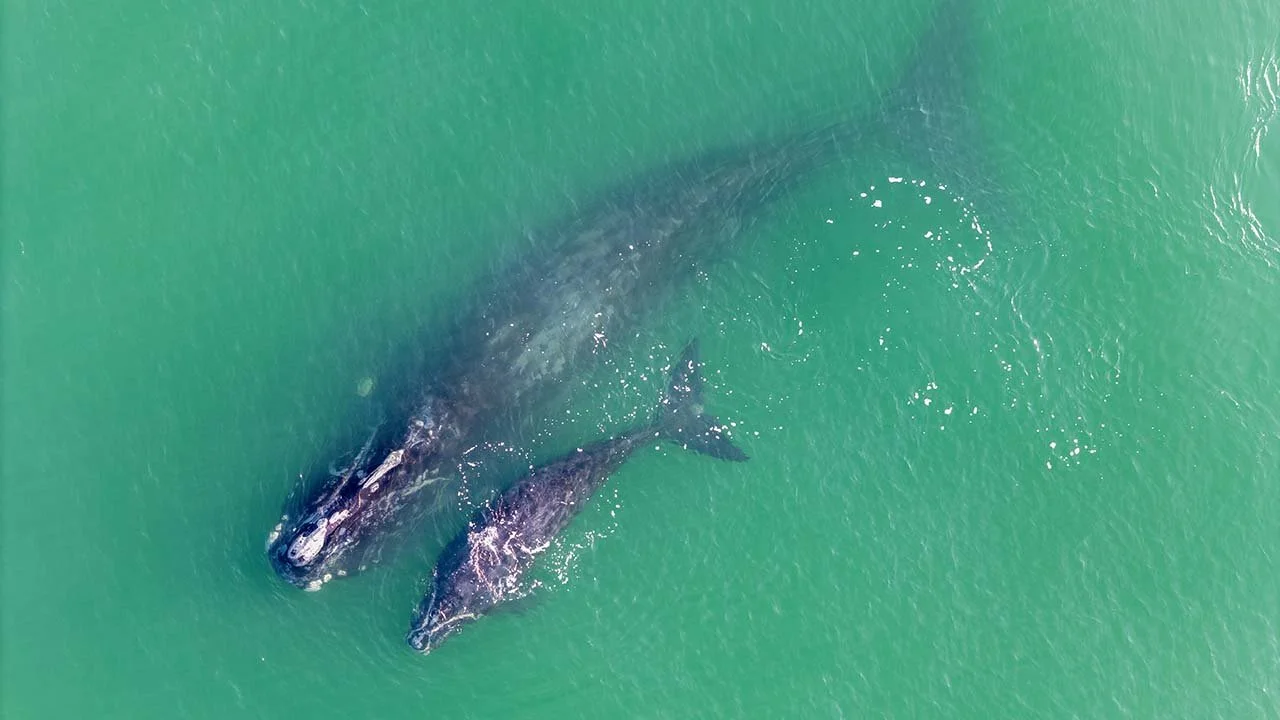
Ghost was sighted with a calf on January 30, 2026, just offshore of Flagler Beach, FL
Photo: Marineland Right Whale Project, Taken by Jeff Greene Under NOAA Permit #26562
From 1,000 feet above the Atlantic, the ocean appears endless — slate gray and restless beneath the winter sky. A survey plane banks gently off the coast of Georgia, and a biologist presses her face to the window. Then she sees it: a dark back breaking the surface, a plume of mist, and tucked close beside it, smaller and new, a calf.
In a species reduced to fewer than 400 individuals, that sight is more than beautiful. It is defiant.
This winter’s calving season — which runs from mid-November through mid-April — has produced 22 documented calves, the highest number in 15 years. For the critically endangered North Atlantic right whale, that figure represents something conservationists have not felt in years: measurable hope.
“We’ve been waiting a long time to see numbers like this,” says a population biologist with the National Oceanic and Atmospheric Administration Fisheries. “It doesn’t mean recovery yet. But it tells us the whales still have the capacity to rebound.”
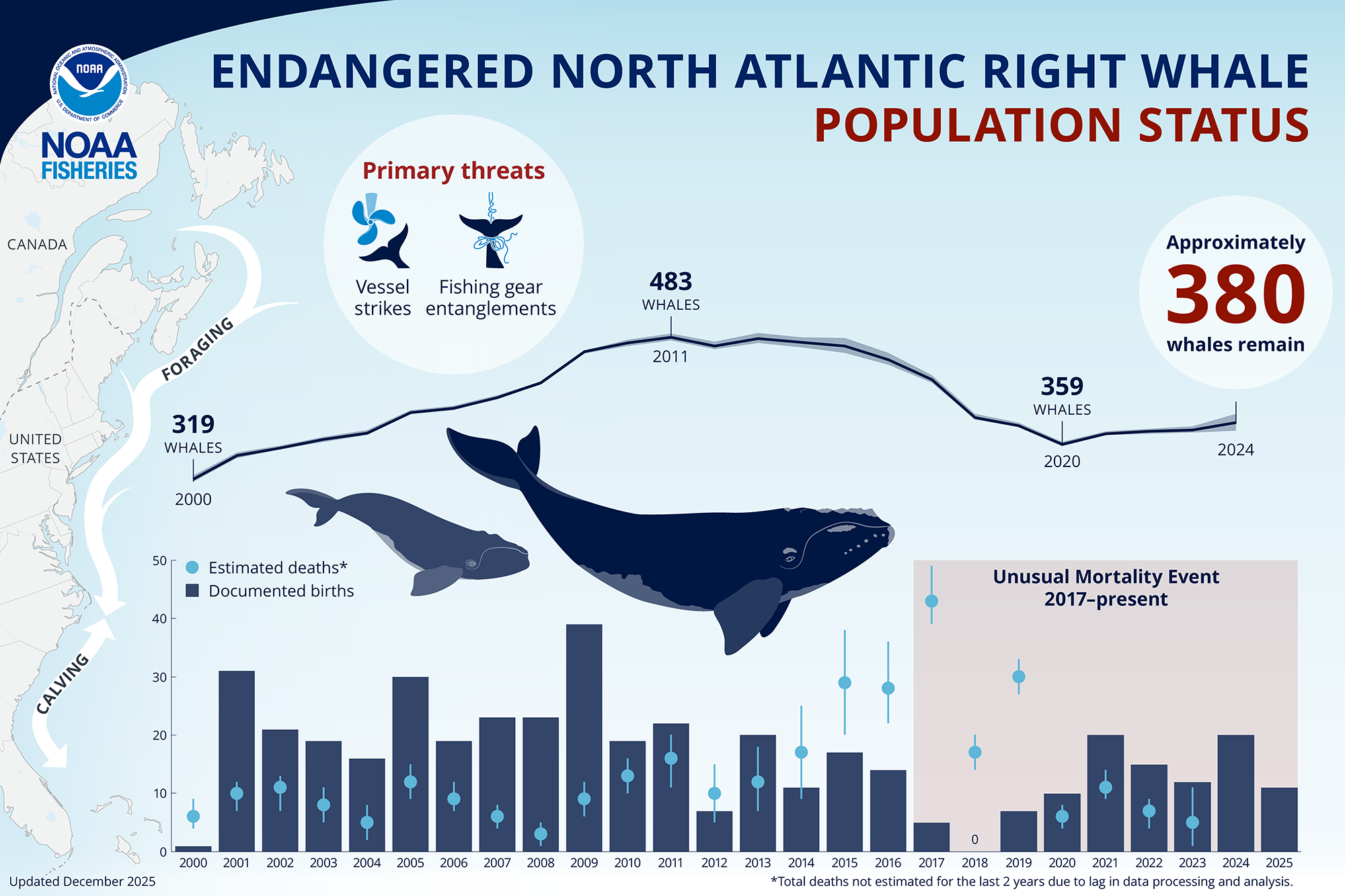
In October 2025, NOAA Fisheries estimated that 384 North Atlantic right whales were alive. The documented birth data displayed in this infographic reflect the number of mother-calf pairs observed for the first time each calving season. Credit: NOAA Fisheries
A Species on the Edge
Since 2017, right whales have been caught in an ongoing Unusual Mortality Event. Entanglements in fishing gear and collisions with vessels have left more than 20 percent of the population sick, injured, or dead. In many recent years, deaths outpaced births.
The population peaked at approximately 483 whales in 2010. Since then, it has declined sharply. Today, scientists estimate roughly 384 individuals remain — including only about 70 reproductive females.
“When your entire future rests on seventy animals, every birth becomes monumental,” says Dr. Philip Hamilton of the New England Aquarium. “We count calves one by one.”
For much of the past decade, the counts were discouraging. Some years produced single-digit calves. Even in stronger seasons, totals hovered around a dozen — not enough to offset ongoing mortality.
But this year’s 22 calves mark a significant shift.
A Reproductive Turn
Right whales reproduce slowly under the best of conditions. Females reach sexual maturity around age 10 and carry a calf for more than a year. Historically, they gave birth every three to four years.
That rhythm has been disrupted.
Due to chronic stress — entanglement injuries, vessel strikes, and climate-driven changes in prey availability — females have recently been calving only every seven to ten years. The additional energy required to heal from rope wounds or navigate shifting feeding grounds appears to suppress reproductive cycles.
“The whales are physiologically stressed,” explains Dr. Michael Moore of Woods Hole Oceanographic Institution. “When energy goes toward survival, it doesn’t go toward reproduction.”
That is why this winter’s higher birth rate is so significant. With limited females and extended intervals between pregnancies, scientists consider 20 calves in a season a “productive” year. At 22 calves — and with the season not yet complete — the 2025–2026 tally suggests that more females are successfully carrying pregnancies to term.
Several calves have been born to first-time mothers, expanding the breeding population — another encouraging sign.
“This tells us some of the females are in good enough condition to reproduce,” says a NOAA reproductive ecologist. “That’s something we haven’t consistently seen in recent years.”
Still, scientists caution against premature celebration. Population models indicate that to reverse decline and achieve sustained recovery, right whales would likely need 50 or more calves per year for multiple consecutive years, combined with a dramatic reduction in human-caused deaths.
Twenty-two calves represent hope — not yet security.
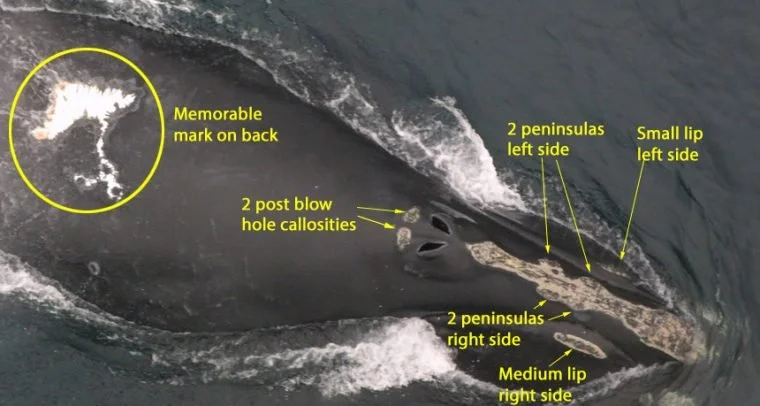
The callosity pattern categorization enables the matcher to examine only a subset of whales to find a match. It reviews sighting info, codes patterns and marks, then searches the catalog for similar whales. Photo: New England Aquarium
Watching from the Sky
Monitoring these fragile giants requires relentless vigilance.
Each calving season, survey aircraft trace systematic routes over the southeastern United States. Observers photograph whales from above, capturing high-resolution images of the white callosity patterns on their heads. These markings serve as individual identifiers, matched against thousands of images in the North Atlantic Right Whale Catalog.
“We’re essentially building life histories,” Hamilton says. “We know which females have calved before, how often, and how their bodies look year to year.”
And yet whales can disappear.
Some vanish for a decade before reappearing. Others are never seen again. In an ocean that spans millions of square miles, even a 50-ton whale can slip from view.
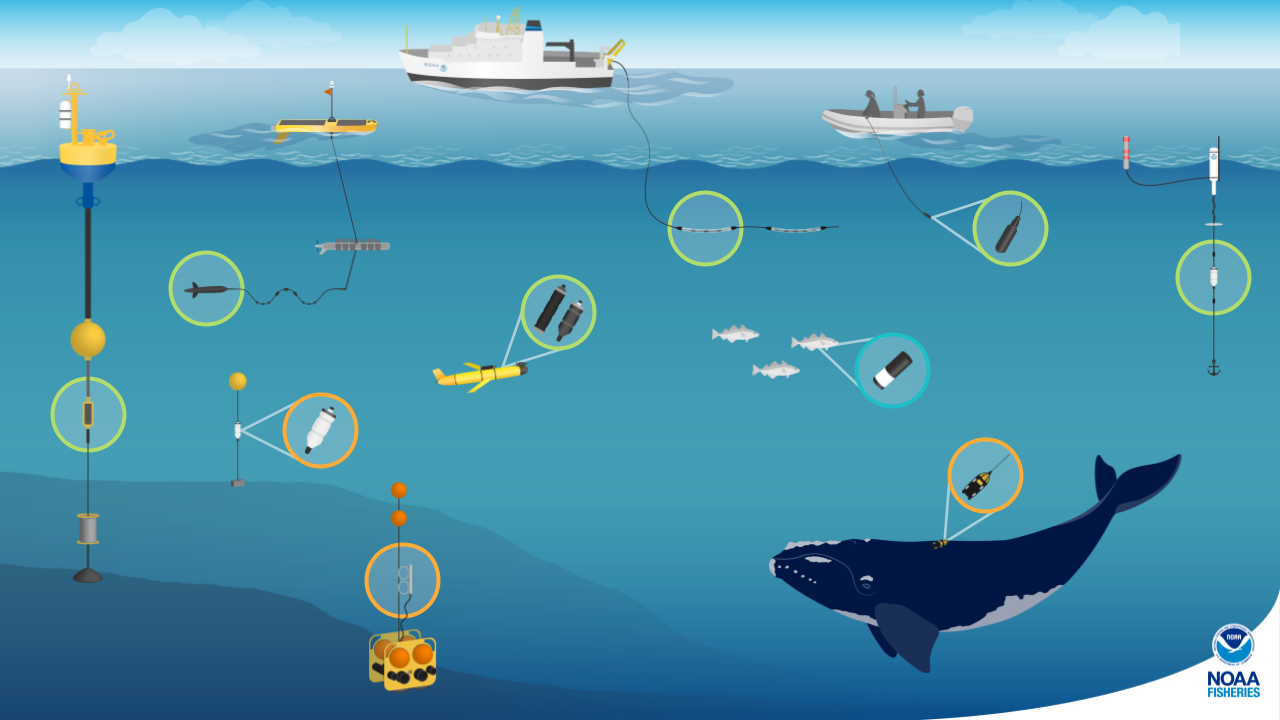
NOAA Fisheries and our partners study marine animals by using a variety of technologies to record underwater sounds, including archival passive acoustic recordings (orange circles), real-time acoustic data collection (green circles), and active acoustics (blue circles).
Listening in the Deep
Protection doesn’t rely solely on sight.
Since 2008, a network of acoustic detection buoys has monitored waters in places like Massachusetts Bay. These devices listen continuously for the whales’ distinctive upcalls. When detected, alerts are sent to researchers at the Cornell Lab of Ornithology, who notify ships to slow down.
“Slower ships save whales,” says a NOAA acoustics specialist. “A reduction of even a few knots dramatically decreases the likelihood of a fatal strike.”
In recent years, increased compliance with vessel speed restrictions — combined with expanded monitoring — may be contributing to fewer confirmed mortalities. Notably, 2025 recorded no confirmed right whale deaths, a rare and encouraging development.
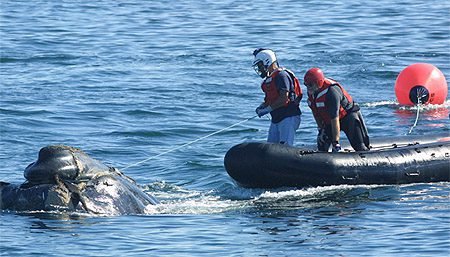
Since 1984, the Center for Coastal Studies has freed over 200 large whales and marine animals from entanglements using specialized techniques. For years, CCS was the only East Coast organization federally authorized by the National Marine Fisheries Service to disentangle large whales like the North Atlantic Right Whale. Photo Credit: Center for Coastal Studies.
Reengineering the Ocean
Entanglement in fishing gear remains the most persistent threat. More than 80 percent of right whales show scars from at least one entanglement encounter. Since 2009, entanglements have accounted for the majority of documented deaths.
In response, engineers and fishermen are experimenting with innovative solutions: ropes designed with “weak links” that break under strain, sinking lines that reduce floating hazards, and ropeless fishing systems that eliminate vertical buoy lines entirely.
“The goal isn’t to stop fishing,” says a fisheries innovation specialist. “It’s to make it whale-safe.”
When entanglements occur, trained response teams attempt dangerous disentanglement operations, cutting heavy rope from massive, struggling animals. Each rescue is painstaking — and not always successful.
Learning From Loss
When whales die, scientists act quickly. Necropsies reveal the hidden impacts of ship strikes, chronic rope injuries, and malnutrition. At institutions like the Smithsonian National Museum of Natural History, skeletal remains become scientific records — evidence guiding future protections.
“Every whale teaches us something,” a Smithsonian curator explains. “Even in death, they inform the next decision.”
A Narrow Window
For now, the Atlantic holds a fragile balance. Twenty-two calves swim beside their mothers — small, dark arcs in vast gray water. They nurse, surface, and learn migration routes that have existed for millennia.
The whales are doing what they have always done: surviving when conditions allow.
“This year’s births show us what’s possible,” says the NOAA population biologist. “If we reduce the threats, the whales respond.”
Recovery will not hinge on one season. It will depend on sustained protection, technological innovation, regulatory enforcement, and global cooperation.
But in conservation, hope is not abstract. It is counted in calves.
And this winter, there are twenty-two reasons to keep trying.
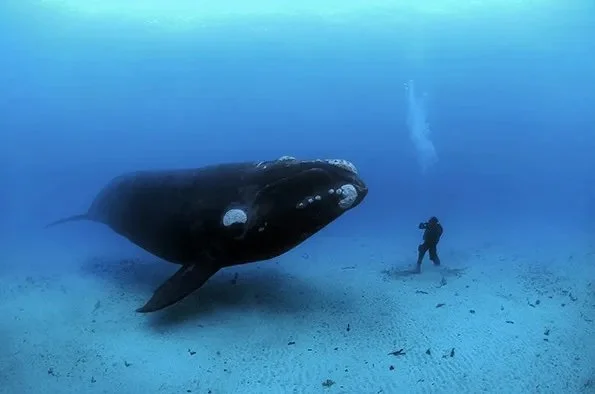
Off the Auckland Islands, a southern Right Whale moves in for a closer look at Skerry’s diving partner. In 2006, National Geographic photojournalist Brian Skerry began photographing the critically endangered North Atlantic right whale, aiming to raise awareness. He highlighted differences between U.S. East Coast whales, affected by entanglement and ship strikes, and healthier Southern right whales in New Zealand. Photo Credit Brian Skerry National Museum of National History
