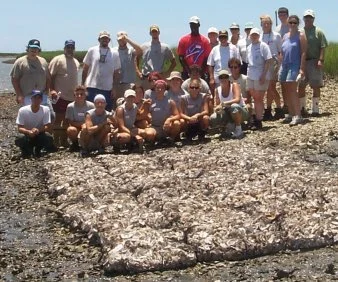
Volunteers working with the South Carolina Oyster Recycling Enhancement program are building an oyster reef to protect the Spartina salt marsh and improve water quality in a tidal estuary.
What Actions Can I Take to Support Ocean Conservation?
Take as many simple, deliberate steps as you can, as often as you can, that bring you joy. Use your superpowers to make the most significant impact. Avoid burnout. This is a marathon, not a race.
So, what are my superpowers?
Dr. Ayanna Elizabeth Johnson has addressed this question in her new book What if we get it Right? Visions of Climate Futures.
In What If We Get It Right?, Ayana Elizabeth Johnson offers a powerful antidote to climate anxiety, presenting a vision of a hopeful, sustainable future. The book challenges prevailing apocalyptic narratives about climate change, instead highlighting the possibilities that arise from proactive environmental action. Johnson emphasizes the potential benefits of climate initiatives—such as clean energy, vibrant communities, and restored ecosystems—shifting the focus from loss to gain and inspiring readers to envision a flourishing world where climate solutions thrive. Featuring insights from over 20 experts.
By blending science, art, and policy, Johnson offers a holistic understanding of climate solutions, emphasizing that the choices we make today will shape the world of tomorrow. A central theme of empowerment runs throughout the book, as Johnson urges readers to see themselves as active participants in shaping the future and offers actionable strategies for engaging in local initiatives. Her personal annotations highlight key insights and emotional moments, guiding readers to reflect on the profound messages within the conversations. Ultimately, What If We Get It Right? serves as a beacon of hope in the climate discourse, inspiring us to embrace creativity, innovation, and community as we take meaningful steps toward a better world.
For Dr. Johnson, the goal isn't just to save the planet; it's to build a future that is worth living in—one defined by clean air, renewable energy, and, most importantly, the mended landscapes of our shared. We need to eliminate greenhouse gas emissions from electricity, transportation, agriculture, industry, and buildings. We need to protect and restore ecosystems. We need to change society, policy, economy, and culture. This is about transformation, and the stakes for humanity are greater than her heart and mind can fully fathom.
She is often asked, “What can I do to address climate change?” And her response is “What joyous work can you do to help address the climate crisis? How can you be of use? “ She is thrilled that this is what she is getting asked about most these days, as more and more eyes are wide open.
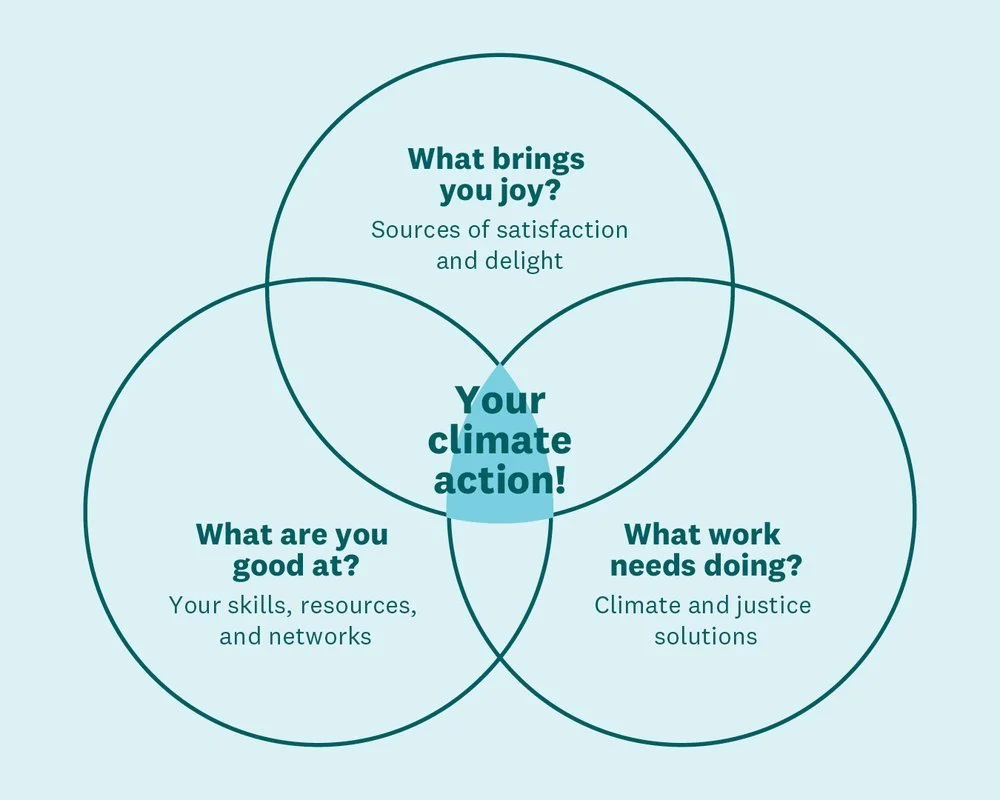
Too often, the climate movement and the media tell everyone to do the same things: Vote, protest, donate, spread the word, and lower your carbon footprint. And, yes, it’s great to do those things. But all too rarely are we asked to contribute our specific talents, our superpowers. Here’s one way to think about what you can do. It’s a climate action Venn diagram with three overlapping circles.
What are you good at?
What are your areas of expertise? What can you bring to the table? Think about your skills, resources, and networks—you have a lot to offer.
What work needs doing?
Are there particular climate and justice solutions you want to focus on? Think about systemic changes and efforts that can be replicated or scaled. There are heaps of options.
What brings you joy?
Or perhaps a better word is “satisfaction.” What gets you out of bed in the morning? Choose climate actions that energize and enliven you.
Please do not choose something that makes you miserable. This is the long haul. So, it's critical to avoid burnout. Choose things that enliven you.
The goal is to be at the heart of this Venn diagram for as many minutes of your life as you can.
This is similar to the Japanese concept of Ikigai, which helps individuals find their purpose. I hope you find your superpowers. Taking this approach will enable way more progress on climate solutions than if we each obsess about our individual footprints.
Next, once you have identified your climate action, it is time to put it into practice.
Keep Showing Up
This is not a spectator sport. It’s not just billionaires and politicians who will decide our future-it’s small business owners and students and citizens: it’s whoever steps up and whoever you bring along with you. Take breaks, but keep going. We shape the future.
Can you help your own company, school, church, or town charge ahead with climate solutions? Because what we need is a change in every sector and every community.
Find Your People
“Who are your people?” These are people in your community, volunteer organizations, who are doing the work. They may be professionals or colleagues who share the ideas and visions and offer opportunities to collaborate. These people are conjurers. They don’t stop at dreaming, they make something where there was nothing, something needed. They make magic in the real world. Support your people, love them, and hold on. Lean into possibility together. Imagining climate futures is a group effort
Join Something
Contribute your skills to existing efforts – Make it possible. Build the website, raise the funds, recruit the talent, plan the event. As Bill McKibben puts it, “Faced with the kind of crises that we face, the most important thing that we can do is: to not always be an individual.”
Bring your Superpowers
Be gentle with yourself on the “What are you struggling with?” Put your insecurities aside and simply consider what you have to offer - in your personal life, professional life, and civil life. If we each harness our superpowers, that will actually enable the radical change we need.
Be a Problem Solver
What this moment in history requires is a relentless focus on solutions. Whether your purview is finance, energy, urban planning, manufacturing, construction, law, food, administration, or transportation, there is nothing more attractive than a problem solver.
Choose Your Battles
As Ayanna puts it: “Do your best and don’t worry about the rest.” And it’s the best advice her parents gave her. Keep things in perspective by keeping at least one eye firmly on the Earth's future. Choose something to fight for, and please, no friendly fire.
Nourish Joy
There are so many things that need to be done, don’t pick something that makes you miserable. It’s imperative to avoid burnout, so choose what enlivens and energizes you. Take climate change seriously, but don’t take yourself too seriously. The work can and should be gratifying and punctuated with joy.
Love Nature
And remember that you are a part of it. We can’t say it better than Rachel Carson:” Those who contemplate the beauty of the earth find reserves of strength that will endure as long as life lasts.”
So, who is Dr. Ayanna Elizabeth Johnson?
To understand Dr. Ayana Elizabeth Johnson is to understand the ocean—not as a distant blue expanse, but as the rhythmic, beating heart of our planet's survival. A Brooklyn native who famously decided to become a marine biologist at the age of five, Johnson has spent her career transforming that childhood wonder into a blueprint for global resilience. Today, she stands at the vanguard of a movement that bridges rigorous field science with high-level policy, fundamentally reshaping how we talk about—and solve—the climate crisis.
The Architect of the Blue New Deal
Johnson’s journey from the classrooms of Harvard to the depths of the Scripps Institution of Oceanography was always fueled by a sense of practical discovery. Early in her career, she earned an award from National Geographic for inventing a new type of fish trap designed to reduce bycatch, ensuring that conservation efforts didn't come at the cost of fishermen’s livelihoods.
This dedication to balanced, community-driven solutions eventually led her to the halls of power in Washington, D.C., where she helped architect the Blue New Deal. By integrating ocean-based strategies—like restoring coastal "blue carbon" ecosystems and expanding offshore renewable energy—into federal policy, she ensured the seas were no longer an afterthought in climate legislation. In 2022, her influence reached the global stage when she was appointed to the U.S. State Department’s Foreign Affairs Policy Board.
Designing the "Urban Ocean"
As the co-founder of Urban Ocean Lab, Johnson focuses her gaze on the 65 million Americans living in coastal cities. This Brooklyn-based think tank works to develop equitable climate-adaptation strategies, from storm-buffering mangrove restoration to smarter zoning for rising seas. Her work consistently emphasizes that the most effective environmental solutions must also be socially just, moving beyond "buzzwords" to create a world that is not just surviving, but thriving.
A Radical Optimism for 2026
In the world of science communication, Johnson is perhaps best known for her push toward "radical optimism". She co-founded The All We Can Save Project to nurture a feminist climate renaissance and co-hosted the hit podcast How to Save a Planet. Her recent bestseller, What If We Get It Right?: Visions of Climate Futures , has become a cornerstone of climate literature, winning the 2025 Phi Beta Kappa Award for Science.
As of early 2026, Johnson continues her work as the Roux Distinguished Scholar at Bowdoin College, where she guides a new generation of leaders to find their own "Climate Action Venn Diagram"—the intersection of what they are good at, what work needs doing, and what brings them joy. Her paperback edition of What If We Get It Right? scheduled for release on April 14, 2026, Johnson remains a tireless advocate for the idea that "getting it right" is still within our reach.