
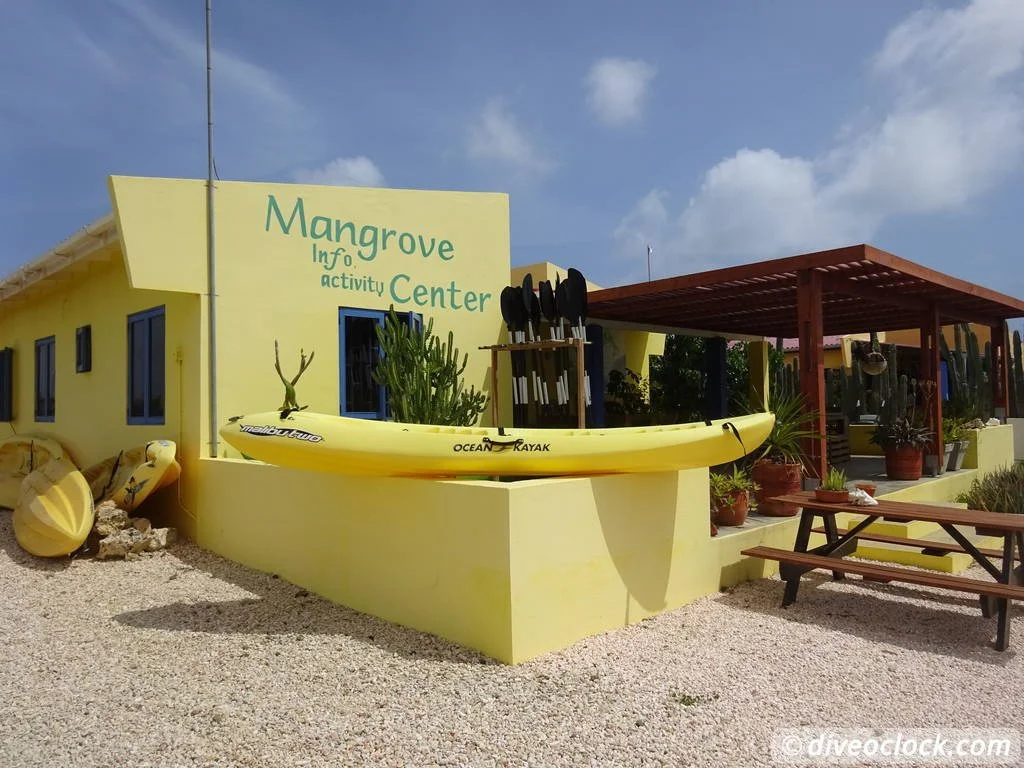
“Welcome to the Mangrove Center of Bonaire.” says Eric Van Hassel, gesturing toward the tangled trees that rise above the mudflats like green cathedrals. “What do you see?" How can these trees benefit the people here — or anywhere?”
For three years, Eric has guided visitors through these coastal forests, but his reverence hasn’t dimmed. His favorite moments come at dawn, when he and his wife paddle silently into the mangroves to was the sun ignite the water. “You just sit, listen, and realize how much this world gives us,” he says.
A legacy of Care
The Mangrove Center’s story is one of passion and persistence. In 2004, environmentalist Elly Albers took over the center and reimagined it as an education and conservation hub. Her mission: to connect people with nature through kayak and snorkeling tours that reveal the hidden life beneath the roots.
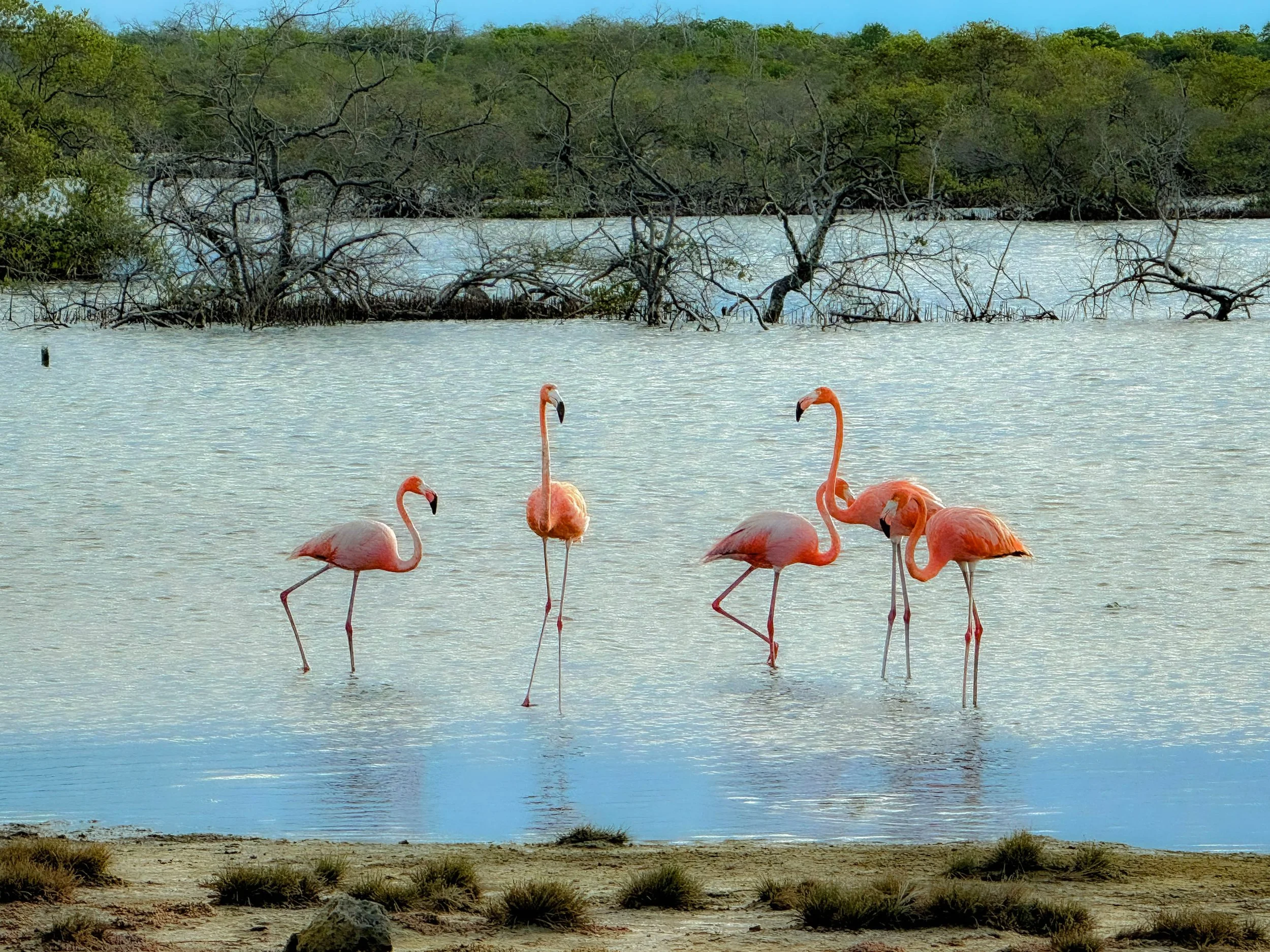
Elly’s work didn’t stop there. In 2018, she founded the Bonaire Wild Bird Rehab Foundation after rescuing hundreds of flamingo chicks stranded on the island’s roads. Since then, her team has cared for more than 2,000 flamingos — releasing most back to the wild. This year, she and National Geographic Photographer Lorenzo Maccari, along with Elisabetta Maccari, co-produced “Mysteries of Mangroves: Protectors of Blue Carbon, “ a book that highlights these vital ecosystems and the wildlife that inhabit the mangroves. Albers writes, “Mangroves also play a big role in fighting climate change by storing large amount of carbon.”
Nature’s Climate Engineers
Mangroves are among Earth’s most effective carbon sinks, capturing five to ten times more CO2 per hectare than tropical rainforests. Unlike land forests, most of this carbon is stored deep on their waterlogged soils, where it can remain locked away for millennia. Though mangroves cover less than 1% of tropical forests, they proved outsized benefits: coastal protection, food security, clean water, and livelihoods for millions.
According to Unsustainable Magazine, mangrove ecosystems are worth an estimated $33,000 to $57,000 per hectare per year — a measure not of their beauty, but of the crucial services they provide: natural fisheries, building materials, storm protection, and tourism.
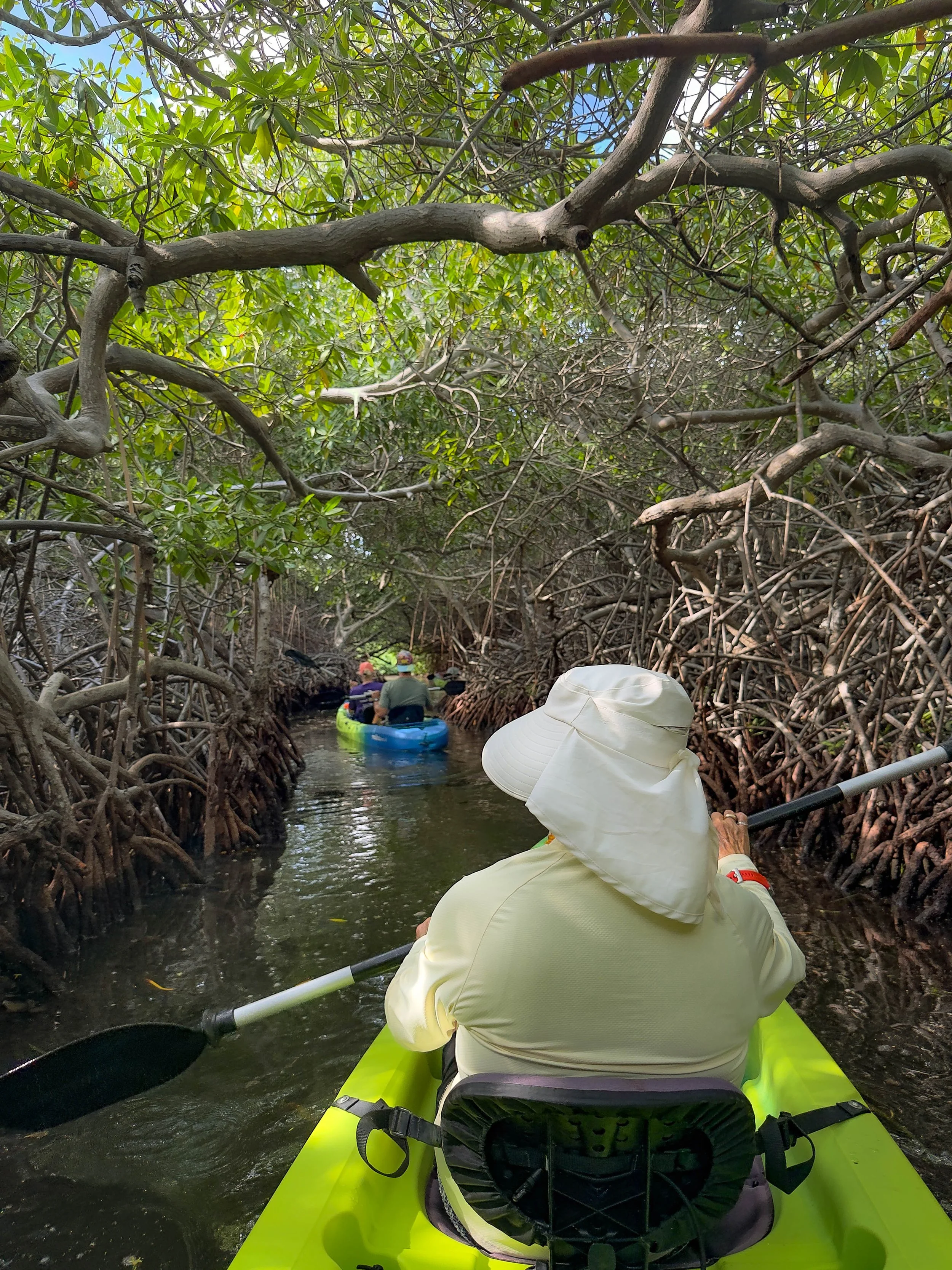
“Mangroves are distributed across the coastlines of the tropics between 30° N and 30° S,” Eric explains as our kayaks glide into a tunnel of roots. “But with warming waters, they’re expanding beyond those limits. They need warmth — at least 68°F — and a delicate mix of salt and freshwater.”
He notes that Asia holds the largest mangrove coverage, followed by South America, Africa, and North America. “Mexico and Brazil have some of the richest forests in the Americas,” he adds, his paddle slicing through the mirrorlike surface.
The Living Barrier
The Living Barrier At the edge of Lac Bay, Eric points to the mangrove roots that cradle the shoreline. “These trees protect us,” he says. Their complex root systems act as natural armor, dissipating wave energy and preventing erosion. During the 2004 Indian Ocean tsunami, areas with healthy mangroves suffered far less destruction. In some regions, floodwaters traveled only a mile or two inland — compared to five miles in places where mangroves had been cleared. The evidence is clear. In Florida, mangroves saved an estimated $1.5 billion in flood damage and protected more than half a million people during Hurricane Irma in 2017. Each year, they help prevent over $80 billion in property losses globally. By contrast, artificial barriers like seawalls cost two to five times more — and worsen erosion. “Why build concrete when the ocean already gives us the perfect engineer?” Eric asks with a grin.

Guardians of Blue Carbon: A Morning in Bonaire’s Mangrove Forest
October 2, 2025
Mangrove Center
October 2, 2025
This article was written as part of the Bonaire Climate Action series, where I highlight individuals and organizations taking action to support conservation efforts by the Bonaire community to improve their environment and meet the challenges of climate change with resilience.
“Welcome to the Mangrove Center of Bonaire. Look at those mangrove trees across the mud flats. What do you see? How can mangrove trees benefit you and the people here on Bonaire or across the world?” asked Eric Van Hassel, your tour guide. He has been working as a tour guide for three years, but stated he could not imagine working anywhere else. His most special activity is paddling with his wife into the mangrove forest at 6 o’clock on a Sunday morning to watch the sunrise when there are no other visitors, and sitting, listening, and observing the magnificence of this biome. Eric shared the origin story of the Mangrove Center.
In 2004, Elly Albers took over as the leader of the Mangrove Center. She aimed to guide it in a new direction with educational kayak and snorkeling tours to promote conservation. Experienced in environmental efforts, she assisted in 2017 when STINAPA requested her help to rescue birds affected by an oil spill. In 2018, flamingo chicks appeared on the streets of Bonaire, and Elly set up a facility with kennels, expanding from 4 to 12. She eventually expanded the facility so birds could feed themselves and move around freely. That year, the rehab center cared for 450 flamingo chicks and juveniles, releasing many into the wild. The Bonaire Wild Bird Rehab Foundation was officially founded on June 1, 2018. This non-profit organization was founded by Elly Albers to care for injured, sick, and orphaned wild birds, with the goal of returning them to their natural habitat. Approximately 80% of the patients are flamingos, an iconic species of Bonaire. Over the years, the rehab has successfully cared for over 2,000 flamingo chicks, offering them a second chance at life in the wild.
This year, she, along with Elisabeth and Lorenzo Maccari, a National Geographic photographer, co-produced a wonderful book, "Mysteries of Mangroves: Protector of Blue Carbon." She explains how mangroves act as nurseries for marine life by providing a safe space for juveniles and other sea creatures to grow from tiny algae to nurse sharks. She states that “Not only are these ecosystems full of life, but they also play a big role in fighting climate change by storing large amounts of carbon.” She acknowledges her community's efforts to protect and restore mangroves, highlighting local action and the cultural significance of these mangroves.
Eric continued his discussion by stating, “Mangroves are distributed across the coastlines of the tropics between 30° N and 30° S latitudes. However, due to the warming ocean currents, the mangrove forest range extends beyond these limits.” He stated that “Mangroves need consistent water temperatures above 68°F; however, they do not tolerate freezing. They are mainly found where fresh and saltwater mix. During my research, I discovered that Asia has the largest mangrove coverage, followed by South America, Africa, and North America. Mexico and Brazil have one of the largest areas of mangrove in the Americas.”
From my own research, I have learned that although mangroves cover less than 1% of the tropical forest area, they are vital coastal ecosystems that provide essential services, including coastal protection, nurseries for marine life, improved water quality, food security, economic value, and climate change mitigation through carbon capture. One hectare of mangroves can absorb and store CO2 at rates five to ten times higher than tropical rainforests due to their unique soil environment. They serve as effective carbon sinks, storing significant amounts of carbon, primarily in their soils and sediments, making them vital for mitigating climate change. Unlike terrestrial forests, which store most of their carbon in biomass, mangroves primarily sequester carbon in their deep, anaerobic soils.
Mangrove forests are very productive. In an article in the Unsustainable Magazine on Mangrove Forests: Environmental and Economic Benefits, Ellen Rubin stated, “Mangrove ecosystems are worth an estimated $33,000-$57,000 per hectare per year. This is due to the services they provide, which range from managed timber use, fuelwood, construction materials, natural fisheries for fish, shrimp, prawns, crabs, and lobsters, nursery habitats for commercially important species, medicinal compounds, water quality maintenance, coastal protection, ecotourism, and nutrient cycling.”
As we relaxed in our kayaks, Eric pointed out the barrier reef that protects Lac Bay. He explained how mangroves protect coastlines. Their roots form a natural barrier against storms, tsunamis, and erosion. In the 2004 Indian Ocean tsunami, healthy mangroves absorbed wave energy, reducing flooding and saving lives. These roots slow the waves, making a difference. In areas with sufficient mangrove coverage, floodwater traveled just 1-2 miles, compared to 5 miles without coverage. Villages with mangroves faced less damage and casualties. The 2004 tsunami showed that mangroves are crucial as natural shields. The UN promotes the restoration of healthy coastal ecosystems, such as mangroves, to protect shores and mitigate disasters. While not a substitute for early warning systems, mangroves play a crucial role in coastal defense.
In Florida, mangroves prevented $1.5 billion in direct flood damage and protected over ½ million people during Hurricane Irma in 2017. It’s estimated that mangrove ecosystems reduce the risk of storm-related property damage for more than 18 million people and prevent more than $80 billion in property damage every year.
Manufacturing solutions to protect against severe weather events is far more expensive and less effective than restoring mangroves. For instance, engineering and building structures like sea walls are 2-5 times more expensive and immediately cause erosion of the ocean floor around them. Additionally, we would lose the carbon sequestration and wildlife habitat benefits that forests provide, not to mention the carbon dioxide produced in the manufacturing of concrete.
Nurseries for marine life:
As we put on masks and snorkels, Eric showed us how young fish and crabs sheltered in the root system. We snorkeled over mature yellow snapper and small grouper schooling in the channels between the mangrove trees. Up to 75% of tropical commercial fish and shrimp depend on mangroves during their life cycle. The three-dimensional environment provides food and shelter, helping juvenile marine life survive and boosting nearby ecosystems, such as seagrass meadows and coral reefs.
Improved water quality
As we began our paddle, Eric asked us to place our hands in the water and observe the amount of sediment present. Mangrove forests play a crucial role in maintaining water quality by acting as natural filters. He emphasized that their complex above-ground roots slow water, trapping sediments and pollutants, thereby reducing runoff into coastal waters. The mangrove forest captures harmful substances, including nitrates, phosphates, heavy metals, and debris, thereby preventing them from reaching the ocean. The nutrient-rich soils support microbes that break down organic matter, thereby further purifying the water.
As we paddled deeper into the mangrove forest, Eric asked us once again to put our hands in the water and notice how much clearer it had become. Mangroves absorb excess nutrients from runoff, preventing harmful algal blooms. Their roots also protect against pollutants and shield marine ecosystems. Beneficial bacteria in oxygen-poor soils convert nitrates into nitrogen gas and break down pesticides and hydrocarbons, enhancing water quality. Overall, mangroves are vital for healthy marine environments, as they filter sediments and debris, increase light for underwater life, and support seagrass beds and coral reefs.
While snorkeling, Eric showed us the flat-tree oyster found on the red mangrove. These oysters happily act as filter feeders, drawing water into their shells and filtering out plankton and small organic particles through their gills. The oyster then expels the waste, combined with a mucus-like substance, into the sediment. An adult oyster can filter up to 50 gallons of water each day by siphoning water in and out, removing particles such as sediment and excess nitrogen, which it either eliminates as waste or retains in its tissues. This natural filtering process helps clear the water, reduce pollutants, and allow sunlight to reach the seabed, giving underwater grasses a chance to flourish and creating essential habitats for marine creatures.
Food Security
As we were paddling back to the center, we came upon a local fisherman. Eric explained that only local fishermen are allowed to fish inside this marine protected area. This is why it is important to manage this mangrove forest so it provides a reliable and secure food supply to our coastal communities. A 2024 report by the International Union for Conservation of Nature (IUCN) estimated that nearly 80% of global fish catches are directly or indirectly reliant on mangrove ecosystems. Mangroves support the livelihoods of hundreds of millions of people living along the world's coasts. Game and sport fish, such as barracuda, tarpon, and snook, find shelter among the roots of trees as juveniles, forage in the seagrass as they mature, and then venture out into the open ocean as adults. About 75% of all commercially caught fish spend some part of their life cycle among mangroves or coastal forests.
Finally, as we returned from our tour, I developed a much greater appreciation for the mangrove forest and understood why Elly Albers referred to the mangroves as protectors of blue carbon in her recently published book.
Acknowledgments:
· Special thanks to Eric Van Hazzel for his compassion and love for this invaluable ecosystem.
· With a sense of awe, I read the book "Mysteries of Mangroves: Protectors of Blue Carbon," written by Elly Albers and Elisabeth Maccari, and photographed by Lorenzo Maccari. I highly recommend this book, which is available through the Mangrove Center in Bonaire at info@mangrovecenter.com.
· Lastly, if you found this article interesting and are in Bonaire, consider booking the two-hour kayak and snorkeling tour with www.mangrovecenter.com.